The Body in Conversation - Part 8 The Phrenic Nerve: the direct hotline to your breath
By now, if you have been following this series, you will know that I have been slightly obsessed with the diaphragm.
Not because I think it works alone, and certainly not because I think every problem in the body can somehow be solved by “fixing” it, but because it sits right in the middle of so many body systems and conversations.
It moves with the ribs. It is a catalyst and a part of the changes in pressure through the chest and abdomen. It works alongside the abdominal wall and the pelvic floor. It has attachments around the spine, and it responds constantly to what we are doing, whether we are asleep, laughing, running, lifting something heavy or simply sitting here reading.
But there is another part of the story that we haven't really talked about yet.
The diaphragm is a muscle, and muscles do not move without instructions.
So who is sending the messages to the diaphragm to move?
Meet the phrenic nerve.
Actually, meet the two phrenic nerves, because you have one on either side.
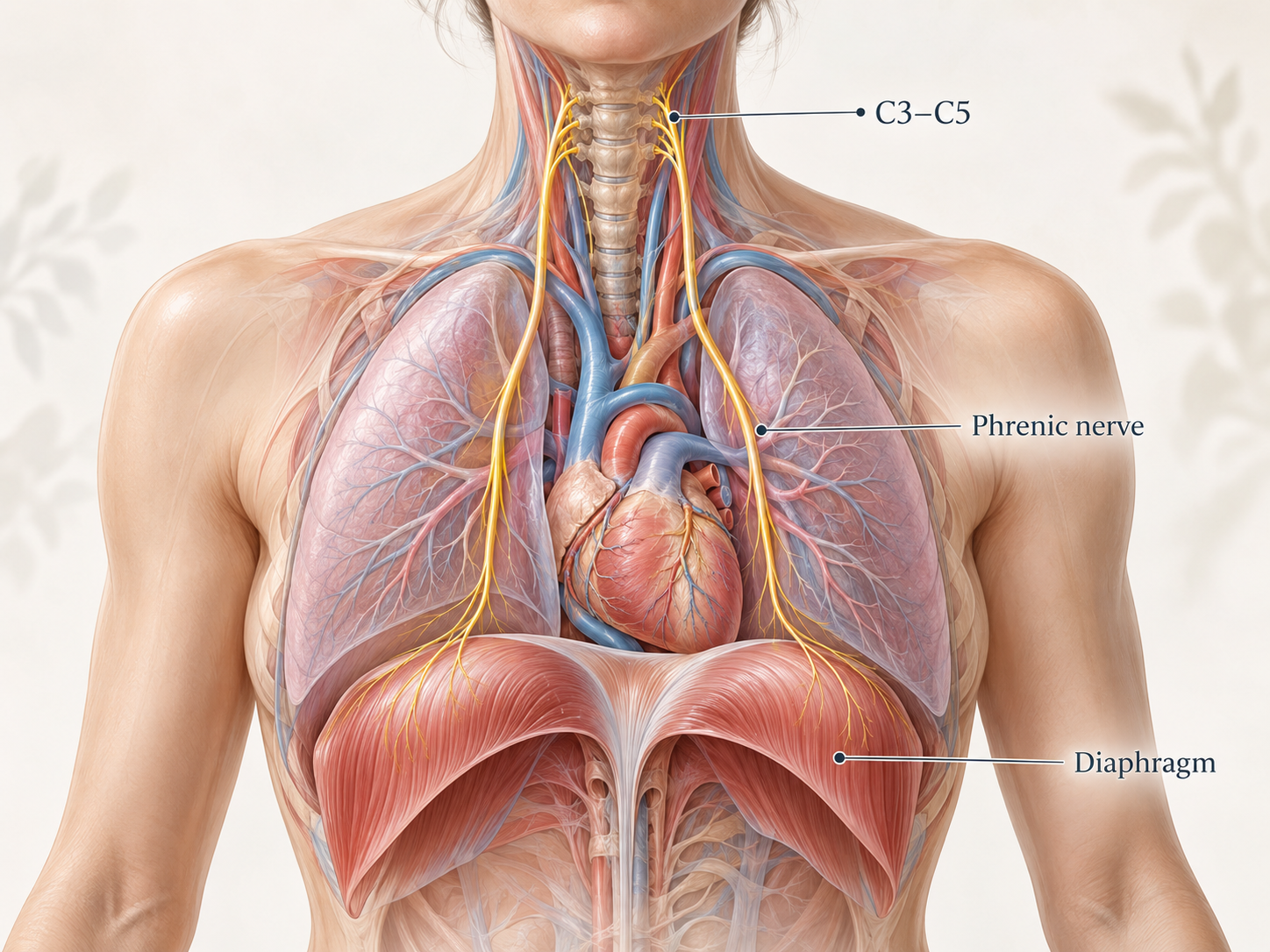
These nerves provide the diaphragm with its main motor supply, allowing each half of the diaphragm to contract. They also carry sensory information back from the diaphragm and from some of the tissues surrounding the heart and lungs. Nerves send information along their afferent system but also collect it via the sensory system.
You could think of them, the phrenic nerves, as a pair of awesome communication cables running between your neck and your breathing apparatus.
And yes, I said your neck.
The phrenic nerve arises predominantly from the cervical spinal nerves C3, C4 and C5, with C4 usually making the biggest contribution.
Which brings us to the little rhyme that generations of medical students I have read about have apparently relied on:
“C3, C4 and C5 keep the diaphragm alive.”
Cheesy?
Absolutely.
Memorable?
Definitely.
And suddenly, something we tend to imagine sitting quietly underneath the lungs has a neurological connection running right the way up into the neck.
I love this bit because it is another of those moments when our neat little body-part boxes start falling apart.
Your neck and your diaphragm are not strangers.
They have been chatting to one another since before you were born.
Why on earth does it start in the neck?
This is perhaps one of my favourite phrenic nerve facts.
If you were designing a human body from scratch, you might reasonably decide that the nerve controlling the diaphragm should leave the spinal cord somewhere close to the diaphragm.
Nice.
Short.
Efficient.
Evolution and development, however, clearly did not receive that memo.
Instead, the phrenic nerve plugs in high in the neck and then takes the scenic route all the way down through the chest.
Why?
Part of the answer lies in what happens while we are developing in the womb.
Early in embryonic development, the beginnings of the diaphragm form much higher in the body, close to the cervical region around C3–C5. As the body develops, the structures forming the diaphragm move progressively downwards towards the base of the chest, while the nerve connection remains linked to those original cervical levels.
Imagine plugging an extension lead into a socket in your neck and then slowly dragging the appliance further and further down the room without unplugging the cable.
That is a pretty accurate visual for the adult phrenic nerve.
And then there is, of course, an even bigger evolutionary story.
The diaphragm itself is a peculiarly mammalian structure, and scientists are still investigating exactly how it evolved. Different hypotheses have linked its ancestry to muscle systems around the shoulder, forelimb and lower neck. In other words, there probably isn't a beautifully simple story in which a fish gill muscle eventually became our diaphragm. Evolution is usually far messier and much more interesting than that.
But I still love the thought that this unusually long nerve carries a little piece of our developmental and evolutionary history inside us.
It is a kind of anatomical archaeology.
Every time you breathe, you are using a system whose peculiar wiring makes far more sense when you look backwards in time than when you simply look at the finished adult body.
The scenic route through your chest
From those cervical roots, the two nerves travel down through the neck and into the chest.
They pass in front of the roots of the lungs and then continue down beside the pericardium, the protective sac surrounding the heart, before finally reaching the diaphragm.
The left and right nerves have slightly different journeys because there is a rather large heart sitting somewhat inconveniently in the middle.
The left phrenic nerve follows the contour of the pericardium over the left side of the heart before continuing towards the diaphragm.
Imagine two long cables dropping from your neck.
One runs down the right side of the chest. The other has to sweep around the heart on its way down.
It is both really elegant and mental anatomy, all at the same time.
And that close relationship with the heart has some unexpected consequences.
The nerve that surgeons really don't want to freeze
Here is a piece of anatomy I didn't know until I started looking more deeply into the phrenic nerve.
During some forms of cardiac surgery, cooling has historically been used to reduce the heart's metabolic demands while surgeons operate.
One technique involved placing very cold saline or ice slush around the heart.
Perfectly sensible if you are thinking about protecting heart muscle.
Less ideal if you happen to be a phrenic nerve lying right beside it.
Because the phrenic nerves run so close to the pericardium, particularly on the left, very cold material placed around the heart can injure the nerve.
Research into cardiac surgery actually found a clear association between ice-slush cooling and postoperative phrenic nerve dysfunction. In one study, ice slush was associated with around an eightfold higher incidence of phrenic nerve dysfunction compared with other factors being examined.
Imagine waking up after heart surgery and discovering that one half of your diaphragm isn't moving properly, not because the diaphragm itself has been cut or damaged, but because the communication cable supplying it has effectively become too cold.
Earlier surgical research even investigated insulating pads placed between the ice and the nerve to protect it. In the end, changing the cooling techniques they used significantly reduced postoperative diaphragm problems.
I find that fascinating because I love stuff like this! Our anatomy map, and understanding it, is also clinically important.
It is important to know where a nerve travels and what it passes on the way.
Everything is connected, literally, not just in a slightly fluffy wellness sense of the phrase.
The body's ultimate hybrid breathing system
Here is the other thing I find really fascinating. Our breathing operates in two worlds at once.
For most of the day, you don't consciously instruct your diaphragm to contract.
Imagine how inconvenient that would be. You snuggle into bed, all cosy, start to fall asleep, and your last thought has to be:
“Remember to breathe, Abby.”
Thankfully, this is not a thing! My brainstem, and yours too, keeps respiratory activity going without waiting for conscious permission.
The respiratory centres respond continuously to information about things such as carbon dioxide, oxygen, activity and metabolic demand, and the motor message eventually travels towards the diaphragm through the phrenic nerves.
The diaphragm contracts.
Its domes descend.
The lower chest changes shape.
Pressure changes.
Air travels into your lungs.
Then the diaphragm relaxes again.
And off you go.
Breath after breath.
Hour after hour.
Around the clock.
But then I can also say:
Hold your breath.
And you can.
I can ask you to take a longer breath out.
You can do that too.
You can sing.
Whistle.
Laugh.
Cough.
Sniff.
Speak.
Blow out birthday candles.
Take a huge breath before diving underwater.
Or deliberately change how you breathe before you lift something heavy.
This doesn't mean that the phrenic nerve itself flips between an “automatic setting” and a “manual setting”. The control occurs higher up in the nervous system.
But the diaphragm is unusual because its movement can be driven by automatic respiratory control and influenced by voluntary control.
The final motor message still travels towards the diaphragm.
I guess we can think of the whole system as the ultimate hybrid controller.
Most of the time, autopilot handles the flying.
But occasionally, you reach forward and take hold of the controls.
And that becomes very relevant when we start using breathing deliberately in movement, rehabilitation and Hypopressives.
And then there are hiccups...
The phrenic nerve also appears in one of those wonderfully ridiculous human experiences that nearly everybody recognises.
Hiccups.
Hic.
Hic.
Hic.
Usually during a ‘we must talk now’ conversation. Do you know what causes them?
You may, given the blog topic, think it must be the phrenic nerve, and you would be partially right, but a hiccup isn't simply the phrenic nerve spontaneously misbehaving!
It is a neurological reflex involving an entire circuit.
The diaphragm and other inspiratory muscles suddenly contract involuntarily, then the glottis abruptly closes, producing that unmistakable little hic.
Sensory pathways involving the vagus and phrenic nerves appear to feed into the hiccup reflex, the nervous system processes that information, and motor signals, including those travelling along the phrenic nerve, then activate the diaphragm.
So yes, the phrenic nerve has a role to play, but even the humble hiccup turns out to be another conversation between sensation, spinal cord, brainstem, nerves, muscles and breath.
Which may explain why we humans have invented such gloriously odd ways of trying to get rid of them.
Drink water backwards.
Hold your breath.
Swallow repeatedly.
Get someone to frighten you.
I cannot promise that your partner jumping out from behind the bathroom door is evidence-based medicine.
But changing breathing or swallowing can potentially alter some of the sensory and respiratory activity involved in the reflex. So it may work!
And there is an even more interesting technique called active prolonged inspiration.
You take as full an inhalation as feels comfortable. When you arrive at the top of that breath, you keep the airway open and continue gently trying to inhale for around 30 seconds. You then slowly breathe out.
Researchers investigating this technique proposed that the prolonged inspiratory effort may alter the phrenic and vagal activity involved in the hiccup reflex while also changing respiratory chemistry.
In their small case series, all 21 participants reported that their hiccups stopped.
That is definitely not enough evidence to declare that we have solved hiccups forever.
But it is wonderfully interesting.
Once again, something automatic is happening.
And then we deliberately change the breathing pattern.
Sometimes that changes the conversation.
When your brain gets the address wrong
The phrenic nerve isn't simply sending instructions down towards the diaphragm.
Information travels upwards as well.
Sensory fibres carry information from the central region of the diaphragm and from nearby membranes around the chest and heart.
And this produces another very cool neurological oddity.
Sometimes irritation around the diaphragm can be felt in the shoulder.
At first, that sounds ridiculous.
What on earth has your shoulder got to do with your diaphragm?
But the brain has to interpret incoming sensory information, and sensation from the diaphragm arrives at spinal levels that overlap with sensory information associated with the shoulder region.
I like to imagine a message arriving at the nervous system with a slightly smudged or poorly written postcode.
The information gets there.
The brain just occasionally files it under the wrong address.
So irritation lower in the chest or upper abdomen can sometimes be perceived as discomfort much higher up.
This phenomenon is called referred pain.
It is another wonderful example of why pain does not necessarily tell us precisely where its source is.
The nervous system is interpreting information.
It isn't reading Google Maps. But it is giving us pointers.
What about a stitch?
A stitch is often thrown into phrenic nerve conversations too.
You'll see people say that a side stitch is simply your diaphragm cramping or the phrenic nerve becoming irritated.
We don't actually know that.
Exercise-related transient abdominal pain, the slightly grander name for a stitch, is common during activities such as running and swimming, but its exact cause remains debated.
So I wouldn't confidently point at the phrenic nerve and say:
“That's the culprit.”
But I do think the uncertainty itself is interesting.
Even something as ordinary as the stitch you got running cross-country at school still hasn't been completely explained.
The body likes to remind us how much we still really don't know.
Superman and a breathing pacemaker
And now for perhaps the best phrenic-nerve-related story.
Most of us hear the word pacemaker and immediately think of the heart.
But we can pace breathing too.
After actor Christopher Reeve sustained a severe cervical spinal cord injury in 1995, he required mechanical ventilation because the normal signals from his brain could no longer adequately drive his breathing.
Importantly, however, his phrenic nerves and diaphragm could still respond to stimulation.
In 2003, he became one of the early participants in a clinical trial of a diaphragm pacing system developed in Cleveland.
And this is where I want to slightly correct the version of the story you sometimes see online.
Surgeons did not place electrodes directly onto Reeve's phrenic nerves.
Instead, electrodes were implanted laparoscopically into specific motor points within the diaphragm, where stimulation could activate the muscle through its nerve supply.
Tiny electrical pulses then caused the diaphragm to contract rhythmically.
Think about that for a moment.
The automatic signal from the brain could no longer travel normally through the injured spinal cord.
But the lower part of the system was still capable of working.
So technology stepped into the missing part of the conversation and supplied the rhythm.
Electrical signal.
Diaphragm contracts.
Air moves in.
Signal stops.
Diaphragm relaxes.
Air moves out.
Reeve was subsequently able to spend periods breathing using the diaphragm pacing system, which was much more of a natural respiratory method, albeit medically induced, than having to rely all the time on positive-pressure mechanical ventilation.
Today, diaphragm pacing remains an option for carefully selected people with high spinal cord injury when the relevant nerve and muscle pathways still remain functional. NICE describes both phrenic-nerve stimulation and intramuscular diaphragm stimulation as approaches that can allow complete or partial reduction in mechanical ventilator use in suitable patients.
We can start to see that:
A nerve is not simply a cable.
A muscle is not simply a motor.
Breathing emerges from an entire communication system.
And sometimes, when one part of the system is interrupted, medicine can help find another way into the conversation and movement pattern and help improve lives.
That involuntary gasp when you hit cold water
There is one more breathing reflex you may have experienced personally.
You jump into freezing water.
And before you have had time to tell yourself to breathe calmly, your mouth opens and you gasp.
It is astonishingly fast.
That initial gasp is part of what physiologists call the cold-shock response.
A sudden fall in skin temperature produces a powerful cardiorespiratory response that includes an involuntary gasp followed by rapid breathing, increased heart rate and a rise in blood pressure.
The phrenic nerve is involved because the diaphragm has to receive a motor command to produce that sudden inspiration, but I wouldn't quite say that cold skin sends a message “straight to the phrenic nerve”. That would be pretty cool, but the brain and nervous system sit in the middle of that response.
The fascinating bit is that conscious control temporarily loses the argument.
You can stand beside the water thinking:
“I am going to breathe beautifully and calmly when I get in.”
Your nervous system may have other ideas. I know mine did when I did the Wim Hof course!
Splash.
GASP.
The response is protective, but it is also one reason sudden cold-water immersion can be dangerous. If that first involuntary gasp happens while your face is underwater, you can inhale water.
And once again, we see those two breathing worlds collide.
Voluntary intention says one thing.
The automatic survival system says another.
Guess which one wins? It will always be about survival!
Can we actually “work” the phrenic nerve?
This is where I think we need to avoid another internet rabbit hole.
You will increasingly see exercises described as ways to stimulate, release, activate or even reset the phrenic nerve. I have seen them frequently.
I don't think that is the most useful way to describe what we are doing.
If you are sitting here breathing comfortably, your phrenic nerves are already doing rather a lot.
We do not need to keep poking them metaphorically with a stick.
What we can work with is the extraordinary respiratory system that surrounds them.
We can explore movement through the ribs.
We can change our postural position.
We can alter our breathing rate.
We can lengthen one or more of our exhalations.
We can increase or decrease inspiratory demand.
We can make sounds: shouting, talking, singing.
We can play with pressure.
And, importantly, we can give the system different experiences rather than trying to force one supposedly perfect breathing pattern upon it. There is defo not one; there are many different ones to try!!
Some traditional diaphragmatic breathing exercises ask someone to lie on their back with one hand on their chest and another on their abdomen, then deliberately allow the abdominal hand to rise while trying to keep the upper chest relatively still.
That can be useful in specific circumstances.
But if you have followed me for any length of time, you'll know that I'm not especially interested in teaching everybody to push their belly out while keeping everything else perfectly still.
The diaphragm doesn't breathe alone.
So instead, place your hands gently around your lower ribs.
As you breathe in, imagine the lower ribcage widening three-dimensionally.
Forwards.
Sideways.
And backwards.
Imagine an umbrella gradually opening inside the lower ribcage.
The abdominal wall responds because the diaphragm is descending and the abdominal contents need somewhere to go.
The pelvic floor responds underneath.
Then breathe out and feel that shape quietly changing again.
No need to force anything.
No heroic inhalation.
No gripping.
Just notice what moves.
Then change the task.
Imagine a candle flame in front of you.
Breathe in comfortably and then release the air through softly pursed lips, producing a narrow stream of air that would make the flame dance without blowing it out.
Notice what happens when the exhale becomes longer.
Then add sound.
Take another easy breath and let a long:
Haaaaaaaaaaaa...
travel out.
Notice the vibration.
Notice the ribs.
Notice the abdominal wall.
Change the pitch.
Change the volume.
Make it theatrical.
Why not?
We don't need to say that this is “releasing the phrenic nerve”.
It is something much more interesting.
You are deliberately changing the task and watching how the whole breathing system responds.
That is the experiment.
The direct hotline
And perhaps this is the thing I really want you to take from the phrenic nerve.
The diaphragm isn't simply a dome-shaped muscle sitting underneath your lungs.
Imagine again the jellyfish that we have used throughout this series.
Its domes gently descend as you breathe in.
The lower ribs widen around it.
The abdominal contents accommodate the movement.
The abdominal wall responds.
The pelvic floor responds below.
Then imagine those two long phrenic nerves dropping down from the neck like communication cables towards that moving jellyfish.
Messages travel down.
Sensory information travels back.
The brain receives information.
The brain interprets.
The body adjusts.
Again.
And again.
And again.
Sometimes you are entirely unaware of it.
Sometimes you deliberately step into it.
Sometimes a hiccup hijacks it.
Sometimes freezing water overrides you.
And sometimes medicine can even plug electricity into the system and allow a diaphragm to breathe when the usual message from the brain can no longer reach it.
That is quite extraordinary.
And this is why I am much less interested in teaching everyone one supposedly perfect way to breathe.
I want your breathing system to have options.
I want your ribs to move.
I want the diaphragm to respond differently when the task changes.
I want your abdominal wall and pelvic floor to participate in that changing pressure system rather than constantly being told to brace, squeeze or hold.
I want you to be able to breathe while resting, walking, lifting, running, laughing, singing and doing whatever wonderfully human things your body needs to do.
Because healthy systems aren't rigid.
They adapt.
They respond.
They communicate.
The phrenic nerve doesn't work alone.
Neither does the diaphragm.
Nothing really does.
And perhaps that is exactly why this series is called The Body in Conversation.
Next time, we are going to meet another nerve travelling through this same neighbourhood.
One that has become something of an internet celebrity.
The vagus nerve.
Humming.
Cold water.
Breathwork.
“Vagal toning.”
“Nervous-system resets.”
There are some enormous claims being made about this wandering nerve.
So next time, we are going to follow where it actually goes, find out what it actually does and separate the genuinely fascinating physiology from some of the rather enthusiastic stories the internet has attached to it.