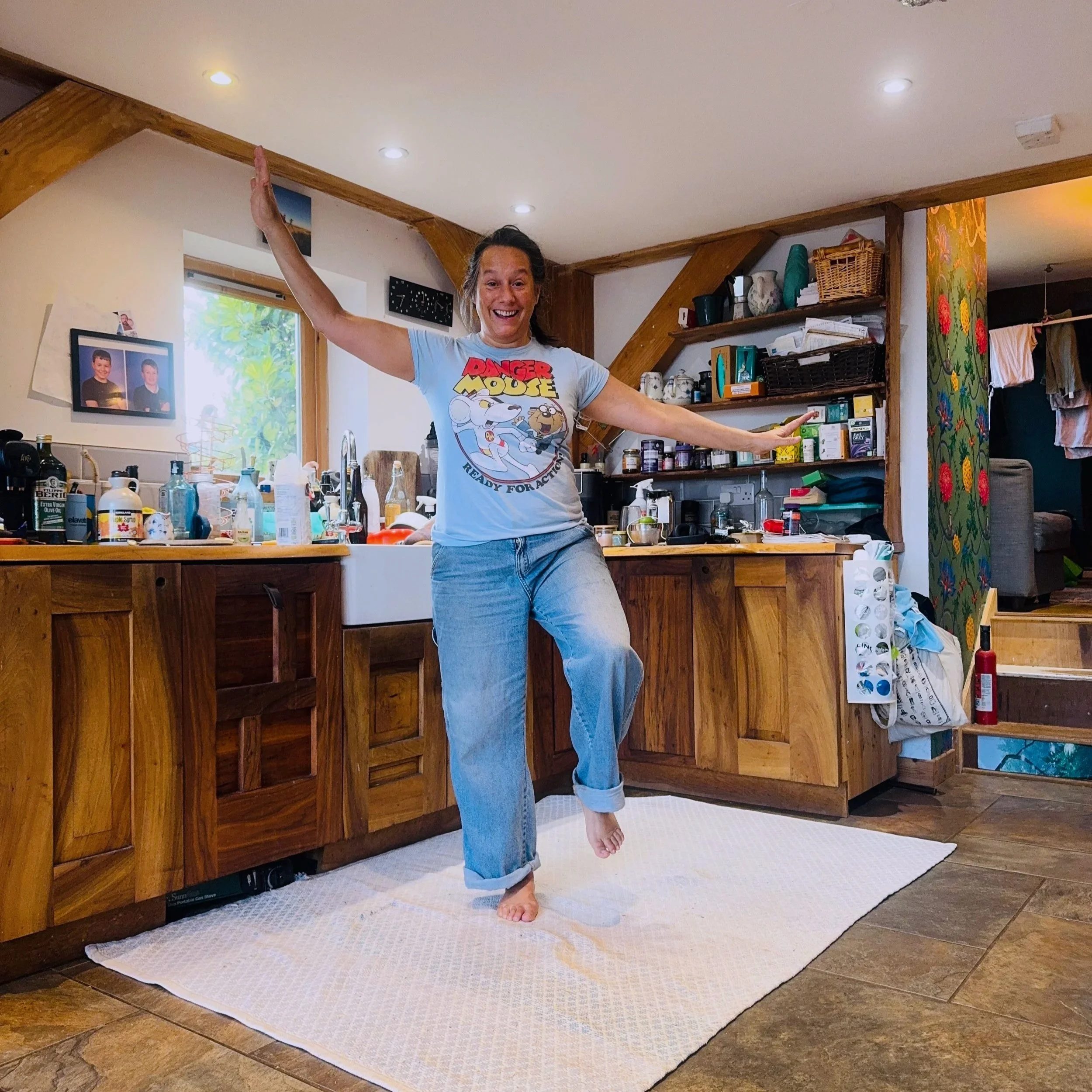
What curling your toes, tapping your back and changing the way you breathe can teach us about the body.
I've been disappearing down one of my usual rabbit holes this week, and it all started with something rather strange.
I was reminded of a hack I was given years ago and then parked, that curling your toes, might help when your bladder suddenly decides you need to pee. RIGHT NOW!
Your toes!
I know. Mental, isn't it? I love our strange little body quirks.
But this is actually one of the strategies included in NHS guidance for managing bladder urgency. And naturally, that sent me off investigating what other seemingly unrelated movements and techniques might influence what our bladder, bowel and pelvic floor are doing.
What I found was fascinating. Some of these techniques have been used in clinical practice for years, some are supported by research, and others appear in NHS guidance despite us not fully understanding why they might help.
And that last point is important. Just because something appears in clinical guidance doesn't mean we've established exactly how it works. Sometimes the research is still catching up with what clinicians are observing, and sometimes a technique simply hasn't been studied enough for us to draw firm conclusions.
Why, of why they resist Hypopressives so much is beyond me.
But what connects all these little tricks I am going to share with you, is something I talk about constantly.
The pelvic floor isn't a solo operator, it is actually a part of a much bigger team.
That team comprises of and is not limited to our muscles, joints, breathing, sensory systems, spinal cord and brain. And sometimes changing what one part of the body is doing can influence how another part behaves.
So, this Sunday, I thought we'd explore a few of these connections. We'll look at what you can try, what the science actually tells us and why repetition might be an important part of changing how we respond to bladder and bowel symptoms.
And no, before anyone asks, this isn't another article telling everyone to do more Kegels!
First, why does your bladder suddenly shout NOW?
Before we start curling our toes and tapping our backs, it helps to understand what's actually happening when we actually experience bladder urgency.
Your bladder is essentially a muscular storage organ. As it gradually fills with urine, stretch-sensitive nerves send information to your spinal cord and brain about what's happening inside it.
The muscle making up much of the bladder wall is called the detrusor, and during normal filling it remains relatively relaxed while the outlet, your urethra, stays closed.
When it's an appropriate time to empty, the nervous system coordinates a change. The bladder contracts, the outlet relaxes and urine can pass.
Simple enough in theory, but in reality, this involves a rather complicated negotiation between the brain, spinal cord, bladder and pelvic floor.
Sometimes that negotiation can become a little overenthusiastic.
You might experience a sudden, overwhelming urge to pee even when your bladder isn't particularly full. And for some people, certain situations seem to make the urgency much worse.
Putting the key in the front door is a really classic example.
You can be absolutely fine walking home, but the moment you reach the door, your bladder decides it cannot possibly wait another thirty seconds.
What's particularly interesting is that urgency isn't always determined by how much urine is in the bladder. Our nervous system, attention, previous experiences and learnt associations can all influence how strongly we experience the sensation.
And this is where some of our strange little tricks come in.
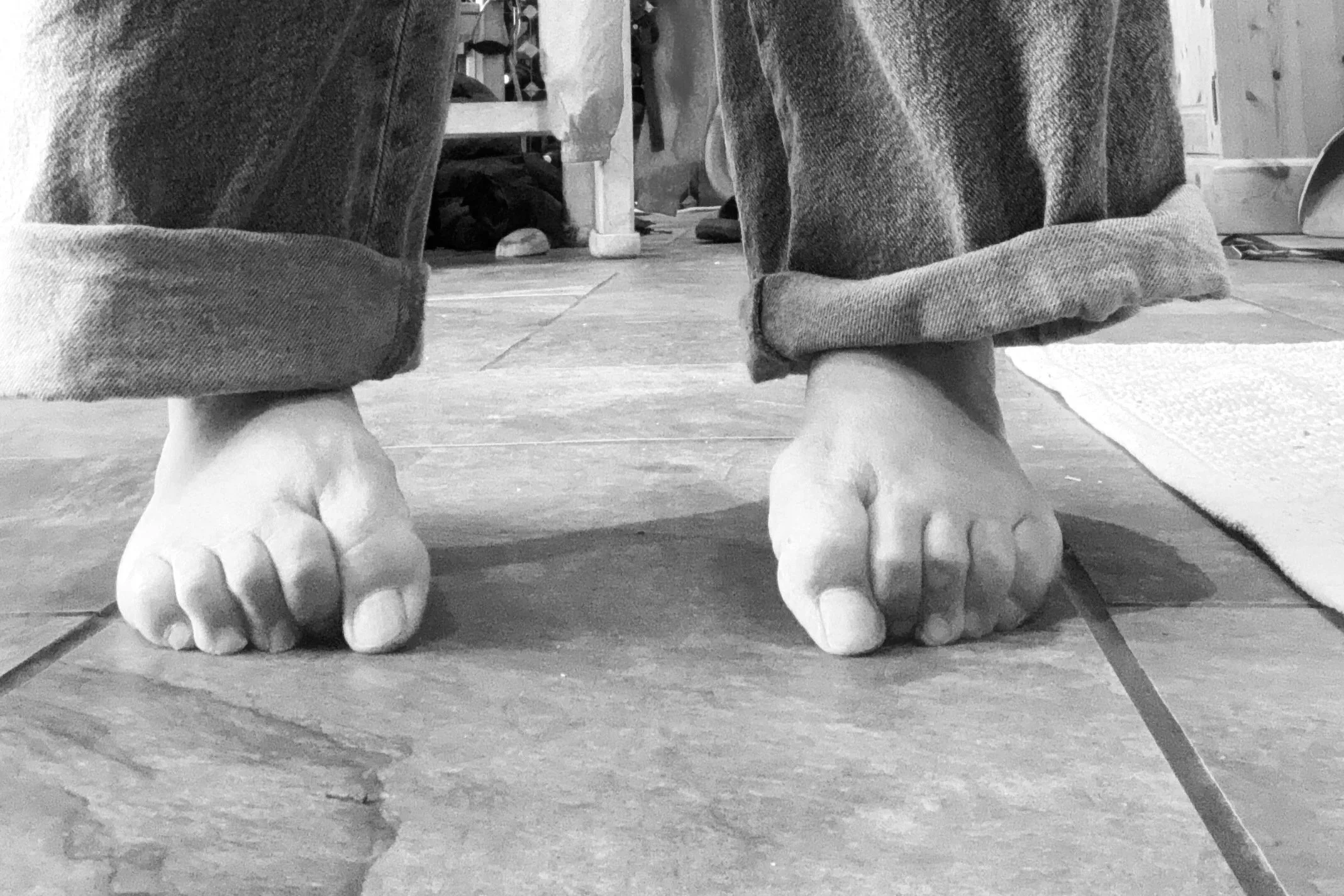
Curling your toes to calm your bladder
Let's start with the one that sent me down this rabbit hole in the first place. The trick I was given 14 years ago and then parked and it gathered dust!
Gloucestershire Hospitals NHS Trust includes curling your toes downwards as one of its suggested techniques for managing sudden bladder urgency.
The next time you experience that sudden urge, rather than immediately rushing to the toilet, try stopping where you are and gently curling your toes downwards inside your shoes.
Imagine making a little fist with your feet. Hold the movement briefly, then release. If your toes start to cramp, ease off a little or try alternating between your feet.
The idea is to give yourself a moment to allow the urgency wave to settle before calmly making your way to the toilet (or snakes house as it is called in my world…).
Now, why would moving your toes have anything to do with your bladder?
That's where things become intriguing, because the precise mechanism hasn't yet been established, however there is actually a neurological connection between the nerves supplying parts of your feet and lower legs and those involved in bladder control.
One of the nerves we're interested in is the posterior tibial nerve, which travels down the back of your lower leg and branches into the foot.
Its nerve fibres originate from spinal nerve roots that overlap with those involved in controlling the bladder and pelvic floor.
And this isn't just an interesting bit of anatomy.
We do know that stimulating the tibial nerve electrically can influence bladder function. In fact, tibial nerve stimulation is already an established treatment option for some people with overactive bladder.
The idea is that stimulation of this nerve can influence the neural circuits involved in bladder storage and emptying.
Which raises a further rather fascinating question.
If electrically stimulating a nerve in the lower leg can influence bladder behaviour, could voluntarily moving the toes or activating the calf muscles also affect the signals involved in urgency?
Maybe? It certainly is an interesting possibility.
Some pelvic health physiotherapists suggest that curling your toes creates additional sensory and motor activity, potentially competing with the urgency signals travelling through the nervous system.
Think of it as giving the nervous system something else to process rather than allowing all your attention to be directed towards the bladder. So almost a distraction technique. Perhaps helping you to start processing the information being received
But here's the distinction.
We know that tibial nerve stimulation can influence bladder activity. What we haven't yet established is whether simply curling your toes produces the same neurological effect.
The overlap in nerve pathways makes the idea worth investigating, but it doesn't prove totally prove that scrunching your toes elicits that same mechanism.
And that's what I love about exploring the body.
Sometimes a seemingly unrelated movement has a genuinely interesting anatomical connection.
We just need to be careful about where the evidence ends and the hypothesis begins.
We do know that deliberately contracting the pelvic floor can influence bladder activity through neurological reflexes. But we don't have evidence showing that curling your toes activates exactly the same reflex.
It's possible that the movement provides another sensory signal for the nervous system to process, or that it shifts your attention away from the urgency. There may be other mechanisms involved too.
At the moment, we, and I hate to say this, simply don't know. although I do think it's important to be comfortable saying that, sometimes we don’t know and that’s good enough, as long as it works!
Something can be worth investigating without us pretending to understand every detail of how it works.
What about standing on your tiptoes?
Now this one is particularly interesting because there is a genuine neurological connection between the movement and the nerves involved in bladder control.
When you rise onto your tiptoes, your gastrocnemius and soleus muscles (calf muscles) contract to lift your heels off the ground. Both muscles are supplied by the tibial nerve.
And here's where things get a little nerdy, but cool nerdy.
The tibial nerve contains fibres from spinal nerve roots L4–S3 (that’s your lower lumbar spine and your sacrum), overlapping with the sacral nerve pathways involved in bladder and pelvic floor control.
In fact, clinicians can and do use electrical stimulation of the tibial nerve to influence bladder activity in some people with overactive bladder.
This is called posterior tibial nerve stimulation, or PTNS, and it's a recognised treatment option.
So, when we rise onto our tiptoes, we're not simply distracting ourselves with a balancing exercise. We're actively using muscles supplied by a nerve that has a recognised neurological relationship with bladder control.
But does that mean performing a heel raise has the same effect as therapeutic electrical stimulation?
Not necessarily. Maybe even better, because we are recruiting a whole body activation or involvement. sadly no one has studied the whole body regular practice method.
During a heel raise, the tibial nerve carries motor signals to the calf muscles, while sensory information travels back towards the nervous system. During clinical tibial nerve stimulation, electrical impulses are applied to the nerve in a controlled way to influence the pathways involved in bladder function.
We know the nerve is active during a heel raise, but we haven't established that this particular movement produces the same bladder-inhibiting effects as electrical stimulation.
Still, it's a fascinating connection and one worth exploring.
And it's not just my suggestion. NHS bladder retraining guidance includes rising onto your tiptoes as one of the techniques people can try when urgency strikes.
If you'd like to experiment, stand near something stable, gently lift your heels and lower them again a few times while breathing normally.
Notice whether the urgency changes.
Sometimes even the smallest movements and changes show just how interconnected the body really is.
Tapping your lower back
Now this one is a little stranger, maybe…
Some bladder urgency guidance suggests gently tapping or rubbing the lower back, around the sacrum, to help manage an urgency wave.
The sacrum is the triangular bone at the bottom of your spine, just above your bottom.
If you want to try it, place a hand over that area and gently tap or rub while keeping your breathing relaxed.
The interesting connection here is that the sacral nerves involved in bladder and bowel control travel through this region, although the sacral sections of the spinal cord themselves sit much higher up, around the lower thoracic and upper lumbar vertebrae.
I've written a previous blog about Onuf's nucleus, a fascinating little collection of motor neurons in the sacral spinal cord involved in controlling the external urethral and anal sphincters, if you fancy disappearing down another rabbit hole with me. 😀
There are also established medical treatments that use electrical stimulation of particular nerves to influence bladder activity. One of these is sacral neuromodulation.
But, and this is an important distinction, tapping your lower back is not the same thing as stimulating a sacral nerve with a medical device.
However, it did get me thinking about something else. these things usually do!
EFT, or Emotional Freedom Techniques.
You might have heard of it as tapping therapy, where people rhythmically tap particular points on the body while focusing on an emotion, thought or uncomfortable experience.
And there is actually some interesting research behind it.
A 2025 systematic review found that EFT showed promising results for reducing anxiety, although the researchers also highlighted limitations in the quality of the studies. More recently, a 2026 review found improvements in both reported psychological stress and some physiological measures of stress.
So why might tapping help?
Well, it may actually involve several things happening together. The rhythmic touch provides sensory information to the nervous system, while the your attention is directed towards a particular feeling or experience. The combination of touch, attention, breathing and emotional processing may help change how that experience is perceived.
Researchers are still investigating which parts of EFT are responsible for its effects, including whether tapping specific points matters.
And this is where I started wondering about the possible parallels with bladder urgency.
When someone experiences a sudden urge to pee, there's the physical sensation coming from the bladder, but there can also be a strong emotional response. That immediate feeling of panic, the anticipation of leaking, and the overwhelming need to get to a toilet RIGHT NOW!
So, that got me thinking could gentle rhythmic tapping provide an additional sensory input, helping to shift attention and perhaps reduce some of the alarm associated with that sensation coming from the bladder?
It's a plausible possibility, although I am making a bit of a leap as it hasn’t been established that sacral tapping works through the same mechanisms as EFT.
And I certainly can't claim that tapping your sacrum directly switches off bladder contractions. Because I couldn’t find any research that supports it. But that doesn’t mean that out here in the living messy world it won’t work for you!
I find the comparison between tapping one part of your body and EFT fascinating because it reminds us that the nervous system doesn't experience bodily sensations in isolation. Touch, attention, previous experiences and emotional responses all contribute to what we feel and how we react.
So perhaps there's more than one reason why something as simple as tapping your lower back might help someone manage an urgency wave.
And to be fair, it is definitely worth experimenting with, if it works for you - go for it.
We don't need to invent a definitive scientific explanation before trying a gentle, low-risk strategy and observing whether it makes a difference.
We just need to be curious enough to investigate, and sensible enough to recognise the difference between what we know and what we're still exploring.
If you would like to try EFT - I found a great one here on Youtube with Dr. Bri and a pal
Sometimes sitting down is more useful than rushing
Another technique involves sitting on something firm when urgency strikes.
Rather than making a frantic dash to the toilet, you stop and sit on a firm chair. Some guidance also suggests using a rolled towel beneath the pelvic area.
The idea is to give yourself an opportunity to settle the urgency before moving again.
Sitting changes the contact and pressure information being received by the body. It also changes what your muscles are doing and, perhaps most importantly, stops that automatic rushing response.
Now, I wouldn't claim that sitting on a firm surface mechanically closes the urethra or switches off the bladder. We don't have evidence to support such a detailed precise explanation.
But for some people, stopping, feeling supported and allowing the urgency wave to pass may be useful.
And this brings us to another rather interesting technique that doesn't involve moving a muscle at all. Well if you view your brain as a muscle then you are moving it!
Give your brain something else to think about
Have you ever noticed that the more you concentrate on needing to pee, the worse the sensation seems to become?
That's because our experience of urgency involves more than the bladder itself. And finding myself writing the final pass of this blog at the far end of the LIDL car park in Prestonpans (so I can get reception). Whilst waiting for the boy to finish double judo up the road. I have been thinking about bladders a lot and there have over the last two hour been a couple of times, where I have curled my toes, because writing about it and focusing on it has made me think I need to pee!
Attention, anticipation and emotional responses can all influence how bodily sensations are experienced.
One strategy used in bladder retraining is to deliberately redirect your attention when urgency strikes.
You might count backwards from 100 in sevens, mentally work through a shopping list or concentrate on naming objects around you.
The aim of this isn't to pretend that you don't need the toilet.
It's to reduce the immediate focus on the urgency and give yourself an opportunity to respond calmly.
This is particularly interesting when we consider how strongly certain situations can become associated with needing the toilet.
That front-door urgency I mentioned earlier is a good example.
Over time, the brain can and does learn to associate particular environments or activities with emptying the bladder. And to make change, we sometimes need to interrupt that association and redirect our response.
There's actually some really cool science behind this.
In psychology and behavioural therapy, we know that learnt responses can be changed by recognising what triggers them, interrupting the usual pattern and practising an alternative response.
Habit reversal training uses this principle to help people change certain repetitive behaviours. And while bladder urgency isn't the same thing as a behavioural habit, there are some interesting parallels, that this section of the blog triggered in my head.
What I found that was really fascinating is that researchers have demonstrated that simply showing people photographs associated with their own bladder urgency can actually change bladder sensations and, in some cases, trigger measurable bladder muscle activity.
So that front-door urgency isn't necessarily just in your head. The brain and bladder really are communicating, and learnt environmental cues can influence how the bladder responds.
This is also why bladder retraining has such an important place in managing urgency. It's recommended by NICE as a first-line treatment, and redirecting attention is one of the recognised strategies used within it.
Rather than immediately responding to every urgency signal by rushing to the toilet, we're practising something different. We notice the sensation, interrupt the automatic response, redirect our attention and, when appropriate, allow the urgency to settle before moving calmly towards the toilet.
And when we repeat that process successfully, we're giving ourselves opportunities to learn that an urgency signal doesn't always require an immediate dash to the bathroom.
It's not about ignoring the bladder or forcing ourselves to hold on indefinitely. It's about developing a little more choice in how we respond.
Which brings us to another way of managing urgency
The bladder-suppression reflex and pelvic floor contractions
We know that a correctly performed pelvic floor contraction can help some people quieten their bladder urgency.
This involves neurological pathways that coordinate bladder storage and emptying. Deliberate pelvic floor activity can influence the bladder's behaviour through reflex mechanisms.
In bladder retraining, some people are taught to perform a few short pelvic floor contractions when urgency strikes, allowing the muscles to relax completely between contractions.
At this juncture I would like to put a really big caution sign.
This is not appropriate for everyone.
And it's certainly not an excuse to tell every woman experiencing urgency to go away and do another hundred Kegels. Which i have had women say their doctors have said (no lies).
Because what if her pelvic floor isn't at all weak?
What if it's already overactive, holding excessive tension or struggling to relax?
Adding more contractions to a muscle that's already working too hard may actually make things worse.
And this is something I feel really strongly about - this one size fits all prescribing.
Can we please stop prescribing Kegels for everything?
Somewhere along the way, pelvic floor rehabilitation seems to have become synonymous with squeezing. The NHS even prescribes an app pf that name!
Leaking? Do your Kegels.
Prolapse? Do your Kegels.
Urgency? More Kegels.
But the pelvic floor is not simply a set of muscles that need to be made stronger or tighter.
No, It needs to be able to contract, relax, lengthen, respond to changes in pressure and coordinate with the rest of the body. Not just grip hard at the bottom of what is supposed to be a responsive system.
And even the way we're taught to perform a contraction is important. Although many learn them from google or chatGPT or claude, which isn’t ideal.
Traditionally, people are often told to imagine stopping themselves passing wind, then drawing that contraction forwards and upwards.
But what happens when someone has a rectocele, where the rectum bulges towards the posterior vaginal wall, or a pelvic floor that's already overactive?
We can't assume everyone responds to that instruction in the same way.
I've seen people respond to squeezing cues by gripping their bottom, holding their breath, increasing abdominal pressure or actually bearing down rather than lifting.
And when the posterior vaginal wall is already vulnerable, that's actually really relevant. But who checks? How can/do all these women without access to a pelvic floor physio know whether they need to Kegel or not or even if they are getting them right or not?
A well-coordinated pelvic floor contraction should generally produce an inward and upward response. But someone who's already holding excessive tension may struggle to generate an effective additional contraction or fully release afterwards.
That doesn't mean starting a contraction around the anus automatically pulls a rectocele downwards. We don't have evidence establishing that. But Kegels when not performed well are akin to any exercise when not performed well - not that effective.
What matters is the what the exercise looks/feels like in each person's body.
Are the muscles lifting or bearing down? Is the posterior wall being supported appropriately? Can the person fully release the contraction? And what happens when we introduce breathing, movement or increased abdominal pressure?
A rectocele also involves changes in the supporting tissues of the posterior vaginal wall, and we can't simply squeeze those anatomical changes away.
Pelvic floor muscle training can improve prolapse symptoms for some women, but it doesn't reliably reverse the structural change itself.
And if someone is also struggling with posture, breathing, constipation, incomplete bowel emptying or excessive straining, we need to address those factors too.
This is why I believe assessment and individualised movement are so important.
The cue itself isn't the treatment. It's the response to the cue that matters.
A pelvic floor that can squeeze really hard isn't automatically a pelvic floor that's functioning well.
Sometimes the most useful thing we can teach someone isn't how to squeeze harder, but how to stop gripping and restore better coordination.
The Knack: when timing matters more than strength. Or does it?
Now, there is one particular pelvic floor technique that has been investigated in clinical research, and it's called the Knack.
The idea is relatively simple. Before coughing, sneezing or performing an activity that usually causes leakage, you deliberately contract the pelvic floor and maintain that contraction through the moment of increased pressure.
Then you release.
Research has shown that doing this can reduce movement of the bladder neck during coughing and help some women manage stress urinary leakage.
But let’s pause here for a moment because here is where I have a few questions.
When we cough or sneeze, the pelvic floor doesn't simply contract and hold everything in place. It's responding to a sudden change in pressure, and that response involves a complicated combination of muscle activation, movement and tissue deformation.
In fact, research investigating pelvic floor behaviour during coughing has demonstrated that some muscles can be active while lengthening, rather than simply shortening.
So if we deliberately contract the pelvic floor before a cough and maintain that contraction throughout, are we changing its ability to respond naturally to that sudden pressure increase?
We know that the Knack can reduce downward displacement. What we don't know is whether limiting that movement is always beneficial for every person, or how it affects the pelvic floor's ability to lengthen and recover appropriately.
And what if someone already has an overactive pelvic floor?
If those muscles are already holding excessive tension and struggling to relax, asking them to contract even more may not be particularly helpful. It could potentially aggravate their symptoms, especially if they're unable to release fully afterwards.
This is why I think we need to be careful about teaching the Knack as a universal one size fits all strategy.
It can be useful for someone with stress urinary leakage who can produce an effective contraction and release it appropriately.
But it isn't necessarily the right starting point for someone with pelvic pain, high resting muscle tone or poor relaxation.
And there's another interesting finding. In one study, only around a quarter of women who were taught the Knack as part of a pelvic floor training programme demonstrated it automatically during a cough after 12 weeks. Those who did weren't significantly better off in terms of their continence outcomes than those who didn't.
So perhaps the bigger question isn't simply whether we can teach someone to contract before coughing.
It's whether that strategy improves how their particular pelvic floor functions.
Because (as you know) I don't want a pelvic floor for you that's constantly bracing against the world.
I want one that can respond to pressure, accommodate movement, provide support when needed and then let go.
And sometimes that might involve a well-timed contraction.
But sometimes it might mean learning to stop gripping in the first place.
Why breathing out before you lift can help
Here's another technique that sounds almost too simple.
Before standing up from a chair or lifting something, begin a comfortable exhale and continue breathing as you move.
Try it the next time you stand up.
Notice what happens around your ribs, abdomen and pelvis when you breathe out during the effort compared with holding your breath.
The diaphragm, abdominal wall and pelvic floor work together to manage changes in pressure during movement.
Breathing out during effort can be a useful way of coordinating that system, particularly for people who habitually hold their breath and brace.
But we need to be careful about saying that exhaling automatically reduces abdominal pressure or prevents leakage.,The relationship between breathing, pressure and pelvic floor behaviour is far more complicated than that.
What matters is how the individual responds.
For some people, a simple change in breathing strategy can make movement feel easier and more controlled.
For others, we may need to investigate further. What we all have to remember is breathe out as you lift the child, shopping bags, huge garden slabs and then BREATHE!
What if your pelvic floor needs to relax rather than strengthen?
This is one of the areas I think deserves far more attention.
Some people have pelvic floor muscles that struggle to relax r lengthen when required or just sit with a lovely resting tone, moving gently with the breath zero effort.
They may experience pelvic pain, urinary urgency, difficulty emptying, constipation or discomfort during intimacy or smear tests (sorry to lump that in with sex!).
They/you could have all of this and yet still be told to strengthen their pelvic floor, to squeeze.
Imagine constantly gripping your fist and then being told the answer is to squeeze it harder.
At some point, we need to consider whether the problem is actually a lack of strength or a lack of appropriate relaxation and coordination.
One simple place to start is with comfortable, supported breathing.
Lie on your back with your knees supported, or rest on your side, and allow your breathing to move gently through your lower ribs, including the sides and back.
Notice whether you're gripping your bottom, abdomen or jaw.
See whether you can soften any unnecessary tension without pushing down or bearing down into your pelvic floor.
The aim isn't to force the muscles to lengthen.
It's to begin recognising what they're doing and whether they can let go.
For someone with an overactive pelvic floor, this kind of awareness and down-training may be far more appropriate than another strengthening programme.
And what about your jaw?
This is another connection I find super fascinating.
Next time you're concentrating, stressed or rushing around, notice what your jaw is doing.
Are your teeth touching? Is your tongue pressing hard against the roof of your mouth? Are you gripping your bottom or holding tension in your abdomen at the same time?
Try allowing a little space between your teeth, softening your tongue and taking a comfortable breath into your ribs.
Then notice whether anything else changes.
And there's some really interesting research here.
A 2024 study involving 65 women found correlations between measurements of the jaw muscles and the perineal region, alongside associations between teeth grinding and pain during intercourse.
Now, this was an observational study, so it doesn't establish that jaw tension causes pelvic floor dysfunction. But it does suggest there may be a relationship worth investigating.
Another 2024 study, this time a randomised controlled trial, investigated what happened to the pelvic floor after just 15 minutes of soft-tissue therapy around the jaw.
The researchers found that women receiving the jaw treatment showed significant improvements in their ability to relax their pelvic floor muscles between contractions, measured using electromyography (EMG).
And here's the really interesting bit. Ultrasound measurements showed an almost 53% increase in pelvic floor activation-related movement during contraction following the jaw treatment, compared with just under 9% in the control group.
Now, that particular difference wasn't statistically significant, so we can't claim that jaw treatment reliably improves pelvic floor contraction by 53%. But the changes in relaxation were significant, and that alone is worth taking note of.
What we don't yet know is whether simply unclenching your jaw produces the same effects as 15 minutes of hands-on therapy, or whether the findings apply to people with pelvic floor dysfunction.
What I also find useful is that jaw tension can also often provide a clue to a person's wider pattern of muscular guarding.
And becoming aware of tension in one area may help someone recognise what they're doing elsewhere.
It's not magic. It's another way of investigating how we organise tension throughout the body.
And perhaps another reminder that the pelvic floor isn't working in isolation.
Now, what about the bowel?
So far, we've concentrated mainly on the bladder, but the bowel has its own rather interesting relationship with the pelvic floor and nervous system.
And bowel urgency can be every bit as distressing as bladder urgency.
That sudden feeling of needing to open your bowels immediately can make people anxious about travelling, exercising or even leaving the house.
But it's important to distinguish urgency from frequency.
Bowel urgency means experiencing a sudden, compelling need to empty. Bowel frequency simply means opening your bowels more often than usual.
Someone may experience frequent bowel movements without urgency, or significant urgency despite only opening their bowels once or twice a day.
And the reasons behind these symptoms can be very different.
Loose stools, inflammation, medication, incomplete evacuation, rectal sensitivity and pelvic floor coordination can all play a part.
Which is why, once again, we need to investigate rather than automatically prescribe exercises.
Why putting your feet on a stool can make such a difference
One of the simplest ways to change the mechanics of bowel emptying is to change how you're sitting on the toilet.
Placing your feet on a small stool so your knees are slightly higher than your hips, then leaning forwards from the hips (not rounding your back) comfortably, can help some people empty their bowels more easily.
The reason relates partly to the puborectalis muscle, which forms a sling around the anorectal junction and contributes to continence. let me explain this a little more because I know what I mean - but 15 years ago that would have been a set of random words!!
The anorectal junction is the point where the rectum (the final part of your bowel that stores poo) meets the anal canal (the passage through which poo leaves your body).
A muscle called the puborectalis wraps around this junction like a sling, helping create a bend that contributes to bowel control.
When you're holding on, the sling helps maintain that bend. When you're having a poo, the muscle relaxes, allowing the bend to straighten somewhat so poo can pass more easily.
It's one reason why changing your position on the toilet, for example raising your knees above your hips, can make emptying easier.
Therefore changing your hip and trunk position can influence the angle and mechanics of your bowel emptying.
But there's more to it than simply putting your feet up.
We also need to consider whether someone is holding their breath, gripping their abdomen or trying to force the bowel movement.
Ideally, we're looking for a supported position where the pelvic floor and anal sphincter can relax appropriately, allowing emptying without excessive straining.
And for someone with a rectocele or difficulty evacuating, these details can be really important.
Of course, a footstool won't correct every cause of constipation or obstructed defaecation, but it can be a useful part of managing the mechanics.
Stop hovering over the toilet
While we're discussing toilet habits, here's another one.
If you're someone who hovers over public toilets rather than sitting down, it's worth thinking about what your muscles are doing.
When you're hovering, your legs and trunk are working to hold you in position. You may also be maintaining unnecessary tension around the pelvis.
But emptying the bladder requires the outlet to relax appropriately while the bladder contracts.
And the same principle applies when we're having a poo, although the mechanics are slightly different.
Remember that puborectalis muscle we talked about earlier? The one that forms a sling around the anorectal junction, where the rectum meets the anal canal?
Well, when we have a poo, that muscle needs to relax so the bend at the anorectal junction can straighten a little, making it easier for the stool to pass.
If you're hovering and using your legs, bottom and pelvic floor to hold yourself in position, you may be making it harder for those muscles to relax and coordinate properly.
And if you're struggling to empty, you may end up pushing and straining to compensate.
This can be particularly relevant for someone with constipation, a rectocele or difficulty coordinating their pelvic floor during bowel movements.
So, where possible, sitting in a supported position with your feet comfortably resting on the floor may make emptying easier. And for bowel movements, using a small footstool/up turned toilet rolls or the sanitary bin on its side - to bring your knees slightly higher than your hips can help some people find a more comfortable position.
And before any of us panic, hovering doesn’t cause pelvic floor dysfunction. But it can make going to the tolet more stressful.
If you're someone who struggles to empty completely, whether that's your bladder or bowel, it's worth looking at your toileting habits.
Sometimes the smallest changes can make the biggest practical difference.
The strange usefulness of trying again
For some people who struggle with incomplete bladder emptying, a technique called double voiding may be recommended.
This involves finishing your wee, allowing a little time to pass, then making another relaxed attempt to empty.
You might stand up, move gently and sit down again before seeing whether any more urine passes naturally.
The important word here is naturally.
We're not trying to force urine out by bearing down or straining.
Incomplete emptying can happen for several reasons, including problems with bladder muscle function, obstruction or poor coordination between the bladder and the urethra.
So this is a technique that should be used when appropriate, rather than something everyone needs to practise.
And if you're regularly struggling to empty your bladder, that needs proper investigation. but double voiding may help in the interim.
Can you retrain bowel urgency?
Now this is another area that sent me off investigating.
There are recognised bowel retraining approaches, sometimes called holding-on programmes, designed to help certain people improve control over bowel urgency.
The idea is to gradually practise recognising and managing the sensation of needing to empty.
And here's something rather clever about our anatomy. We actually have two anal sphincters. The internal anal sphincter works largely automatically, without us consciously controlling it, while the external anal sphincter is made of skeletal muscle that we can voluntarily contract and relax.
So when we feel the urge to have a poo, we have the ability to consciously tighten that external sphincter to help us hold on until we're somewhere appropriate to empty.
For some people, bowel retraining involves learning to use a gentle, sustained anal sphincter contraction when urgency arrives.
And interestingly, the emphasis isn't always on squeezing as hard as possible.
In fact, I'd actively discourage that. Excessive gripping can cause the muscles around the anus and pelvic floor to become uncomfortable, fatigued or cramped. And if you're prone to pelvic floor spasms, which can be absolutely horrible and incredibly painful, repeatedly squeezing hard may aggravate things rather than help.
A manageable contraction that can be maintained while breathing normally is way more useful than a maximum-effort squeeze that quickly becomes exhausting.
And just as importantly, we need to be able to let go afterwards. Continence isn't simply about how tightly we can close the outlet. It's about being able to close it when needed and relax it appropriately when it's time to empty.
Some programmes begin with the person safely sitting on the toilet, practising a very short delay before emptying.
As control improves, that delay may gradually be increased.
This is something that should be individually assessed and guided, particularly if there are problems with constipation, incomplete evacuation or an overactive pelvic floor.
And if bowel frequency is being driven by loose stools, inflammation or another digestive problem, holding-on exercises won't necessarily address the underlying cause.
We can't simply train our way out of every bowel problem.
But for the right person, learning to respond differently to urgency can be an important part of rehabilitation.
So why does repetition matter?
This is where all these little tricks begin to connect.
Whether we're talking about bladder retraining, improving the timing of a pelvic floor contraction, changing toileting habits or learning to release unnecessary tension, we're often asking the nervous system to practise something different.
Think about how we learn any movement.
Initially, it takes concentration.
We have to think about what we're doing, make adjustments and notice the response.
Sometimes it works. Sometimes it doesn't.
But with appropriate repetition, the movement can become more familiar and better coordinated.
Bladder retraining follows a similar principle.
If you've developed a habit of rushing to the toilet every time you feel urgency, you may be able to practise a calmer, more controlled response.
At first, that might only mean waiting a few moments.
Over time, repeated successful experiences may help build confidence and reduce the automatic rush-to-the-toilet response.
But it's important to distinguish this from repeatedly performing a technique simply because someone has suggested it.
If a movement increases pain, causes straining or makes symptoms worse, repeating it isn't necessarily going to help.
And we shouldn't assume that every little trick, such as toe curling or sacral tapping, has been proven to create long-term neurological changes.
The stronger evidence for repetition comes from structured rehabilitation approaches such as bladder retraining, motor learning and appropriately prescribed pelvic floor training.
The trick is finding the right input, at the right level, for the right person.
Which is why my approach has always been about looking beyond the obvious symptom.
What is the body actually doing? Why might it be doing it? And what happens when we change the information we're giving it?
Your little Sunday experiment
So here's what I'd love you to take away this week.
You don't need to try all 14 techniques. In fact, please don't!
Choose one that's appropriate for you and approach it with a little curiosity.
Perhaps you'll try curling your toes the next time bladder urgency strikes, or notice whether standing on your tiptoes changes the sensation.
Maybe you'll experiment with your toilet position, or become more aware of how often you hold your breath or clench your jaw without realising.
Notice what happens.
Does the sensation change? Does the movement feel easier? Can you respond a little differently?
And if you repeat an appropriate technique over time, does your response become more familiar?
You don't have to turn every trip to the toilet into a scientific experiment.
Although, clearly, that's exactly what I've been doing this week!
And please remember that these little tricks aren't substitutes for assessment or treatment. Persistent or new bladder or bowel symptoms, pain, blood in your urine or stools, difficulty emptying or unexplained changes in bowel habits deserve proper investigation.
One final thought
I think we're sometimes far too quick to reduce pelvic floor health to a muscle that needs strengthening.
Squeeze it. Lift it. Hold it. Repeat.
But the pelvic floor is part of an incredibly complex system involving movement, pressure, sensation, muscular coordination, reflexes and the nervous system.
Sometimes strengthening is absolutely the right approach.
Sometimes we need to improve timing.
Sometimes we need to release excessive tension.
And sometimes a small change in movement or attention may help us manage a symptom.
Even something as strange as curling your toes.
The important thing is understanding what we're trying to change, why it might work and whether it's actually helping.
Because pelvic floor health isn't just about how strong your muscles are.
It's about how well the whole system works together.
Have a fantastic Sunday!
Abby x
Pelvic healing from the inside out.
Free resources for bladder training here
References and further reading
Bladder urgency, retraining and those strange little tricks
Gloucestershire Hospitals NHS Foundation Trust — Patient information on bladder urgency and overactive bladder, including practical urgency-management strategies such as toe curling, heel raises and sensory distraction.
NICE NG123: Urinary incontinence and pelvic organ prolapse in women — UK clinical guidance covering bladder retraining, pelvic floor muscle training, urinary incontinence and prolapse management.
NICE NG210: Pelvic floor dysfunction, prevention and non-surgical management — Guidance on assessment, rehabilitation and individualised management of pelvic floor dysfunction.
Bend + Mend Physiotherapy: An Overactive Bladder? Curl Up Those Toes! — A physiotherapy explanation of toe curling, tibial nerve pathways and bladder urgency.
Pelvic Floor Exercise: Urinary Urgency, Incontinence and Frequency — Practical advice on managing urgency and frequency.
Perform Physio + Pilates: Six Top Tips for Regaining Bladder Control — Physiotherapy advice on bladder-control strategies.
Pelvic Exercises: Bladder Control Training — Information on bladder retraining and urgency-suppression techniques.
Tibial nerve stimulation and bladder control
NICE: Percutaneous posterior tibial nerve stimulation for overactive bladder — Clinical guidance on electrical stimulation of the tibial nerve to influence bladder activity.
European Association of Urology: Management of non-neurogenic female lower urinary tract symptoms — Clinical evidence and recommendations covering overactive bladder, bladder training and nerve stimulation.
These references explain the established neurological relationship between the tibial nerve and bladder control. They do not establish that voluntarily curling the toes or performing heel raises produces the same effects as therapeutic electrical stimulation.
The brain, learnt associations and bladder urgency
Clarkson and colleagues (2020): Reproducing situationally triggered urgency incontinence in a controlled environment — Researchers showed women photographs associated with their own bladder urgency triggers. The images changed bladder sensations and, in some participants, produced measurable bladder muscle activity and leakage.
Clarkson and colleagues (2022): Neuroimaging of situational urgency and incontinence provoked by personal urgency cues — A follow-up study using brain scans to investigate responses to personally relevant urgency triggers, including familiar situations such as arriving home.
These studies are particularly interesting when considering how attention, anticipation and learnt associations can influence bladder behaviour.
The Knack, coughing and pelvic floor coordination
Miller and colleagues (2001): Pelvic floor muscle contraction during a cough and decreased vesical neck mobility — An ultrasound study demonstrating reduced bladder-neck movement when women deliberately contracted their pelvic floor before and during coughing.
Antônio and colleagues (2023): One in four women with stress urinary incontinence who are taught the Knack manoeuvre adopt this motor pattern while coughing — A study investigating whether women automatically adopted the Knack after training and whether doing so was associated with better continence outcomes.
Stafford and colleagues (2014): Dynamics of male pelvic floor muscle contraction during coughing — Research exploring how different pelvic floor muscles respond during coughing, including their movement and lengthening behaviour.
Bladder Base Displacement During Functional Activities in Primiparous Women (2022) — Research investigating bladder-base movement during everyday activities and changes in pressure.
These studies help explain why pelvic floor function involves more than simply producing the strongest possible contraction. Timing, movement, coordination and the ability to release all deserve consideration.
Overactive pelvic floors, relaxation and prolapse
Torosis and colleagues (2024): A Treatment Algorithm for High-Tone Pelvic Floor Dysfunction — Expert consensus guidance addressing pelvic floor muscles that struggle to relax, including their relationship with urinary, bowel, sexual and pelvic pain symptoms.
NICE NG210: Pelvic floor dysfunction — Recommendations covering assessment and non-surgical management.
NICE NG123: Urinary incontinence and pelvic organ prolapse — Recommendations for conservative management of prolapse, including pelvic floor rehabilitation.
These are particularly relevant to the discussion about why pelvic floor strengthening isn't automatically appropriate for everyone, especially where excessive tension, poor relaxation or posterior vaginal wall symptoms are involved.
The jaw and pelvic floor connection
Physical manifestations of stress in women: Correlations between temporomandibular and pelvic floor disorders (2024) — An observational study involving 65 women that investigated relationships between jaw muscle measurements, the perineal region and reported symptoms.
A Single Session of Temporomandibular Joint Soft Tissue Therapy and Its Effect on Pelvic Floor Muscles Activity in Women: A Randomized Controlled Trial (2024) — Researchers investigated pelvic floor activity following 15 minutes of jaw soft-tissue treatment. They reported significant changes in pelvic floor electrical activity during relaxation phases. An almost 53% increase in ultrasound-measured movement during contraction was also observed, although that particular result was not statistically significant.
These studies suggest an interesting relationship between jaw function and pelvic floor behaviour, but they don't yet establish that simply unclenching the jaw produces the same effects as hands-on treatment.
EFT, tapping and sensory input
Emotional Freedom Techniques for Anxiety Disorders: A Systematic Review (2025) — Research reviewing EFT tapping for anxiety, with promising findings alongside limitations in study quality.
Clinical EFT for Psychological and Physiological Stress Reduction (2026) — A review exploring psychological and physiological responses to EFT.
These studies provide background for the discussion about rhythmic touch, attention and emotional regulation. They do not demonstrate that tapping over the sacrum directly stimulates the nerves controlling the bladder, or that sacral tapping and EFT work through the same mechanisms.
Bowel control, anal sphincters and toileting habits
Cambridge University Hospitals NHS Foundation Trust: Exercises for people with bowel control problems — Patient guidance explaining anal sphincter exercises, gentle sustained contractions, relaxation and the management of bowel urgency.
NICE CG49: Faecal incontinence in adults, management — UK clinical guidance covering assessment and management of bowel-control difficulties.
NICE CG61: Irritable bowel syndrome in adults — Guidance relevant to bowel frequency, altered bowel habits and symptoms that may require a different approach from pelvic floor exercises alone.
A final note about the evidence
The techniques discussed in this article vary considerably in the strength of their supporting evidence.
Some, including bladder retraining, appropriate pelvic floor rehabilitation and certain nerve-stimulation treatments, have been investigated in clinical studies and are included in professional guidance.
Others, such as toe curling, heel raises and gentle sacral tapping, appear in patient advice but haven't been studied sufficiently on their own to establish exactly how they work.
And while the research on jaw function, muscular tension and nervous system responses is fascinating, it's important not to confuse an interesting connection with proof of a particular treatment effect.
Not every technique will be appropriate for every person or every pelvic floor condition.
As always, the important thing is to investigate what's happening, understand the individual and choose an approach that actually helps.