The Body in Conversation. Part 12: Bringing It Back to Hypopressives
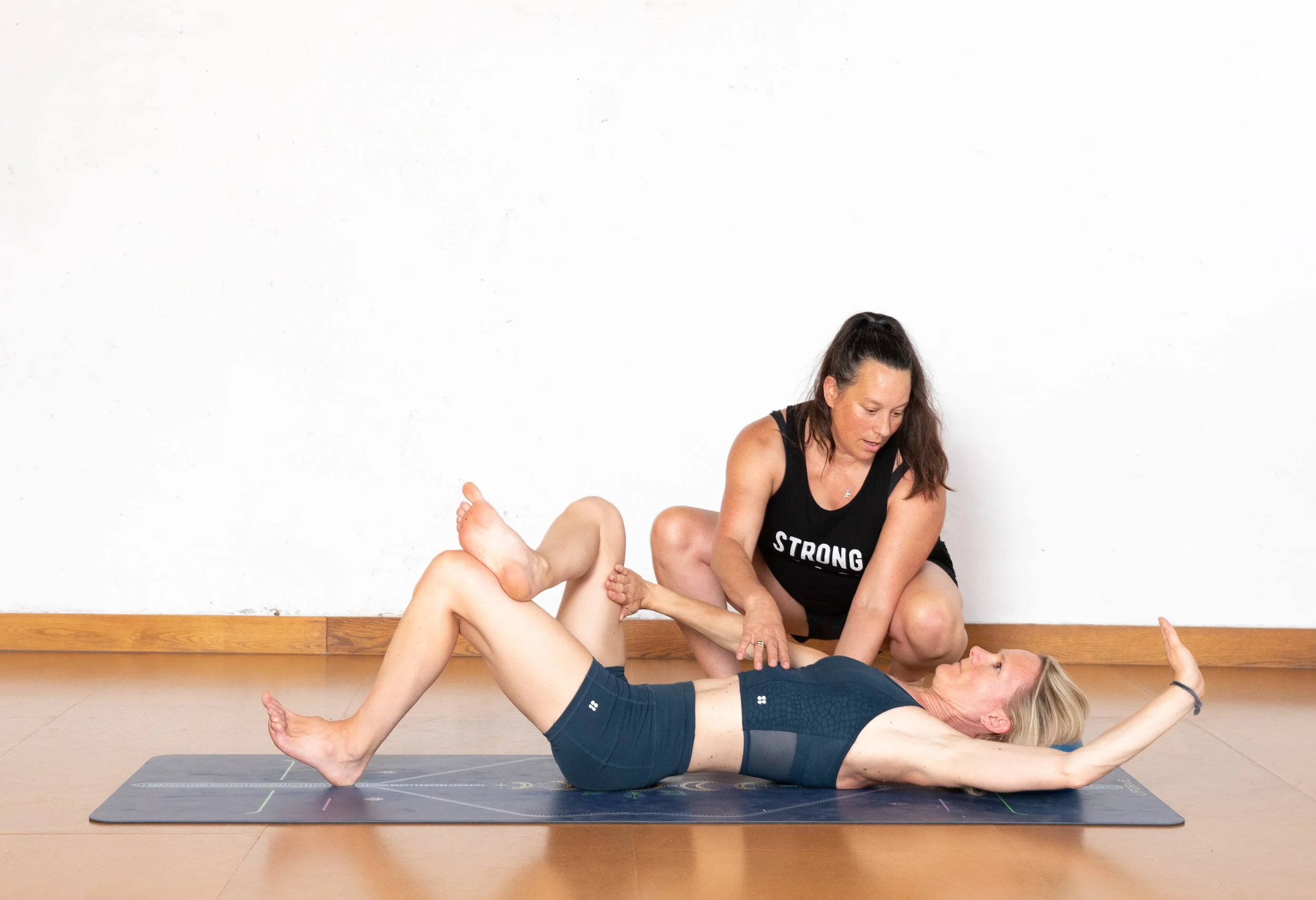
Abby Lord coaching a master class in Hypopressives
So here we are, twelve parts, twelve weeks and 3 months later, and after wandering through the ribs, spine, abdominal wall, pressure system, phrenic nerve, vagus nerve, jaw, tongue, balance, movement and all the different ways the body adapts, we finally come back to the thing that started so much of this for me in the very first place.
Hypopressives.
If there is one thing I hope this series has made clear, it is that the diaphragm does not work alone. It never has. So when we use it in Hypopressives, we are not doing one clever trick with one muscle. We are changing the behaviour of a whole system.
This, I feel, is a really important point to make, because Hypopressives have often been explained in very simple terms. Exhale, hold the breath, open the ribs, create a vacuum, everything lifts, pressure drops and the pelvic floor comes up. It is a lovely neat story. But it is also an old one, one that began in the 1980s before we understood all we now do about the inner world of our body systems. We are still learning, so in a year or two even this discussion may feel dated and Stone Age.
We know now that the body is rarely neat and tidy.
For years, the word hypopressive encouraged the idea that the key effect of the technique was a reduction in intra-abdominal pressure. That explanation made intuitive sense because during the apnoea we can visibly see the abdominal wall draw inward and upward. Ultrasound imaging has also shown movement of pelvic structures during the manoeuvre, so it was easy to conclude that pressure inside the abdomen must simply be falling and everything below must be getting pulled upwards as a result.
But visible movement does not automatically tell us what pressure is doing.
That distinction is important.
A 2026 study measured intra-abdominal pressure and levator ani activity during Hypopressives in women who were new to the technique. The researchers did not find a significant reduction in intra-abdominal pressure during the manoeuvre. They did, however, find pelvic floor muscle activation, and the amount of pelvic floor activation was not related to the amount of pressure change.
I actually think that makes Hypopressives more interesting, not less.
Because it means we need to stop thinking about them as a simple low-pressure vacuum and start thinking much more carefully about pressure reorganisation.
That is the language I always use now.
During a Hypopressive apnoea, the breath is held out after a gentle exhalation and the ribcage is deliberately expanded without allowing air to enter through the mouth or nose. That creates a very unusual mechanical situation. The ribcage is widening without an accompanying inhalation, the thoracic cavity changes shape, the diaphragm changes its position and activity, the abdominal wall responds and the pelvic floor responds within that changing pressure environment.
This is also why I am careful not to describe the apnoea as a Valsalva manoeuvre. In a Valsalva there is an expiratory effort against a closed airway, which increases thoracic and abdominal pressure. That is not what we are trying to create in a Hypopressive apnoea. In Hypopressives, we are doing something much more nuanced.
As you can see already, it is a much richer picture than simply saying the pressure reduces.
What we are seeing from the outside is the result of several tissues changing shape together. The abdominal wall draws inward and upward. The ribs widen. The thorax changes shape. The diaphragm is not simply performing a normal inhale because no air is entering. The pelvic floor has been shown in many studies to activate as part of that whole-body response.
This is why I have become increasingly uncomfortable when Hypopressives are described as a passive suction effect.
They are so not passive.
The abdominal wall is involved, and ultrasound research has shown changes in abdominal muscle thickness during Hypopressive exercise, particularly in transversus abdominis and internal oblique. So the hollowing that we can see is not simply everything being sucked upwards. The abdominal wall is participating, lengthening and activating.
If you have followed this series all the way from Part 1, that should hopefully make perfect sense now. We have already talked about why the transversus is much more than a belt around the middle. We have looked at how its fibres and connective tissues link the spine, thoracolumbar fascia, ribs, pelvis and linea alba, and how its upper fibres meet the diaphragm around the lower ribcage. So when rib position changes, when pressure changes and when the abdominal wall reorganises during apnoea, we are not asking four separate muscles to start performing four separate jobs. We are asking a really interconnected structure to change shape.
That is one of the reasons I think rib movement is so important.
People can become very focused on making the abdomen disappear during a Hypopressive apnoea. They chase the hollow, pull the stomach in and try desperately to make the shape look impressive. And this is just not going to have the desired effect.
And in doing that, they can completely miss the actual beauty of Hypopressives.
The true apnoea and the breathing technique do not start with the aesthetics; they start with the ribcage.
I am looking for the ribs to widen. I am looking for the creation of space through the thorax. I am looking for a reflexive abdominal wall to respond rather than being deliberately dragged backwards.
The visible abdominal hollow is a consequence of the manoeuvre, not the goal of it. And depending on your anatomy, you may not see a hollowing at all, but boy, will you experience something really special inside. The minute you stop chasing what the internet ‘shows’ you it should be and start being with the movement, everything changes.
That difference changes everything.
The minute someone starts forcefully sucking the stomach in, they have created a very different strategy. The abdominal wall becomes something they are consciously gripping rather than something responding to the change in thoracic shape and pressure. The jaw may tense, the neck may brace, the shoulders may lift and suddenly the whole thing looks far more like effort than easy, reflexive organisation.
Which brings us back to one of the themes that has run through this entire series.
What else is joining in?
How much effort is being used?
Can the body change?
Can the person breathe normally before and afterwards?
Can they perform the apnoea without turning the whole body into concrete?
That is much, much more useful to me than whether they can produce the biggest possible abdominal hollow.
Of course posture matters here too, because Hypopressives are not simply a breathing technique performed in lots of decorative positions. The positions change the problem the body has to solve.
A supine posture gives the body one set of gravitational and postural demands. Standing gives it another. Add an arm position, split stance, rotation, flexion or quadruped and the nervous system has a different job again.
That is why we use different positions.
Not because I want people to collect poses in an arbitrary fashion. No, they have been designed to be an effective tool to increase load, demand and challenge.
I want the body to experience how the pressure system can reorganise in more than one place and under more than one demand.
I mean, that is the end goal, is it not? If the eventual goal is to move, jump and feel confident, then we can’t just lie on a mat and breathe, although that would be lovely. We have to do more and increase that ‘more’ incrementally, because our pelvic floor does not live on a mat. It has to work when we stand up, walk, carry, reach, cough, laugh, run and lift.
If the whole point of the work is to create better movement and life options, then eventually the practice has to be able to travel with us.
This is where I think Hypopressives are way more useful than the old description suggests.
They are not simply pelvic floor exercises, and they are not simply breathing exercises. They are certainly not just an abdominal vacuum.
For me, they are a way of giving the nervous system another experience of how the ribcage, diaphragm, abdominal wall and pelvic floor can organise themselves together.
Another option.
That word keeps coming back, doesn’t it?
Options.
Because after twelve parts, that may be the thing I care about most.
I do not want a diaphragm that can only breathe beautifully when someone is lying quietly on the floor. I do not want an abdominal wall that only knows how to brace. I do not want a pelvic floor that has been trained to squeeze as hard as possible every time anything happens. And I do not want someone spending the rest of their life consciously micromanaging every breath and every muscle. How utterly draining would that be?
I want the system, your system, to have choices.
Hypopressives can be one way of exploring those choices. They can give someone an unusual sensory experience of rib expansion without inhalation, of the abdominal wall changing shape, of the pelvic floor responding without being told to perform a maximal squeeze, and of pressure being reorganised across the trunk in a way that feels very different from ordinary breathing.
That does not make them magic, although they are often described to me as being magic. So, maybe they are…
And it does not mean the same Hypopressive practice is right for everyone. Although I would argue that there is a version of Hypopressives for everyone. Where the apnoea is contraindicated, we can still work with posture, rib movement, breathing, alignment, activation and movement without the breath hold.
And perhaps you have just been resisting because they don’t require hard effort or they don’t give you the endorphin rush of high-impact exercise. But we can add challenge as you move through the basics into the dynamic work and the more advanced breath holds. They may start off looking passive, but that builds and builds, if you want it to.
But we can all agree they are one tool.
A very interesting and useful one.
Like every tool, they make much more sense when we understand the body we are using them on.
That, really, is why I wanted to write this whole series.
Because once you understand that the diaphragm is connected to the ribs, spine, abdominal wall, heart, lungs, oesophagus, nerves, pressure system, posture and movement, you cannot really go back to thinking of it as simply the muscle that makes you breathe.
And you cannot really look at Hypopressives in quite the same way either.
The apnoea is not the whole story.
The hollow is not the whole story, and for some it is not even a part of their story.
The upward lift of the pelvic floor is not the whole story. We now know from research that these muscles activate during Hypopressives, but we cannot yet say with absolute certainty how much of that response comes down to pressure reorganisation alone. It feels far more like a much wider conversation taking place between the ribs, diaphragm, abdominal wall and pelvic floor together.
And that experience is not going to look or feel identical for everyone.
Rather than feeling a sudden lift, some people might notice a quiet sense of space or calm, an easing of tension through the lower back, or simply a feeling of being a bit more grounded, connected and whole inside their own body.
The interesting bit for me is the conversation between all of them.
And perhaps that is the best place to finish.
The diaphragm is not a solo operator.
Neither is the pelvic floor.
Neither is the abdominal wall.
Neither are you.
Your body is constantly sensing, adjusting, compensating, predicting, moving and reorganising itself. Hypopressives are one way of stepping into that conversation and giving the body another possibility.
Not forcing it into one perfect shape.
Not telling it that everything it has done before was wrong.
Just offering it another way.
And after everything we have explored in these twelve parts, that feels like a pretty good place to leave the diaphragm.
Not isolated underneath the ribs.
But exactly where it belongs.
Right in the very centre of the conversation.