The Coccyx: The Final Note in Your Spinal Melody
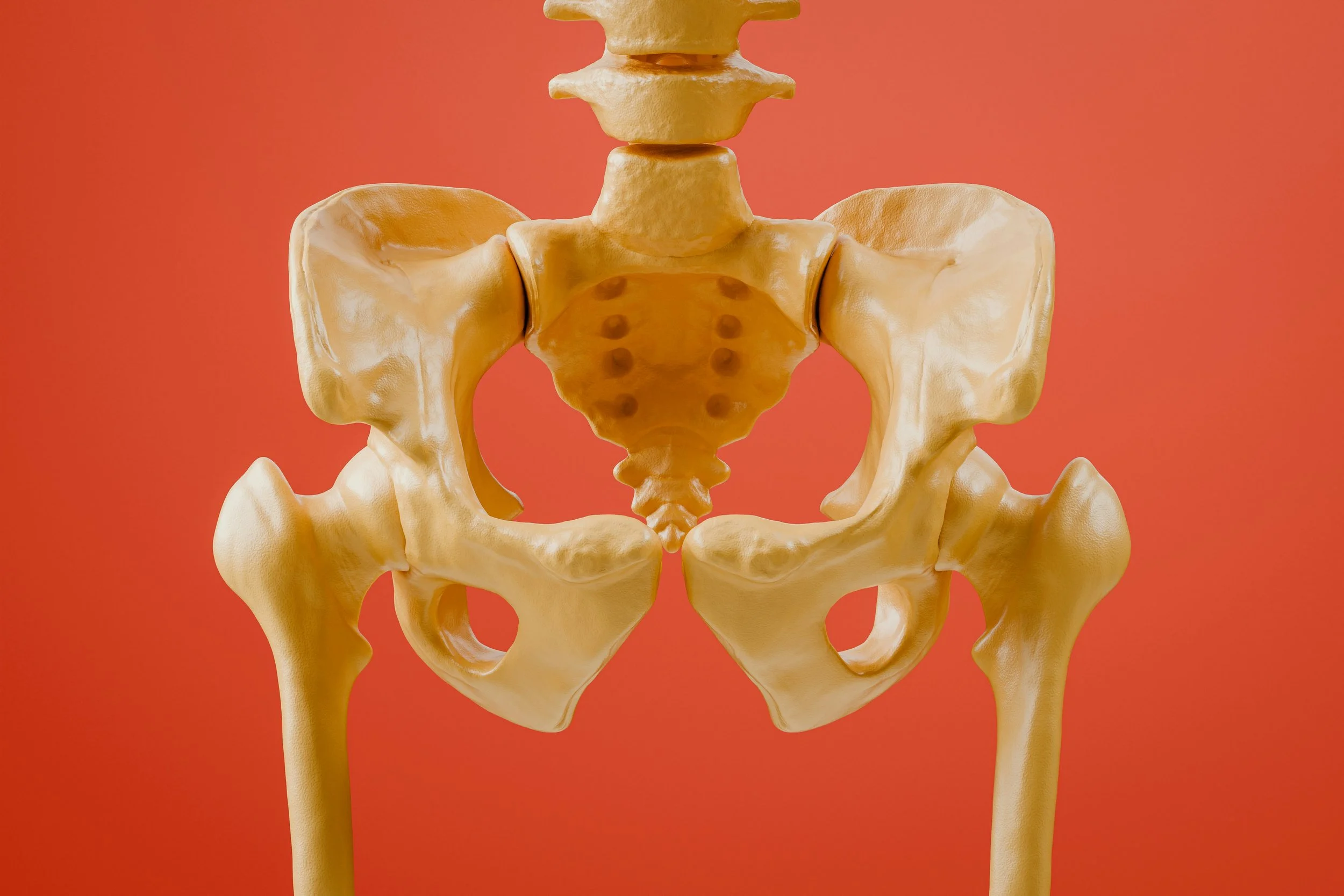
Image of the bones of the pelvis
The coccyx tends to occupy a rather strange place in the world of pelvic health.
It is either blamed for absolutely everything or ignored completely. A little, perhaps, like women themselves have historically been treated by parts of society.
As Caroline Criado Perez writes in Invisible Women:
“Men go without saying, and women don’t get said at all.”
And while I am being slightly playful, there is a serious point here. The structures, symptoms and experiences associated with women’s bodies have frequently been under-researched, misunderstood or treated as though they sit outside the medical norm.
The coccyx may be a tiny bone, but its relative invisibility within many conversations about pelvic health feels oddly familiar. If you spend any time in pelvic-health circles, you will eventually hear that your tailbone is tucked too much, untucked too much, stuck, twisted, unstable or somehow “out of alignment”. Equally, many anatomy books barely mention it at all, as though it were simply a leftover remnant from our evolutionary past.
Neither story feels entirely right to me.
Because the coccyx is not simply a tiny bone sitting quietly at the bottom of the spine. It is part of a beautifully interconnected system of muscles, fascia, ligaments, breath and movement that extends from the soles of the feet to the crown of the head.
And perhaps one of the reasons pelvic-floor symptoms can feel so confusing is that the pelvic floor does not begin and end with the pelvic floor.
In fact, it is not really a “floor” at all.
A floor sounds flat, solid and fixed. The pelvic floor is none of those things. It is a responsive, layered hammock of muscle, fascia and connective tissue, shaped more like a shallow bowl or dome, constantly adapting to breath, movement, load, pressure and position.
It lengthens, recoils, widens, narrows and changes shape as we move through life. It works with the diaphragm above, the abdominal wall around it, the hips beside it, and the sacrum and coccyx behind it.
So perhaps our language has accidentally encouraged us to think too narrowly.
The pelvic floor is not a trapdoor at the bottom of the body, waiting to fail and allow the leading actors, our pelvic organs, to tumble helplessly into the great chasm of the outside world.
Perhaps my previous life as an actor and drama teacher is showing here, but I find the theatre metaphor super useful.
Our organs are not nervously waiting in the wings or above a sprung trap door in the centre of the stage, relying on one exhausted group of muscles to hold the entire set together. The pelvic floor is not the lone stagehand who will be blamed when something drops, shifts or does not quite go according to script.
It is one important member of a much larger cast.
The muscles, fascia, ligaments and connective tissues all contribute. The diaphragm, ribs and abdominal wall help organise pressure. The hips, spine, sacrum and coccyx respond and adapt as we breathe and move. The nervous system is there in the background quietly directing proceedings, while the feet provide the stage beneath us.
Sometimes one part of the cast needs more strength. Sometimes another needs more freedom, timing, confidence or support. Occasionally the whole production needs to slow down, regroup and rehearse a different strategy.
But no single structure was ever meant to carry the performance alone.
And when symptoms appear, the answer is rarely a need to shout at the pelvic floor to squeeze harder and hope it remembers its lines.
The coccyx is part of the pelvic-floor system
This blog is about the coccyx and the role it plays as part of this much larger team.
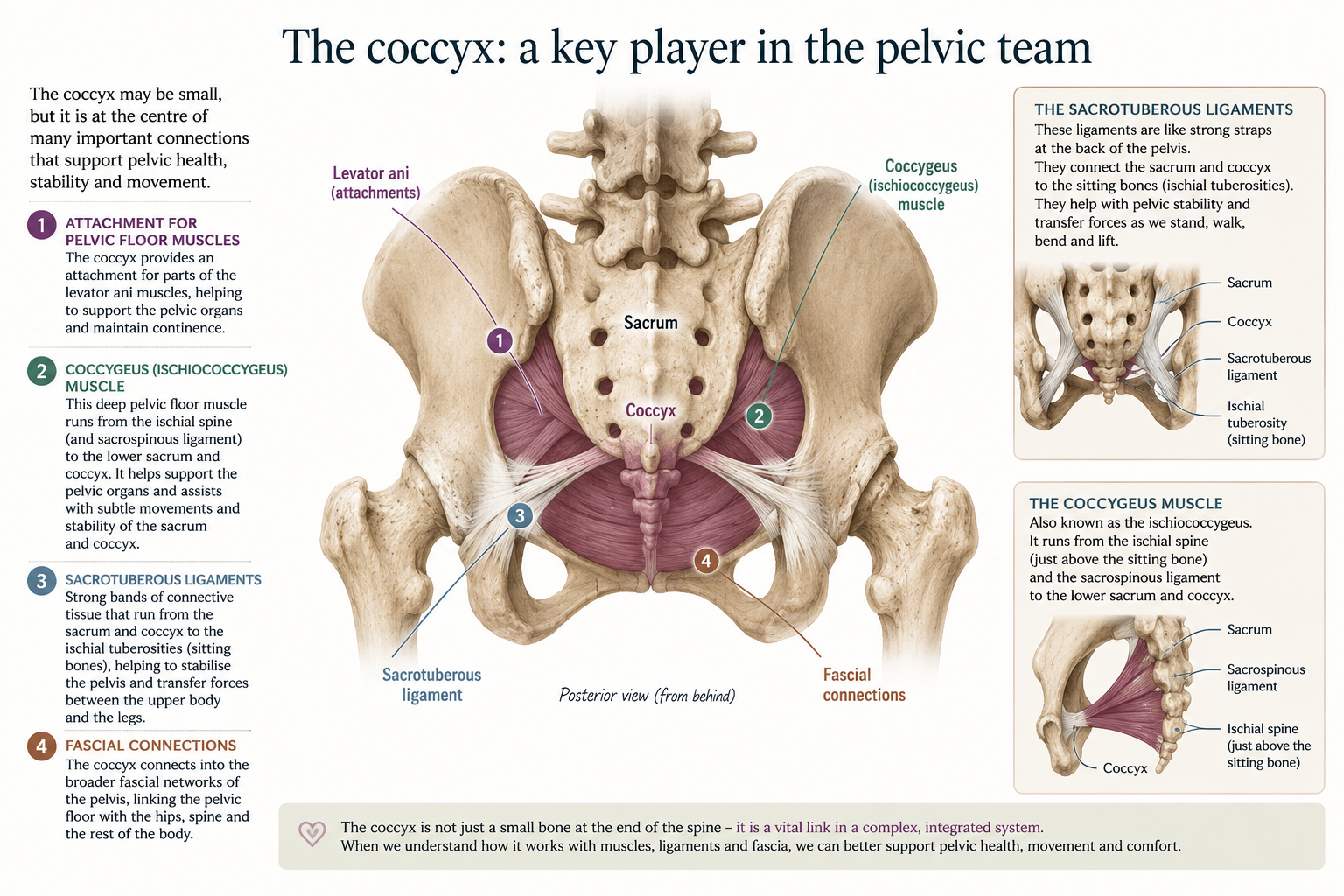
The coccyx serves as an attachment point for several important structures, including parts of the levator ani muscles and the coccygeus muscle, one of the lesser-known muscles at the back of the pelvic floor. The coccygeus is sometimes called the ischiococcygeus, which rather helpfully describes where it travels: ischio- refers to the ischium, the bone that forms the sitting-bone area, while -coccygeus refers to the coccyx, or tailbone. More precisely, the muscle runs from the ischial spine, a small bony point just above and slightly in front of the sitting bone, and the nearby sacrospinous ligament towards the lower sacrum and coccyx.
The coccyx also connects with the sacrotuberous ligaments and the broader fascial networks of the pelvis. The sacrotuberous ligaments are strong bands of connective tissue running from the sacrum and coccyx towards the sitting bones. In very simple terms, you might imagine them as supportive straps at the back of the pelvis. They help connect the spine to the pelvic bones, contribute to stability and transfer forces between the trunk, pelvis and legs as we stand, walk, bend and lift.
This means the coccyx is not simply a little bone dangling rather pointlessly at the bottom of the spine. It sits within a busy meeting place of muscles, ligaments and fascia, linking the pelvic floor with the sacrum, hips and wider movement system.
What also fascinates me is that Imaging studies suggest that the coccyx is not simply a passive passenger. During an effective pelvic-floor contraction, the tailbone moves subtly forwards into the pelvis and slightly towards the head (like a dog tucking its tail under) reminding us that it participates in the wider coordination of the pelvic floor rather than simply sitting beneath it.
This fits beautifully with the clinical work of the physios I admire Diane Lee and Antony Lo, both of whom encourage us to think less about isolated muscles and more about systems: pressure systems, load-sharing systems and movement systems.
The body rarely operates in easy neat anatomical compartments.
When someone tells me they have heaviness, leaking, constipation, coccyx pain or a feeling that “everything is falling down”, I am rarely interested only in their pelvic floor. I want to know how they breathe. How they sit. How they walk. How they respond to stress. Whether their ribs move. Whether they trust their body. I listen to what they are saying.
Because the coccyx is part of the conversation, but it is very rarely the entire story.
Your spine and pelvis are constantly talking to one another
We often speak about posture as though there is one perfect position that we should all aspire to hold all day long.
But living bodies are not statues.
Your lumbar spine, sacrum and coccyx are constantly adapting as you breathe, laugh, walk, run, lift children, climb hills and collapse on the sofa after a long day. Health may depend less on finding the “correct” position and more on having access to many positions.
Eric Franklin's work has long emphasised that the sacrum and coccyx are designed to move in response to breath and load. His movement imagery encourages people to feel the sacrum subtly nodding and gliding as the body bends and straightens. In his pelvic-floor work, he describes how deep knee bends encourage sacral nutation and a gentle backward movement of the coccyx, while returning to standing creates the opposite relationship.
This idea also aligns with contemporary biomechanics. The sacrum articulates with the lumbar spine above, the pelvis halves at either side and the coccyx below. These joints possess small but meaningful amounts of movement that are influenced by respiration, posture and force transmission.
Small movements matter.
Tiny changes in the way we distribute load through the ribs, pelvis and spine can profoundly alter how comfortable, supported or free the body feels.
Breath changes the relationship between the coccyx and pelvic floor
You all already know I have a complicated relationship to say the least with the phrase “belly breathing”.
The research tells us that breathing exercises alone are unlikely to outperform targeted pelvic-floor training for conditions such as prolapse and urinary incontinence. A recent systematic review concluded that the evidence for breathing exercises as a stand-alone treatment remains limited.
In the context of my work, that would mean simply giving you the full-body breath to practise and nothing else.
No postural work.
No movement.
No strength.
No pressure-management strategies.
No exploration of the ribs, spine, hips, feet, nervous system or coccyx.
And that is not how I work.
Breath matters enormously, but it is one part of the wider system. It can help us improve awareness, rib movement, diaphragm function and coordination, but it is rarely the whole answer on its own..
And yet, that does not mean breathing is irrelevant.
Far from it.
Breathing is how the diaphragm, ribs, abdominal wall, spine and pelvic floor learn to coordinate with one another.
Sarah Duvall often speaks about the importance of restoring three-dimensional rib expansion rather than forcing the abdomen to push forwards. Diane Lee similarly describes the diaphragm and pelvic floor as parts of an integrated pressure-management system rather than isolated structures that can simply be strengthened independently.
When the ribs become stiff, the sternum collapses, or the thoracic spine loses some of its natural variability, the body still has to manage pressure somehow.
Sometimes that pressure is transferred into gripping bottoms.
Sometimes it becomes jaw tension.
Sometimes it becomes breath holding.
Sometimes it shows up as leaking, heaviness or discomfort around the coccyx.
Pressure is not the enemy.
Life needs pressure.
The question is not how we eliminate it, but how effectively the body can organise it.
Pain is rarely just about a "misaligned coccyx"
Of course, tailbone pain can absolutely follow falls, childbirth, prolonged sitting or surgery.
But pain science increasingly reminds us that tissues do not exist in isolation.
Protective muscle guarding, nervous-system sensitisation, previous experiences, fear of movement, sleep, breathing patterns and emotional stress can all shape how any of our symptoms are experienced.
The coccyx is no exception to this fundamental reasoning.
Two people may have very similar MRI findings and entirely different experiences of pain.
One person may sit comfortably through a three-hour film.
Another may struggle after ten minutes at their desk.
That is not because one body is damaged and the other is not. It is because pelvic health emerges from a truly extraordinarily complex interaction between tissues, movement, perception and context.
The coccyx does not need fixing. It needs options.
Perhaps the biggest shift in my own thinking has been moving away from asking:
"How do we put the coccyx back where it belongs?"
And instead asking:
"How many options does this person's spine, pelvis and nervous system have available?"
Can the ribs rotate?
Can the hips roll?
Can the pelvis rock forwards and backwards?
Can the coccyx move with breath?
Can the body adapt to different loads?
Can it soften when it needs to soften and stiffen when it needs to stiffen?
Because a healthy coccyx is probably not a perfectly positioned coccyx.
At this point, I can almost hear those of you who have broken your coccyx in the past breathing an audible sigh of relief.
Bodies are wonderfully adaptable. Bones heal, tissues remodel and nervous systems learn. The occasional tumble down the stairs, an awkward landing on the ice or an enthusiastic attempt to impress your children on a trampoline does not necessarily doom you to a lifetime of pelvic-floor dysfunction.
The body is far more resourceful than that.
It is an adaptable coccyx.
It is a coccyx that participates in all that you do in your life from walking, breathing, laughing, lifting to simply resting.
It is the final note in a constantly changing spinal melody, and with every movement, that final note should be allowed to change.
As we breathe, bend, walk, sit, squat, turn and reach, the coccyx subtly adapts with the rest of the spine and pelvis. It was never designed to hold one perfect position. Its role is to respond, participate and move as part of the wider rhythm of the body.
And perhaps that is the most important thing to remember:
your pelvic floor does not stop at the pelvis, and your coccyx is not the forgotten tail at the end of your body.
It is part of a living, responsive system that is changing with every breath you take.
By now, you may be wondering why a small collection of bones at the bottom of the spine deserves quite so much attention.
The truth is that the coccyx matters not because it holds the answer to every pelvic-floor symptom, but because it sits at the crossroads of so many different systems. Breath, movement, load, fascia, posture, memory and emotion all leave their mark here.
And perhaps that raises one final question.

What happens at the other end of the spine?
We speak endlessly about posture. We are told to stand tall, hold our heads high and pull our shoulders back. We instinctively recognise confidence in the way somebody enters a room and sadness in the way they leave it. Actors train for years to understand how emotion changes movement, and movement teachers spend decades helping people notice patterns that have become so familiar that they are almost invisible.
But we rarely talk about what happens at the other end of the spine.
What happens to the tail when we are frightened? When we are grieving? When we are embarrassed, exhausted or trying desperately to hold everything together?
Language itself hints that we already know the answer. We speak of people with their “tail between their legs”, being “uptight”, being “broken-hearted” or “unable to let go”. These expressions are not anatomical descriptions, of course, but they point towards something important: emotions are not experienced solely in the mind. They are lived and expressed through the body.
Fear may encourage us to brace, grip and become smaller. Shame can subtly draw the sternum downwards and leave us wanting to disappear into ourselves. Grief often feels heavy, as though the body has lost some of its buoyancy. Joy, on the other hand, can create a sense of spaciousness: the ribs widen, the breath deepens and movement becomes easier and more expansive.
None of this means that sadness causes coccyx pain or that confidence magically cures pelvic-floor symptoms. Human beings are far more complex than that. But modern pain science, alongside the work of people such as Diane Lee and the Franklin Method, reminds us that posture, muscle tone, breath and emotional experience are deeply interconnected.
The coccyx sits at the end of a spine that is constantly responding to the world around it. It is attached to muscles and fascia, influenced by breath and load, and shaped by the thousands of experiences we accumulate over a lifetime. A difficult birth, a harsh comment about our body, a stressful period at work, years spent trying to appear “strong”, or simply the habit of sitting for hours every day may all leave traces in the way we organise ourselves.
The Franklin Method has long used imagery to explore this relationship. Rather than treating the pelvis as a rigid bowl that must be held in a particular position, it invites us to imagine movement, elasticity and responsiveness. To picture the sacrum gently nodding with the breath. To feel the sitting bones widening and narrowing. To rediscover the subtle rhythm between the spine, the pelvis and the world around us.
Perhaps that is why I find the coccyx so fascinating.
Not because it is the hidden source of every pelvic-floor problem, but because it reminds us that the body is always listening. It listens to gravity, to movement, to injury, to laughter, to stress and to the stories we tell ourselves.
We are encouraged to hold our heads high.
Perhaps, every now and then, we should also spare a thought for the quiet, adaptable little tail at the other end of the spine.
Changing the final note…
1. The tailbone clock
Lie on your back with your knees bent and your feet on the floor.
Imagine your coccyx is the hand of a clock.
As you gently rock your pelvis towards your feet, imagine the tail lengthening away from your head.
As you rock towards your ribs, imagine the coccyx softly curling underneath you.
Explore the spaces in between.
Move slowly enough that you can sense the movement travelling through your sacrum, lower back and ribs.
The goal is not to find the “right” position but to remind your nervous system that the tail has options.
2. The cat's tail
Come onto all fours.
Rather than beginning the movement from your head or shoulders, imagine a long, expressive tail growing from your coccyx.
Let the tail curl gently beneath you and notice the wave travelling up your spine.
Then allow the tail to reach behind you and feel the wave move forwards through your sacrum, ribs and neck.
Repeat several times, changing the speed and size of the movement.
Can you feel that the coccyx is not the end of the story, but part of it?
3. Sitting-bone walking
Sit on a firm chair.
Gently shift onto one sitting bone and then the other.
Imagine your coccyx hanging like the pendulum of an old clock between them.
Allow your ribs and waist to join in.
Experiment with tiny spirals and weight shifts.
Walking is, after all, little more than a beautifully organised series of controlled falls and recoveries.
4. The dog's tail
This one sounds silly, but stay with me.
Think about a happy dog wagging its tail. The movement does not happen only at the tip, it travels through the spine, ribs and whole body.
Now think about a frightened dog with its tail tucked underneath. Instantly, the spine changes, the breath changes and the body becomes smaller.
Standing or kneeling, imagine:
your tail hanging neutrally behind you;
your tail wagging from side to side;
your tail gently tucking;
your tail lengthening into the space behind you.
Notice what happens to your breath, your jaw, your chest and your mood.
5. The final note
Stand and take a few slow breaths.
As you inhale, imagine your spine as a musical scale, with the coccyx as the final note at the bottom.
As you exhale, bend your knees, turn your head or shift your weight from foot to foot.
Notice how the final note changes.
Because as I have already said in the blog above “a healthy coccyx is probably not a perfectly positioned coccyx. It is an adaptable coccyx, one that was designed to change with every breath, every step and every movement you make.”