An exploration of anatomy, ancient wisdom, the really extraordinary way we develop and the connections we may have forgotten.
There's a muscle buried deep inside your body that's been called the muscle of the soul and the muscle of emotions. It's associated with fear, survival, instinct, vitality and our connection to the earth. Some believe it holds our emotional experiences, while others see it as a messenger, responding to the world around us and reflecting our relationship with movement, gravity and ourselves.
And then there's modern anatomy, which rather less romantically describes it as a hip flexor.
Now, I love anatomy. I love understanding how muscles, bones, nerves and connective tissues work together. I love that we can examine the body in such extraordinary detail these days, and that we're still discovering things about structures we've been studying for centuries. But I sometimes wonder whether, in our dogged determination to understand every individual part of the human body, we've forgotten something actually rather important.
What it means to experience the whole of it, and to explore those deeper, sometimes quite esoteric connections that we can sense but don't always have the words to explain.
Because the more I explore the psoas, the more interesting its relationships become. With our breathing diaphragm, the lumbar spine, the muscles of our back, the fascia surrounding our pelvis and even the muscles of our inner thighs. And, of course, with the wider movement system of which our pelvic floor is a part.
But the story of the psoas doesn't begin and end in an anatomy textbook. It takes us into ancient traditions, our relationship with fear and emotion, the extraordinary process of developing in the womb and even the nature of reality itself.
Quite a journey for one muscle, don't you think?
A muscle with some extraordinary neighbours
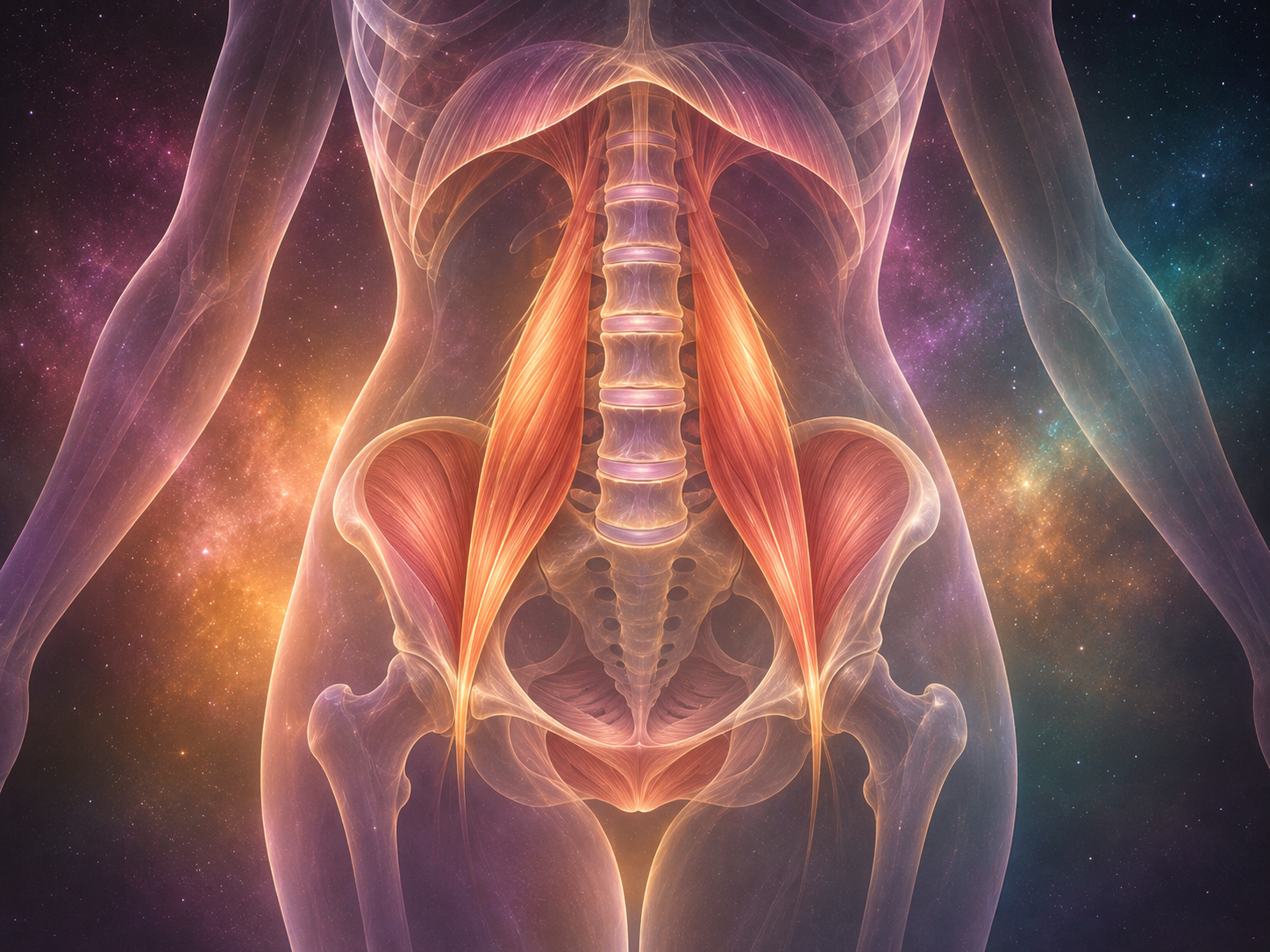
First, let's work out where this mysterious muscle actually lives.
You have two psoas major muscles, one on either side of your lumbar spine. They begin around the lowest thoracic vertebra, T12, and extend down through the lumbar region, attaching to the vertebral bodies, discs and transverse processes, those little bony projections extending outwards from your spine. From there, they travel down through the back of your abdominal cavity, cross the front of your pelvis and hip, and eventually attach to your femurs at a bony projection called the lesser trochanter.
Let’s run though that journey for a moment. The Psoas is a muscle extending from your spine, travelling through the depths of your trunk and arriving at your thigh bone. It is one of the few muscles directly connecting the vertebral column to the lower limb.
And along the way, it finds itself in some pretty interesting company.
Within the posterior part of the psoas lies the lumbar plexus, a network of nerves supplying parts of the lower abdomen, pelvis and legs. Nearby are the kidneys, the quadratus lumborum and the connective tissues of the posterior abdominal wall. Behind the lumbar vertebrae sit the spinal extensors, including multifidus and erector spinae, helping us extend, control and stabilise our spine.
The psoas lives towards the front and sides of that same spinal column, where it can contribute to spinal movement and stability as well as hip flexion. These muscles don't simply oppose one another. Depending on what we're doing, they may be working together to control movement, manage load or support the spine.
And they're surrounded by some to my mind really fascinating connective tissues.
The thoracolumbar fascia (which is around the centre of your lower spine) is an extensive arrangement of fascial layers associated with the muscles of the lower back, abdominal wall and pelvis. The psoas sits in front of its anterior layer, within its own fascial covering, while the spinal extensors occupy a compartment behind the spine. They're distinct structures, but their relationships with the lumbar vertebrae and surrounding tissues mean they participate in the mechanics of the same region.
I find this particularly interesting when observing people move. Sometimes someone will struggle to extend their hip without arching their lower back. Sometimes they'll have plenty of movement in one direction and very little in another. And sometimes they're working so hard to maintain what they've been told is good posture that they've almost forgotten how to move naturally.
Shoulders back, tummy tight, bottom tucked, ribs down. All those little instructions we've collected over the years.
But what happens when we stop trying to hold everything in place and allow the different parts to move?
That's one of the reasons I spend so much time watching people walk, bend, turn and breathe. I'm interested in what their body has chosen to do, why it might be doing it and what other options might be available.
And the psoas has another neighbour that makes this exploration even more interesting.
The diaphragm.
If you've been following my Diaphragm Series, you'll know that the diaphragm is far more than a dome-shaped muscle sitting underneath your lungs. Its muscular attachments extend towards the lumbar spine through structures known as the right and left crura. It also has a thickened fascial arch called the medial arcuate ligament, which passes over the upper psoas and is associated with the fascia surrounding it.
So the diaphragm and psoas really are connected, although not quite in the way they're sometimes described. They aren't one continuous muscle, and the Psoas doesn't simply pull the diaphragm down whenever it tightens. But they do absolutely share an anatomical neighbourhood, fascial relationships and connections around the lumbar spine.
My whole I love, love, love our bodies - loves this.
Here are two muscles with different jobs, one intimately involved in breathing and the other contributing to hip and spinal movement, occupying closely related territory within our trunk.
And it makes me think about what happens when someone's breathing has become restricted, their spine seems reluctant to move and their hips are doing very little. Perhaps there isn't one particular muscle that needs releasing. Perhaps there are several parts of the body that have become accustomed to moving together, or not moving very much at all.
Sometimes changing the way we breathe gives us an opportunity to explore movement differently. Sometimes moving our spine or hips changes how breathing feels.
It doesn't mean we've mechanically released the psoas through the diaphragm. It means we've explored another possibility.
And there is much more to this muscle than its relationship with the spine.
As the psoas travels down towards the hip, it meets the iliacus, a broad, fan-shaped muscle lining the inside of the pelvic bone. Imagine the pelvis as a bowl, with the iliacus spreading across part of its inner surface while the psoas descends from above. Together they're known as the iliopsoas, and they're major contributors to hip flexion.
Every time you lift your knee to climb a stair, step into your trousers or bring your leg forwards when walking, this partnership is helping.
But something even more interesting happens with the connective tissues surrounding them.
The fascia of the psoas doesn't simply end when the muscle reaches the pelvis. Its lower, inner fascial covering has been described as thickening and continuing into the deep fascia of the pelvic floor. The wider iliopsoas fascia also has relationships with the connective tissues of the abdominal wall, pelvis and thigh.
So although the psoas doesn't actually become one of the muscles of the pelvic floor, its connective tissue relationships extend into the very region we're so often encouraged to think of as an isolated muscular system.
And I think that's quite extraordinary. Because when we look at a labelled anatomy diagram, we see individual muscles with clearly defined beginnings and endings. But the connective tissues surrounding them don't always respect those neat divisions. Thank goodness.
For years, anatomy textbooks (and me!) commonly described the psoas and iliacus as joining into one shared tendon. Yet a detailed anatomical study published in 2022 challenged that description, finding that their insertions onto the upper femur were more distinct than many modern accounts suggested. This is one study, but more will follow.
Even after all these years, we're still refining our understanding of something as apparently straightforward as a hip flexor.
And that same study revealed something else I find super intriguing.
Near the lower psoas, the researchers identified fascial continuity with the pectineus, a small muscle at the top of the inner thigh that helps bring the leg forwards and towards the body's midline. They also described more complicated relationships between the iliopsoas and other adductor muscles (inner thigh) than traditional descriptions often acknowledge.
Now follow that connection back towards the pelvis.
The pectineus originates near the pubic bone, where we find a structure called the pectineal ligament, or Cooper's ligament. Research into this ligament has demonstrated its relationships with the pectineus, iliopsoas fascia and the fascia of the obturator internus, a muscle lining the inner wall of the pelvis.
And here's where my pelvic floor fascination really begins.
Part of the levator ani, one of the main muscular components of our pelvic floor, attaches to a thickened band of fascia associated with the obturator internus. That band is called the tendinous arch of levator ani.
In fact, anatomical research has demonstrated that the obturator internus and levator ani share a broad area of obturator fascia, providing a fascinating anatomical basis for investigating how hip movement might contribute to pelvic floor function.
So we're looking at a region where the spine, hip flexors, inner thighs and pelvic floor have multiple relationships through their muscular attachments, shared bones and connective tissues.
And I can't help wondering how much we might discover if we explored those relationships more often.
When someone comes to me with pelvic floor symptoms, I don't just want to know what their pelvic floor can do. I want to see what happens when they move their hips, when they stand on one leg, when they rotate their spine or when they breathe.
Because the psoas is often described as a hip flexor, the adductors as muscles that bring the legs together and the pelvic floor as a group of muscles supporting our pelvic organs. All perfectly useful descriptions, but they can encourage us to imagine that each one operates independently.
And that simply isn't how we experience movement.
When you stand on one leg, your pelvis doesn't stop being involved because you've decided it's a hip exercise. Your spine doesn't clock off when your leg moves. Your breathing doesn't disappear when you lift something, and your pelvic floor isn't sitting quietly waiting for its turn.
The degree to which these systems influence one another depends on the task and the individual, but they're all contributing to the activity of one human being.
And perhaps that shouldn't surprise us as much as it sometimes does.
Because we didn't begin life as a collection of separate parts. What if we've forgotten how to experience the whole?
Here's something that never fails to fill me with wonder.
You began as a single cell.
One tiny cell from which an entire human being developed.
Your spine, your diaphragm, your pelvis, your nervous system, your hands, your feet, your heart. All emerging through an extraordinary process of division, differentiation, migration and growth.
And here's the part I find particularly beautiful.
We literally folded as we developed.
Early in embryonic development, the body undergoes a remarkable transformation. What begins as a relatively flat arrangement of developing tissues folds into a three-dimensional form. Structures move, cavities form, tissues change their relationships and the foundations of our organs and body systems take shape.
The diaphragm itself has a particularly interesting developmental history. Its muscle, tendons and connective tissues arise from several embryonic sources, with muscular precursors migrating from the cervical region (the area around and including the neck) as the diaphragm develops.
The psoas and pelvic floor follow different developmental pathways, but all these structures emerge within the same growing organism.
Just imagine that for a moment.
Nothing was assembled afterwards. There wasn't a finished spine waiting for someone to attach a diaphragm, or a pelvis waiting for its muscles to be fitted.
We grew as one living being. That fills me with so much awe. That and the expanse of the Milky way (the one in the night sky, not the chocolate bar).
And when I think about that, I find it increasingly difficult to imagine the body as simply a collection of independent parts.
Which brings me to something that might seem an enormous leap from the psoas, but bear with me. Wecare diving into another interest of mine but I will connect them!
There's an ancient image from Buddhist philosophy called Indra's Net.
Imagine an infinite web stretching out in every direction. At each intersection hangs a beautiful jewel, and reflected within every jewel are all the other jewels. Look closely into one reflection and you'll find more reflections, continuing endlessly.
It's a breathtaking image.
In Huayan Buddhist philosophy, it expresses the idea that everything exists in relationship with everything else. That things don't simply exist independently and then happen to become connected, but that their relationships are part of what makes them what they are.
I love that idea. And it has stayed with me since Religious and Moral education with Mr Marshall at George Watson’s ( a nod to the man and teacher that inspired me, in a topic I chose because I thought it would be an easy Higher.) Blew my mind more like!
And I can't help seeing a parallel with the way we study the body. We separate muscles, organs and systems so that we can understand them, but in doing so we can lose sight of the relationships that make them part of a living whole.
It's a thought that also brings me to the physicist David Bohm and his concept of the Implicate Order.
Bohm proposed that beneath the world of apparently separate objects and structures there might be a deeper, undivided order. He described the familiar world we observe as the Explicate Order, an unfolded expression of something more fundamental, which he called the Implicate Order.
One of the images he used to explore this idea was the hologram.
When you cut an ordinary photograph in half, you lose half the picture. But with a holographic recording, a smaller piece can still contain information about the whole image, although with less detail.
The whole, in some sense, represented within the part.
Bohm called the underlying, undivided movement of reality the Holomovement.
And what's even more extraordinary is that modern theoretical physics is still exploring ideas that challenge our understanding of what reality actually is.
You may have heard of string theory, which explores the possibility that the fundamental building blocks of our universe are tiny vibrating strings. But there's another idea, closely associated with developments in string theory, called the holographic principle.
The idea is that information describing a region of space might, in certain circumstances, be represented on a boundary with fewer dimensions. Almost as though a three-dimensional world could be described by information existing on a two-dimensional surface.
In 1997, physicist Juan Maldacena developed a remarkable theoretical framework showing how a gravitational theory in one kind of spacetime could be equivalent to a quantum field theory in fewer dimensions.
Now, that doesn't mean we've discovered that our universe is literally a hologram. But it does open up some extraordinary questions about the relationship between what we experience and the deeper mathematical descriptions of reality.
And this is where I find the work of Dr Jude Currivan particularly interesting.
In her book The Cosmic Hologram: In-formation at the Center of Creation, (which I listen to in the car, it is available on audible - hae had to re-listen several times because her theories are pretty mind expanding), Currivan brings together ideas from cosmology, quantum physics, information theory and ancient wisdom to explore the possibility that information and relationships are fundamental to the universe.
Rather than imagining reality as a collection of separate objects that occasionally interact, she invites us to consider an interconnected, evolving whole in which everything participates.
In her later book, The Story of Gaia, she takes this exploration further, considering the emergence of life, consciousness and our planet within that much larger picture. Which I read first!
And I love the questions this raises.
What if the boundaries we perceive between things aren't quite as absolute as we imagine? What if our habit of dividing everything into smaller and smaller parts is only one way of understanding a much bigger picture?
I find myself thinking again about Indra's Net, with its infinite reflections, and Bohm's idea of an enfolded universe.
These aren't identical theories, and Currivan's interpretation of consciousness and universal interconnectedness goes beyond what physics has established. But there's something rather beautiful about the way these different perspectives invite us to reconsider the nature of the whole.
And then I find myself returning to that tiny cell from which we developed.
One living beginning, unfolding into an extraordinary arrangement of tissues, organs and systems, each with its own identity yet participating in the life of one organism.
Perhaps that's what draws me towards all these ideas that might seem unrelated.
Not because they offer one final explanation, but because they remind me how much more there might be to discover.
And I think really do think we need to leave a little room for wonder and awe.
Now, I'm not suggesting that embryology proves Bohm's ideas, or that the psoas is literally a hologram. His work was an exploration of physics and the nature of reality, not an Abby theory about hip flexors.
But I find the philosophical parallels quite, quite beautiful.
The jewels of Indra's Net, each reflecting the others. Bohm's idea of an enfolded whole. The extraordinary unfolding of a developing human being.
Different traditions, different ideas and different ways of understanding the world, yet all inviting us to consider what it means to be part of something larger.
And this is where I think we've perhaps lost some of our human wisdom.
We have become extraordinarily good at separating, naming and measuring things. We can examine microscopic structures, monitor muscle activity, record our movements and produce astonishing images of our internal anatomy.
And I wouldn't want to give up that knowledge for a moment.
But I wonder whether our constant search for explanations has made us less comfortable with the things we don't yet understand.
Or perhaps less willing to simply experience them.
We're encouraged to analyse our sleep, track our steps, monitor our heart rate and correct our posture. Now we're moving into an age where artificial intelligence can provide us with answers to questions we might once have spent years and years exploring.
There are of course enormous benefits to that.
But I wonder what happens if we become so accustomed to looking outside ourselves for answers that we stop paying attention to our own experience.
To the feeling of being grounded. The way our body responds to music or another person's presence. The change in our breathing when we feel safe. The instinct to move, stretch, shake, curl up or simply be still.
Ancient traditions explored many of these experiences through concepts such as Qi, the Lower Dan Tian and the Hara. In Taoist practice, the Lower Dan Tian is associated with the cultivation of vital energy, while the Japanese concept of Hara speaks to our centre and sense of groundedness. Traditional Chinese Medicine associates the Kidneys and Water element with fear, while yogic traditions explore the body's energetic centres through concepts such as the chakras and practices involving breath and movement.
We don't have to translate every one of these ideas into a particular muscle or nerve pathway to appreciate them.
And I don't feel the need to be sceptical of ancient wisdom simply because it uses a different language from modern anatomy.
Perhaps some of it reflects ways of observing and experiencing ourselves that we've become less familiar with.
Perhaps there are things we haven't yet learned how to measure.
And perhaps some of the mystery of being human will always remain.
I'm actually very comfortable with that.
In fact, I think there's something wonderful about it.
The emotional psoas and learning to listen
This brings me back to Liz Koch, whose work has profoundly influenced the conversation surrounding the psoas.
Koch has spent decades exploring our relationship with this muscle through movement, gravity, awareness and what she calls Core Awareness. Her books, including The Psoas Book, Core Awareness and Stalking Wild Psoas, invite us to think about the psoas as more than a mechanical structure to be stretched or strengthened.
And what I particularly enjoy about her approach (apart from her individual character and way of looking at the world and the female body) is the invitation to experience the psoas rather than simply analyse it.
Because we can become so focused on fixing ourselves.
We feel tension, so we stretch. We feel weak, so we strengthen. We discover a postural difference, so we correct it. We feel something unusual, so we search for an explanation.
But what if we began by listening?
What if we gave ourselves a little time to notice how our body feels when it's supported, how it responds to gentle movement or what happens when we stop trying quite so hard?
Koch describes the psoas through ideas of instinct, responsiveness and deep bodily intelligence. Her approach encourages us to develop a relationship with the body rather than treating it as a machine that needs constant adjustment.
And that feels very relevant to the way I work.
Because when someone comes to see me with pelvic floor dysfunction, I'm interested in far more than whether their pelvic floor is weak or tight.
I want to know how they move and breathe, what happens when they stand on one leg, whether their hips can move independently of their spine, how they respond to load and whether they're able to relax as well as contract.
I want to understand the person living inside of that body.
And that includes their experiences, their confidence, their fears and their relationship with movement.
The psoas has long been associated in somatic writing with our fight-or-flight responses, particularly because hip flexion is involved in movements such as running, withdrawing the legs or curling into a protective position.
When we're frightened, our bodies can respond before we've consciously made sense of what has happened. Our breathing may change, our heart rate can increase and our muscles prepare us to move, freeze or protect ourselves.
And we all know how emotion can affect us physically.
Think about the sensation in your stomach when you're anxious, how your shoulders rise when you're stressed or how you might suddenly realise you've been clenching your jaw for the past hour.
Our emotions aren't separate from our physical experience.
Whether the psoas specifically stores emotional memories is another question, and not something we've established scientifically. I have explored this pre-sensing in other blogs. I don't think we need to dismiss the very real experiences people report when movement, touch or stillness brings up unexpected sensations or emotions.
Sometimes we don't know precisely why something happens.
That doesn't make the experience meaningless.
And this is also where my work with TRE®, Tension & Trauma Releasing Exercises, becomes particularly interesting.
In 2005, Liz Koch and David Berceli, the developer of TRE®, collaborated on articles exploring the iliopsoas and what they called bio-intelligence.
Berceli's work uses exercises intended to encourage tremoring, something that can occur naturally in humans and other animals during fear, effort, excitement or intense emotional experiences.
I find tremoring fascinating, not because I believe we can prove that shaking physically empties trauma from the psoas, but because it offers another way of exploring our relationship with bodily sensations and responses that aren't always consciously directed.
For some people, these experiences can feel calming or settling. Others may find them unfamiliar or intense, which is why choice, pacing and the ability to pause are so important.
And this brings me back to the pelvic floor.
People experiencing persistent pelvic pain or other pelvic symptoms may also have difficulties with muscular relaxation, altered breathing patterns or protective responses to pain and movement. Sometimes stress plays a part; sometimes there are structural, hormonal, neurological or muscular factors involved. Often the picture is more complicated than one explanation.
But imagine someone who's spent years being told to squeeze their pelvic floor muscles, hold their stomach in and improve their posture, when part of their difficulty is that they don't know how to stop holding on.
For that person, simply being told to strengthen more may not answer the whole problem.
And neither will telling them to release their psoas.
We need to understand what's actually happening.
The pelvic floor has a remarkable ability to respond to breathing and movement. As the diaphragm descends during a comfortable inhalation, the pelvic floor generally accommodates with a subtle downward movement and lengthening. As we exhale, both can recoil. When we lift, jump, cough or run, the demands change again.
There's a constant conversation taking place between breathing, movement, muscular effort and pressure within the trunk.
The psoas isn't controlling that entire conversation, but its relationships with the lumbar spine and hips make it part of the wider movement picture.
And sometimes, when we're exploring pelvic floor dysfunction, changing how someone moves their hips or spine reveals something we hadn't noticed before.
That's what fascinates me.
Not the idea that there's one magical muscle responsible for every problem, but the possibility that looking beyond the obvious might help us understand a person's movement more fully.
Of course, the psoas can also be involved in genuine physical problems. Irritation of the iliopsoas tendon can contribute to pain at the front of the hip or groin. Internal snapping hip may produce an audible or palpable snap as structures move around the front of the joint. Iliopsoas bursitis, some hip joint problems and certain complications following hip replacement can involve this region, while infection or other disease processes can very occasionally affect the psoas itself.
And because of its relationship with the lumbar spine, it may be involved in some presentations of back or pelvic pain.
But the important word here is may.
Not every painful hip has a tight psoas, and not every tight-feeling hip flexor is anatomically short. Stretching can be useful, but so can strengthening, changing how we load a muscle, improving movement options and allowing irritated tissues time to recover.
Sometimes the answer is quite ordinary.
And sometimes it's a little more complicated.
Which is why I keep coming back to curiosity.
I think there's something rather wonderful about the way all these ideas come together. Ancient traditions exploring our centre and our relationship with life, Liz Koch inviting us to listen to our bodies, modern anatomy revealing fascinating fascial connections and embryology reminding us that we developed as one living organism.
Then there's Bohm, asking us to consider whether the apparently separate things we observe might belong to a deeper wholeness.
And Indra's Net, with its infinite reflections reminding us that everything exists in relationship.
I don't need all these ideas to be saying exactly the same thing.
I don't need them to provide one perfect answer.
I simply love that they invite us to look again.
Perhaps in our dogmatic desire to understand every part of the human body, we've forgotten what it means to experience the whole of it.
And perhaps one of the most valuable things we can do is begin to rediscover that experience.
Not by abandoning science, but by allowing ourselves to be curious about more than we can measure.
To move.
To breathe.
To feel.
To notice.
And occasionally, to be completely amazed by the extraordinary business of being human.
Because you, yes YOU, sitting there reading this (if you've made it this far!), are pretty extraordinary yourself.
Just think about what had to happen for you to be here. An unbroken line of ancestors stretching back through thousands, millions, even billions of years. Through ice ages, wars, natural disasters, mass extinctions and enormous changes to our planet. Your distant ancestors were around when dinosaurs roamed the Earth, and somehow, through all those generations, life continued.
Every single generation survived long enough for the next one to exist.
And here you are.
Reading a blog about your psoas and some other Abby style connections.
How absolutely amazing is that?
You are the result of an extraordinary, almost unimaginable journey through the history of life on Earth.
You really are a remarkable human being.
And perhaps we should spend a little more time being amazed by that.
Before we finish, I'd love you to spend a few minutes exploring some of these relationships for yourself.
Not to fix your psoas.
Not to force anything to release.
Simply to see what you discover.
Four gentle explorations for your psoas, hips and pelvic floor
1. Constructive Rest: The art of doing nothing
This is a practice closely associated with Liz Koch's work, and it seems a rather appropriate place to begin after all our talk about listening.
Find a comfortable place on the floor and lie on your back with your knees bent and your feet resting about hip-width apart. If your head needs a little support, place a small folded towel underneath it. Allow your arms to rest comfortably beside you or across your body.
Now, rather than trying to flatten your back, tuck your pelvis or pull your stomach in, simply notice where you're making contact with the floor.
Feel the weight of your pelvis, the backs of your ribs and your feet. You don't need to make your breathing deeper or slower, and there's no particular sensation you're trying to create.
Stay here for five to ten minutes if you're comfortable.
You might notice your back gradually feels more supported, your breathing changes or the muscles around your hips seem less busy. You might notice very little at all.
That's fine too.
I think the interesting thing about this exercise is how unfamiliar doing nothing can feel when we're so accustomed to being told to engage, correct or activate something.
Give yourself permission to be supported without having to perform.
2. The 360° Breath: Exploring the space around your spine
Remain in your comfortable resting position, or come into sitting if that suits you better.
Place your hands around the sides of your lower ribs, with your fingers pointing gently towards the back of your body.
As you inhale through your nose, imagine your lower ribcage widening around its circumference. Feel the space opening sideways into your hands and backwards towards the floor or chair.
You don't need to push your belly out. Instead, allow the movement to spread through the lower ribs, with the abdominal wall responding naturally.
As you inhale, your pelvic floor will generally accommodate the movement with a subtle widening and lengthening. As you exhale comfortably, the ribs return and the pelvic floor can naturally recoil.
There's no need to squeeze, pull your stomach in or force the air out.
Try four to six gentle breaths.
And then pause.
Notice how your back feels against the floor. Whether the movement of your ribs seems different. Whether there's any change around your waist, hips or pelvis.
We're not trying to massage the psoas with our breath. We're exploring the diaphragm's movement within a trunk that also contains our spine, hip flexors and pelvic floor.
3. Standing Hip Extension: Can your hips move without your back doing everything?
Come into standing, facing a sturdy kitchen counter or the back of a chair, and rest your hands lightly on it for support.
Step one foot backwards so you're in a comfortable split stance, with both feet on the floor.
Now allow your pelvis to travel gently forwards as the hip of your back leg moves towards extension. Keep the movement small enough that you can notice what is happening without feeling the need to arch your lower back or force your pelvis into a tuck.
Return to your starting position and repeat five or six times before changing legs.
You may feel some movement or mild lengthening at the front of the hip. You might also notice that one side behaves differently from the other.
What I'm particularly interested in is whether the movement takes place at the hip or whether your lower back tries to take over.
Try making the movement smaller if you find yourself arching or holding your breath.
The goal isn't the biggest stretch. It's discovering how the hip and spine can move in relationship with one another.
4. The Pectineus and Inner-Thigh Exploration: Following the connections
For our final movement, we're going to revisit that fascinating relationship between the psoas, pectineus, adductors and pelvis.
Stand with your feet slightly wider than hip-width apart, keeping a counter nearby for support if you need it.
Gently transfer your weight towards your right leg, allowing your right knee and hip to bend a little as your left leg remains more extended.
Keep both feet comfortably in contact with the floor and allow your pelvis to travel sideways with the movement.
Then return to the centre and repeat on the other side.
Move slowly for five or six repetitions in each direction.
Notice how the inner thighs respond. Perhaps you feel a little lengthening through the groin of the more extended leg. Perhaps one hip moves more easily, or you notice your pelvis has a tendency to rotate.
See whether you can continue breathing comfortably throughout the movement.
Remember the pectineus, the little muscle at the top of your inner thigh with its relationships to the psoas and surrounding fascial tissues?
We're not trying to pull on that fascial connection or force one muscle to release another. We're exploring the way our hips, pelvis and inner thighs participate in movement together.
And perhaps, after everything we've been discussing, that's the most interesting part.
Not the individual muscle we intended to move, but the relationships we discover along the way.
If any of these movements aggravate pain, pelvic heaviness or other symptoms, make them smaller, change your position or stop. They're gentle explorations rather than treatments for a particular pelvic floor condition.
One final thought
We began with a hip flexor.
And somehow we've travelled through the diaphragm, the spine, fascia, ancient philosophy, the experience of fear, the development of a baby in the womb and the possibility of an interconnected universe.
I love that. I just told my husband how much I have enjoyed the brain leaps in this blog.
I think that's how curiosity should work. One question leads to another, and just when you think you've understood something, another possibility opens up.
The psoas doesn't need to be the muscle of the soul for its anatomy to be extraordinary. But neither do we need to abandon the poetry, philosophy or ancient wisdom that surrounds it.
We can appreciate both.
And I think the body becomes infinitely more interesting when we do.
There's more to your body than you think.
References and further reading
Anatomy, fascia and pelvic floor
Sajko S and Stuber K (2009). Psoas Major: A Case Report and Review of Its Anatomy, Biomechanics, and Clinical Implications. Journal of the Canadian Chiropractic Association.
https://pmc.ncbi.nlm.nih.gov/articles/PMC2796950/
Sedlmayr JC et al. (2022). Revision of hip flexor anatomy and function in modern humans, and implications for the evolution of hominin bipedalism. The Anatomical Record. An especially interesting examination of the separate psoas and iliacus insertions and the continuity involving pectineus and other adductors.
https://doi.org/10.1002/ar.24769
Steinke H et al. (2019). The fascial connections of the pectineal ligament. Clinical Anatomy. Describes relationships involving iliopsoas fascia, obturator fascia, pectineus and Cooper's ligament.
https://doi.org/10.1002/ca.23445
Willard FH et al. (2012). The thoracolumbar fascia: Anatomy, function and clinical considerations. Journal of Anatomy.
https://pmc.ncbi.nlm.nih.gov/articles/PMC3512278/
NICE (2021). Pelvic floor dysfunction: Prevention and non-surgical management. Guideline NG210.
https://www.nice.org.uk/guidance/ng210
Liz Koch, movement and somatic awareness
Koch L. The Psoas Book. Originally published in 1981.
Koch L. Core Awareness: Enhancing Yoga, Pilates, Exercise and Dance.
Koch L. Stalking Wild Psoas: Embodying Your Core Intelligence.
Liz Koch's official website, publications and approach to Core Awareness:
Koch L and Berceli D (2005). The Iliopsoas, Part I: Bio-Intelligence and The Iliopsoas, Part II: Applications. Massage Magazine.
Embryology, wholeness and ancient philosophy
Merrell AJ and Kardon G (2013). Development of the diaphragm, a skeletal muscle essential for mammalian respiration. The FEBS Journal.
https://pmc.ncbi.nlm.nih.gov/articles/PMC3879042/
Sefton EM et al. (2018). Developmental origin and morphogenesis of the diaphragm, an essential mammalian muscle. Developmental Biology.
https://pmc.ncbi.nlm.nih.gov/articles/PMC6089379/
Stanford Encyclopedia of Philosophy. Huayan Buddhism. An exploration of interdependence, including the image of Indra's Net.
https://plato.stanford.edu/entries/buddhism-huayan/
Bohm D (1980). Wholeness and the Implicate Order. Routledge. Bohm's work exploring the implicate and explicate orders, the holomovement and the relationship between parts and wholes.
Kohn L (2008). Introducing Daoism. Routledge. Further reading on Daoist traditions, including ideas of vitality, cultivation and the body's energetic centres.
Nummenmaa L et al. (2014). Bodily maps of emotions. Proceedings of the National Academy of Sciences. An interesting modern investigation of the relationship between emotion and experienced bodily sensation.
https://pmc.ncbi.nlm.nih.gov/articles/PMC3896150/
Wholeness, interconnectedness and the holographic universe
1. Stanford Encyclopedia of Philosophy (2024). Huayan Buddhism.
An excellent academic explanation of Indra's Net, the infinite web of jewels reflecting one another, and the Buddhist philosophy of interconnectedness and interdependence.
Stanford Encyclopedia of Philosophy
2. Bohm, D. (1980). Wholeness and the Implicate Order. Routledge & Kegan Paul.
Bohm's original exploration of the implicate and explicate orders, the Holomovement and the possibility of an underlying undivided wholeness. This is the primary source for the ideas you're discussing.
View the original book and its contents
Routled
3. 't Hooft, G. (1993). Dimensional Reduction in Quantum Gravity.
One of the foundational papers behind the holographic principle, exploring whether the information associated with gravitational systems can be described using fewer dimensions.
DOI
4. Maldacena, J. (1998). The Large N Limit of Superconformal Field Theories and Supergravity. Advances in Theoretical and Mathematical Physics, 2, 231–252.
First submitted in November 1997, this is Maldacena's influential work proposing a relationship between certain gravitational theories and quantum field theories in fewer dimensions, which became central to holographic duality.
Read Maldacena's original paper
DOI
5. Currivan, J. (2017). The Cosmic Hologram: In-formation at the Center of Creation. Inner Traditions.
Currivan brings together cosmology, quantum physics, information theory, consciousness and ancient wisdom to explore the possibility of a fundamentally interconnected and informational universe.
Interestingly, the book's preface is titled Indra's Net, making it particularly relevant to the connections you're drawing.
Inner Traditions
6. Currivan, J. (2022). The Story of Gaia: The Big Breath and the Evolutionary Journey of Our Conscious Planet. Inner Traditions.
Currivan develops her ideas further, exploring the emergence of our planet, life, consciousness and evolution through the perspective of an interconnected, evolving universe.
Inner Traditions
7. David Bohm Society. Books by David Bohm.
A useful additional resource listing Bohm's published work, including Wholeness and the Implicate Order, originally published in 1980.