THE BODY IN CONVERSATION. The Diaphragm Series
Part One of Twelve
The Diaphragm: The Muscle That Connects Almost Everything
Every breath changes your body. Most of us never realise just how much.
You Have Already Taken More Than 700 Million Breaths
Depending on your age and breathing rate, You have probably already taken hundreds of millions of breaths, which is pretty amazing when you actually stop and think about it. You probably cannot remember a single one of them, yet every breath has created movement and change throughout your body.
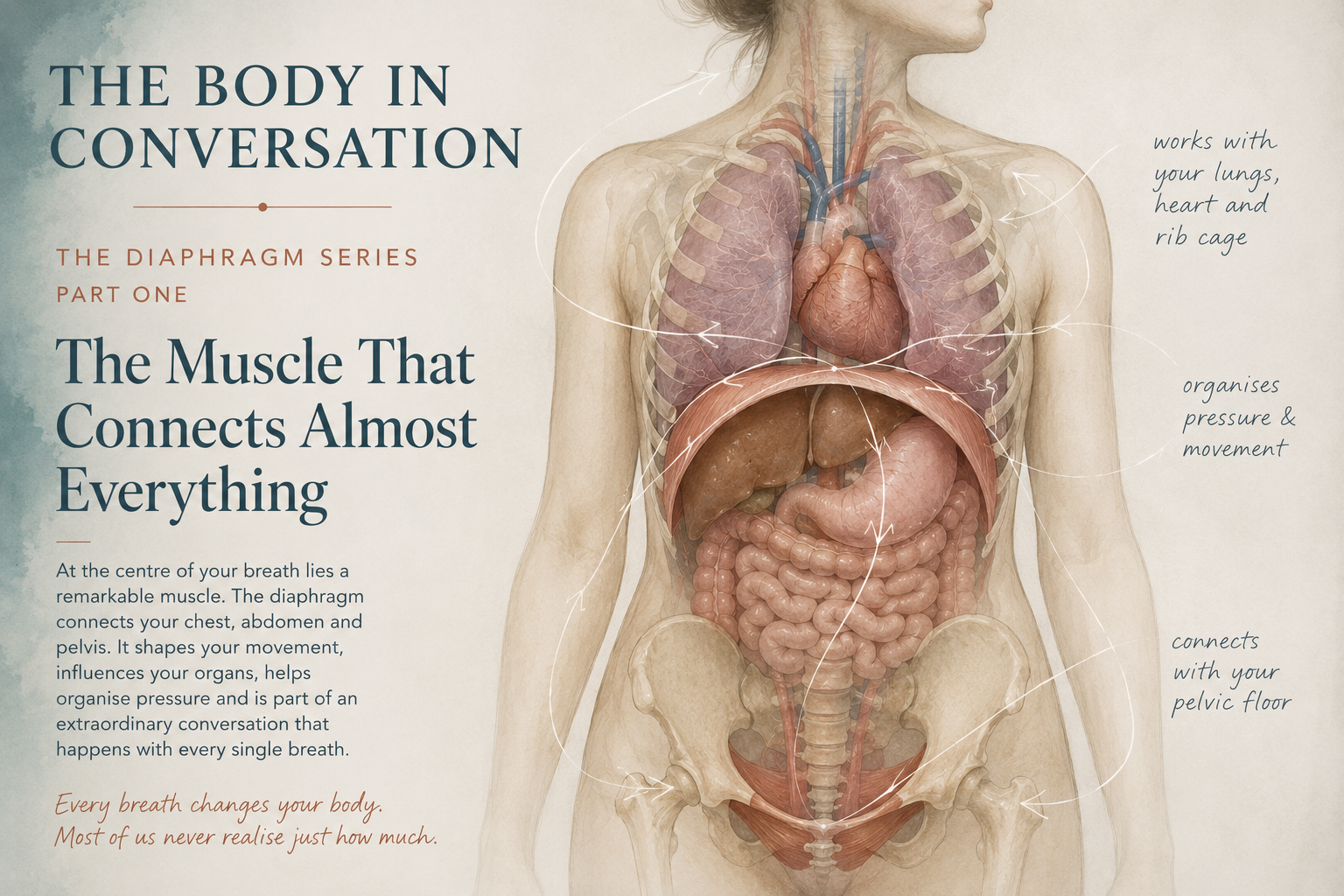
Each inhalation moves far more than simply air. As your diaphragm contracts and changes shape, your heart moves with it, your liver and stomach shift, pressure changes through your chest and abdomen, As your diaphragm contracts and changes shape, your lower ribs widen and the rib cage expands in three dimensions. Your abdominal contents redistribute, your abdominal wall and pelvic floor adapt, and pressure changes through the chest and abdomen. All of this happens together, with every breath. Those changing pressures also contribute to venous return and lymphatic flow. Your abdominal wall responds, your spine adapts and your pelvic floor joins in with the conversation. All of this happens while you walk, laugh, talk, sing, run, lift a child, climb a hill or simply sit reading this.
I think that is pretty fantastic. Sometimes when I pause (I do pause sometimes!) and take a moment and think about it it is almost too amazing, too extraordinary and yet it happens autonomically within us.
Most of us grow up thinking that breathing is mainly about oxygen. We breathe in and oxygen enters the lungs. We breathe out and carbon dioxide leaves. That is, of course, true, but it is only one part of a much bigger and far more interesting story.
Every breath is an amazing act of coordination, and sitting right in the middle of it is a relatively thin, dome-shaped muscle called the Thoracic diaphragm.
Most anatomy books describe the diaphragm as the primary muscle of inspiration. Again, this is absolutely correct, but it is also a massive understatement of what this amazing muscle is doing all day, every day.
More Than a Breathing Muscle
The diaphragm is a respiratory muscle, but it also contributes to posture, movement, pressure regulation and spinal control and support. It plays an important role in voice and phonation, assists the pressure changes that support circulation and lymphatic flow, and forms a major moving boundary between the chest and the abdomen.
Anatomically, it connects to your ribs, your sternum and your lumbar spine. It works alongside your abdominal wall and coordinates with your pelvic floor. It has wonderfully close relationships with your heart, lungs, oesophagus, liver, stomach and some of the largest blood vessels in your body.
Every time the diaphragm contracts, those relationships change. Some structures move. Some change shape. Pressures alter. Muscles respond. The nervous system adapts.
The diaphragm is never working in isolation. It is part of an ongoing conversation with the rest of your body.
For me, this is where anatomy becomes magic. Not magic in the supernatural sense, but that feeling of awe you get when you begin to understand just how brilliantly the human body is put together.
A Different Way of Looking at Anatomy
One of the problems I have with the way we sometimes learn anatomy is that everything gets separated into individual pieces. We learn the lungs, then the heart, then the spine, then the abdominal muscles and eventually the pelvic floor. We can end up knowing lots of names, attachments and actions without fully appreciating how those structures work together in an actual moving, breathing human being.
The body does not work in neat little chapters.
The diaphragm is a fantastic example of this because it sits right at the crossroads of so many of our body systems. It is involved in respiration, movement, posture, circulation, digestion, voice, pressure regulation and balance. Its behaviour also changes according to what the nervous system needs from us at any particular moment.
Once you start to understand the diaphragm, you begin to see why looking at the body as a collection of separate parts can only take us so far.
The really interesting stuff happens in the relationships between those parts.
That is where this series is going. I did try writing this as one blog post but it was clear it was growing arms and legs so series it is.
The Great Coordinator
Imagine describing the conductor of an orchestra as simply the person who waves a stick.
It would technically be correct, but it would completely miss the point.
The conductor is not individually producing the music. They are helping to organise timing, rhythm, balance and communication between all the different parts of the orchestra.
I think the diaphragm gives us a useful way to think about something similar within the body. I do not mean that the diaphragm is the director directing every other structure, because the body does not work like that either. Instead, it is one important participant in a fantastic system of coordination.
The diaphragm does not create movement on its own. It contributes to the organisation of movement alongside the rest of the body. It does not control intra-abdominal pressure by itself. It participates in the way pressure is created, distributed and reorganised. It does not stabilise the spine on its own either. It works alongside the abdominal wall, pelvic floor, spinal muscles, rib cage and nervous system to help us meet the demands of whatever we are doing.
Walking asks something of it. Running asks something different. Talking, singing, lifting, laughing, coughing and sneezing all create different demands again.
That is what I find so awe inspiring about the diaphragm. It does not have one fixed job or one perfect way of working. It adapts to the world and us.
Why I Wanted to Write This Series
I have spent years teaching Hypopressives, breathing, movement and pelvic health, and I keep finding myself coming back to the diaphragm. And this was true of this week as I prepared to coach more trainers this weekend too.
Every time I teach the pelvic floor, there it is.
When we talk about posture, it appears again.
When we explore pressure, ribs, the abdominal wall, movement or the spine, somehow we end up back at the diaphragm.
The more I have studied it, taught it and watched bodies move, the more fascinated I have become by it. Not because I think the diaphragm explains everything. It absolutely does not. I am wary of any approach that tries to explain the whole human body through one muscle, one nerve or one system.
What fascinates me is how many conversations the diaphragm is involved in.
That curiosity is what has led to this series.
Over the next twelve weeks, we are going to take the diaphragm apart and put it back together again. We will explore its anatomy and its relationship with the heart, spine, ribs, oesophagus, abdominal organs, nervous system and pelvic floor. We will look at pressure, posture, movement, lymphatic flow, circulation and voice.
We will also explore some of the things I see and play with in my own teaching, including what happens when we change the jaw, tongue, throat, eyes, hands and feet. Where the research is strong, I will tell you. Where the science is still developing, I will tell you that too. And where something comes from my own observations as a teacher rather than established research, I will make that clear.
Because I think curiosity and evidence can happily live in the same space, around the same kitchen table.
In fact, that is where some of the most interesting conversations begin.
This Is Where Our Journey Begins
By the end of this series, I hope you will never think about breathing in quite the same way again.
Not because breathing is magic, and certainly not because the diaphragm somehow does everything, but because understanding this one remarkable muscle gives us a fantastic window into how the whole body works.
The diaphragm reminds us that anatomy is not simply about learning names, origins, insertions and actions. Those things matter, but they are the starting point.
The really amazing bit is understanding the relationships.
Bones, muscles, fascia, nerves, organs, pressure and movement are having conversations all the time. The diaphragm is right in the middle of many of them.
Every breath is part of that conversation.
And this is where ours begins.
Coming Next: Part Two
An Extraordinary Piece of Engineering
Next week we are going inside the diaphragm itself. We will explore its domes, muscular fibres and central tendon, why that central tendon does not attach to bone, and the fantastic relationship between the diaphragm and the heart that means the two have been moving together with every breath you have ever taken.
And trust me, this is where the anatomy starts getting really interesting. And I promise not to get too nerdy!
Explore Your Own Diaphragm
1. Hands Around the Lower Ribs: Feel the 360° Breath
Sit comfortably or lie in semi-supine with your knees bent. Place your hands around the lower ribs, with your thumbs reaching towards your back and your fingers resting around the sides and front of your rib cage.
Take a comfortable breath in through your nose. Rather than deliberately pushing your tummy out or trying to take a huge breath, notice what happens underneath your hands.
Can you feel the ribs widen into your hands at the sides? Can you sense movement towards your back as well as the front? Do both sides feel similar, or does one side seem to move more easily?
Breathe out naturally and notice the ribs returning.
Try five or six breaths without forcing anything.
Then move your hands around to different areas of the lower rib cage and explore again.
The interesting bit: You are not trying to create a “perfect” breath. You are mapping the movement you already have.
Ask yourself: Where does my breath move easily, and where is there less movement?
2. Change Your Position and See What Happens
This one is super simple but perfect for demonstrating that the diaphragm does not have one fixed way of working.
Start sitting upright and take three comfortable breaths. Notice where you feel movement.
Then gently round your upper back and take another three breaths.
Come back to upright, then gently rotate your body to the right and take three breaths. Repeat to the left.
Finally, if comfortable, come onto all fours and take another three breaths.
Do not try to breathe “better”. Just observe.
You may notice that different parts of your rib cage become easier or harder to expand depending on your position. You may feel more movement in your back in one position, more lateral rib movement in another, or differences between your right and left sides.
That is the amazing bit.
Your diaphragm has not forgotten how to breathe. You have simply changed the mechanical environment in which it is working.
There is nothing to achieve here. Be curious. Move, breathe and notice what changes. Your body will give you far more information when you explore it than when you try to force it into a “perfect” breathing pattern.
Sources
Hodges PW, Gandevia SC. Changes in intra-abdominal pressure during postural and respiratory activation of the human diaphragm. This is a strong source for the diaphragm’s role in respiration, trunk control and intra-abdominal pressure.
Kolar P et al.S tabilizing function of the diaphragm: dynamic MRI and synchronized spirometric assessment. Useful for the diaphragm’s dual ventilatory and postural role.
Further Reading
Bordoni B, Zanier E. Anatomic connections of the diaphragm: influence of respiration on the body system. A broader review of the diaphragm’s anatomy and its relationships with surrounding structures.
Bains KNS et al. Anatomy, Thorax: Diaphragm. StatPearls. A clear anatomical overview of the diaphragm, its attachments, shape and major openings.