How to Relax Pelvic Floor Muscles Safely and Effectively
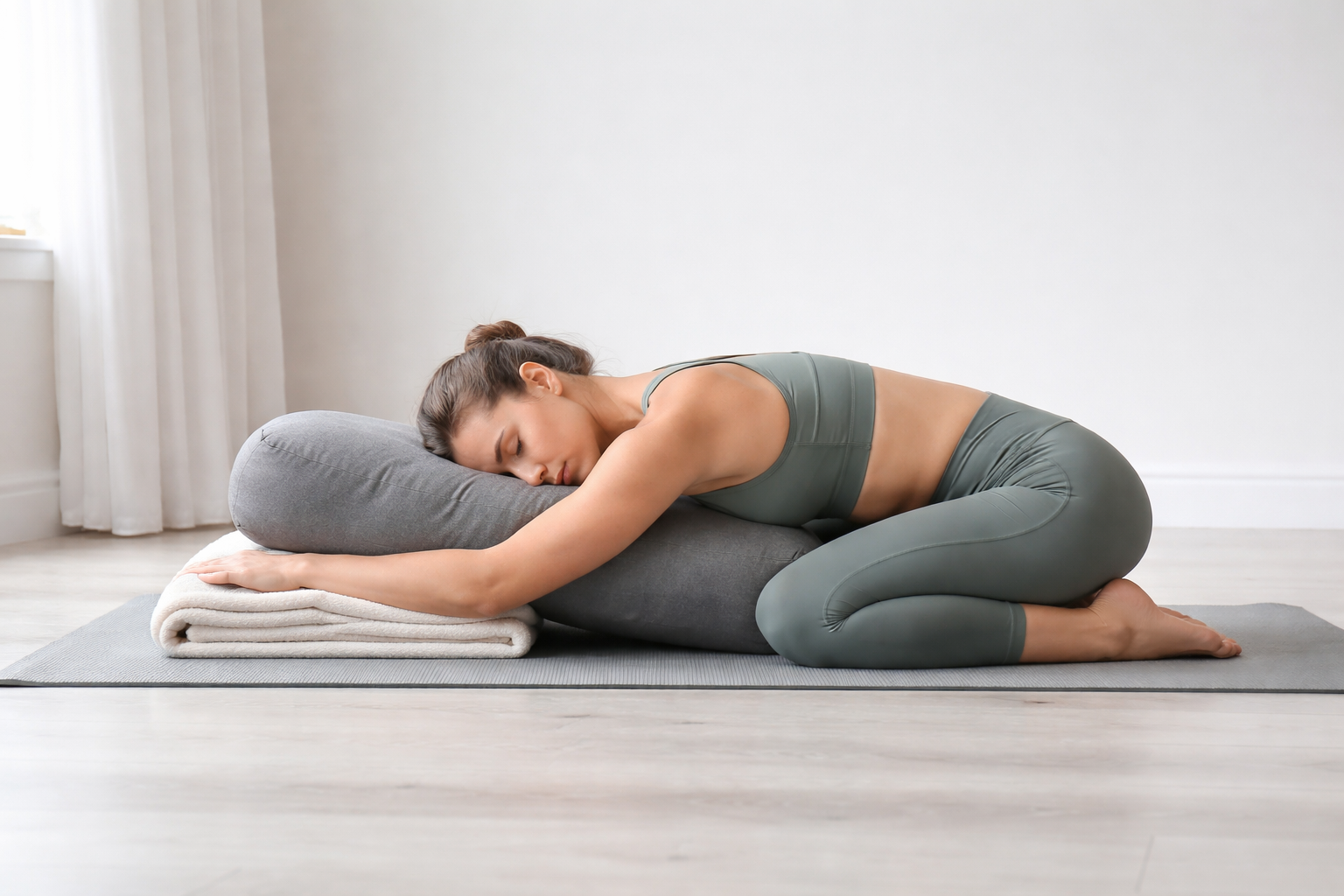
Woman demonstrating supported child’s pose with a bolster to help relax pelvic floor muscles and reduce pelvic tension.
Why constant tightening can worsen pelvic pain, and how to restore balance through breath and decompression
For many women, the first piece of pelvic health advice they ever hear or find via internet searches is simple.
“Do your Kegels.”
The intention is good because strength really does matter, but strength alone is not the whole story.
In reality, many pelvic floor symptoms are not caused by weakness at all. They are actually caused by too much tension.
If the muscles of the pelvis are constantly bracing, gripping, or shortening, the system loses its ability to move freely. Pain, pressure and dysfunction can and often do follow.
Learning how to relax pelvic floor muscles is therefore not a sign of weakness. It is often the first step toward restoring healthy function.
A well-functioning pelvic floor must be able to contract, lengthen, and respond reflexively to both movement and breath.
When we learn to release only then we can strengthen safely. We cannot tone and strengthen a muscle that is tight.
Understanding How to Relax Pelvic Floor Muscles
If you have been searching for ways to relax pelvic floor muscles, you are not alone. Many women experiencing pelvic pain, urgency or pressure are actually dealing with muscles that are working too hard rather than too little.
When the pelvic floor remains tense for long periods, coordination between breathing, movement and the pelvic organs can be disrupted. Learning how to relax the pelvic floor muscles safely is therefore an important step toward restoring healthy function and reducing symptoms linked to a hypertonic or overactive pelvic floor.
What Is a Hypertonic Pelvic Floor?
A hypertonic pelvic floor means the muscles are held in a chronically shortened or tense position in a state of chronic overactivity.
Imagine holding your bicep in a half curl all day. Have you got that visual?
At first it might feel strong. But over time it becomes tired, painful and less coordinated because it never gets the chance to fully lengthen.
The pelvic floor behaves in a very similar way.
When these muscles remain in constant contraction they can become:
fatigued
sensitive
poorly coordinated
Instead of providing support and control, they begin to interfere with normal pelvic function.
Common symptoms of a hypertonic pelvic floor include:
Pelvic pain or aching
Difficulty emptying the bladder or bowels
Pain during intimacy
Persistent urgency
A feeling of heaviness, tightness in the pelvis or like there is a tampon stuck.
For many active women the sensation is described as feeling permanently braced.
7 Signs Your Pelvic Floor Might Be Too Tight
Many women assume pelvic floor problems always mean weakness. In reality, a pelvic floor that cannot relax can create just as many symptoms.
Possible signs include:
1. Pelvic pain or deep aching
Chronic muscle tension can reduce circulation and increase sensitivity within the pelvis.
2. Pain during intimacy
A hypertonic pelvic floor may make penetration uncomfortable or painful because the muscles struggle to lengthen.
3. Difficulty emptying the bladder
Muscles that cannot relax properly may interrupt normal urine flow.
4. Constipation or incomplete bowel movements
If the pelvic floor cannot release fully, it may obstruct bowel emptying. See my blog post on this!
5. Persistent urinary urgency
Tight muscles can irritate surrounding nerves and create a constant feeling of needing to go.
6. Tailbone or hip tension
The pelvic floor works closely with the deep hip muscles, so tightness often spreads to surrounding structures.
7. Feeling “always switched on”
Many women describe a sense of subconscious bracing through the abdomen, hips and pelvis.
These signs often point toward a hypertonic pelvic floor, where relaxation is just as important as strength.
Why You Should Stop Doing Kegels (For Now)
If the pelvic floor is already tight, adding more contraction can increase symptoms.
Kegels involve voluntarily tightening the pelvic floor muscles. But contracting a muscle that is already shortened is like tightening a knot. This is why some women experience worsening symptoms after starting strengthening exercises.
Pain may increase, urgency may worsen, emptying the bladder may become more difficult. Before strength can be developed in your pelvic floor, the muscle needs length and elasticity.
This principle is often described as strength through length.
When the pelvic floor can fully relax between contractions, it regains the ability to respond naturally to movement and breath.
For women with symptoms of a hypertonic pelvic floor, the first step is usually learning how to relax pelvic floor muscles safely.
The Nervous System Connection
Pelvic floor tension is not only mechanical, it is not just about muscles, ligaments, tendons and bones. It is also strongly influenced by the nervous system.
When the body perceives stress or threat, the fight-or-flight response increases muscular guarding. The abdomen, hips and pelvic floor often become part of this protective bracing pattern.
Over time this can become subconscious, many women are not aware they are gripping their pelvis throughout the day.
Breathing patterns play a major role here, we can use breath to start hacking into our learnt tension patterns that are not serving us in a positive way at all, and make real change from the inside out!
The diaphragm and pelvic floor move together as part of the body’s pressure system. When breathing becomes shallow or held high in the chest, this coordination is disrupted.
Slow, expansive breathing helps relax pelvic floor muscles by allowing the diaphragm to descend and the pelvic floor to lengthen naturally.
Through this process the nervous system gradually shifts away from protective tension toward regulation. It really can be as easy as that.
Safe Techniques to Down-Train the Pelvic Floor
When pelvic tension is present, the goal is not to force the muscles to relax. Instead, we create conditions where relaxation can occur naturally.
Diaphragmatic Breathing
Breathing that expands the rib cage, abdomen, pelvis and pelvic floor, helps to restore the natural movement relationship between the diaphragm and pelvic floor.
During an inhale, the diaphragm descends and the pelvic floor gently lengthens.Then during an exhale, the tissues recoil together and follow the diaphragm upward.
The aim is soft expansion throughout the body, not pushing the abdomen outward.
Postural Release Positions
Certain body positions reduce pressure on the pelvis and allow tissues to lengthen.
Examples include:
Supported child’s pose
Gentle forward leaning positions
Relaxed squat variations where appropriate
Comfort and ease are more important than stretching deeply. These positions help the body relax pelvic floor muscles naturally.
The Hypopressive Method for Muscle Length
One of the most effective ways to address a hypertonic pelvic floor is through Hypopressive techniques. Hypopressives work differently from traditional strengthening exercises.
Instead of increasing pressure downward into the pelvis, they create a temporary reduction in internal pelvic pressure.
During the breath hold and rib expansion phase, a gentle vacuum effect occurs within the abdominal cavity. This produces an upward lift through the pelvic organs and connective tissues.
The result is a passive lengthening of the pelvic floor.
Rather than forcing the muscles to relax, the body experiences a moment of decompression that helps reset muscular tone and coordination.
Learn the Foundations of Hypopressives
If you would like to explore these techniques in a safe and structured way, my Beginner Hypopressives Course (£29.95)teaches the foundations step by step.
Inside the course you will learn:
• how to release tension through gentle diaphragm and fascial preparation
• how to coordinate breath and rib expansion without pushing pressure downward
• how to safely begin the Hypopressive apnoea
• how to create space through the pelvic floor and abdominal system
This course is designed for women who want to relax pelvic floor muscles safely while rebuilding natural support from the inside out.
👉 Explore the Beginner Hypopressives Course
Why Specialist Guidance Matters
Relaxation can sound simple, but it is often difficult for women who have spent years subconsciously bracing their bodies.
Incorrect breathing techniques or poorly guided exercises can sometimes increase pressure rather than reduce it. This is why individual assessment can be valuable.
Not Sure If Your Pelvic Floor Is Tight or Weak?
Many women are unsure whether their symptoms are caused by weakness, tension, or poor pressure management.
This is exactly why I created the Pelvic Floor MOT.
During this specialist review we assess:
• breathing patterns
• rib cage movement
• pelvic floor coordination
• pressure management during everyday movement
Rather than guessing exercises, we identify what your body actually needs.
Restoring Balance in the Pelvic Floor
True pelvic health is not about squeezing harder. It is about restoring balance between support and release.
When tension reduces, circulation improves. When muscles regain length, coordination returns. When pressure is managed well, the pelvic floor can respond naturally to movement.
Learning how to relax pelvic floor muscles is not the opposite of strength. It is the foundation that makes strength possible.
FAQ
Can a tight pelvic floor cause constipation?
Yes. If the muscles cannot relax properly, they may obstruct bowel emptying.
How do I know if I have a hypertonic pelvic floor?
Symptoms often include pelvic pain, urgency, difficulty emptying the bladder, or pain during intimacy.
Will relaxing my pelvic floor make me leak?
No. Relaxation improves coordination, which often improves long-term control.
How long does it take to release pelvic tension?
Some people notice changes quickly once breathing and pressure patterns improve. Long-standing patterns usually require consistent practice.
Can Hypopressives help with pelvic pain?
Many women report reduced discomfort due to improved circulation and pressure management.