Hypopressives Are Not About “Reducing Pressure”
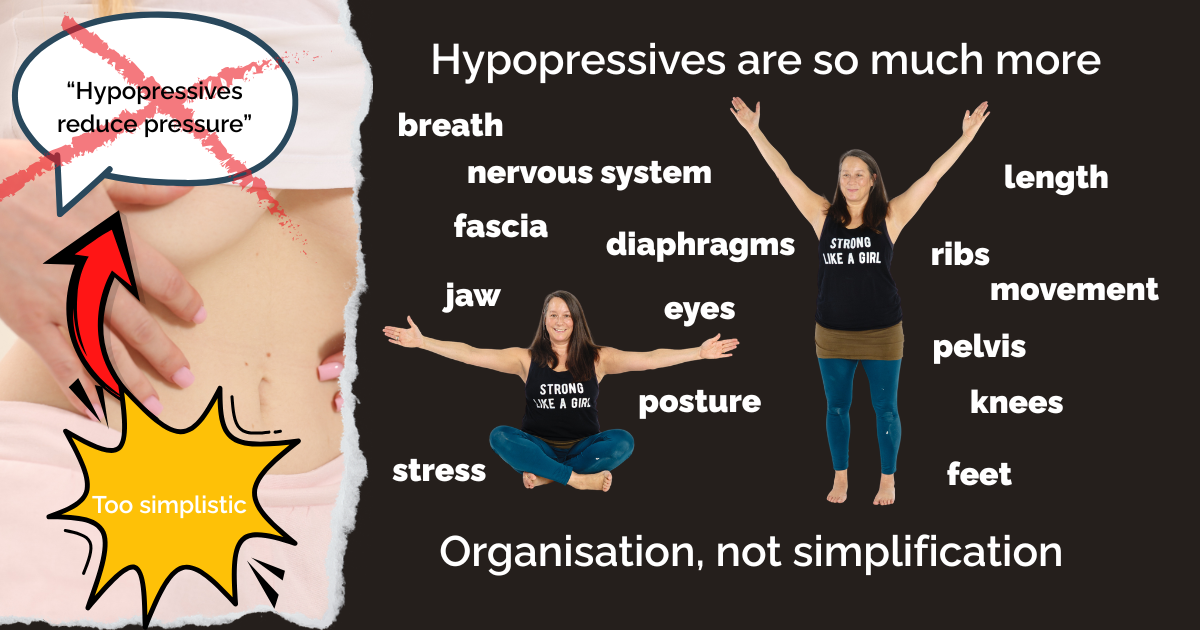
A whole-body view of Hypopressives: beyond the outdated idea of simply reducing pressure.
Why that old idea is too small, too simplistic, and no longer enough
For years, Hypopressives have been explained by many trainers with one neat little sentence:
“They reduce intra-abdominal pressure.”
It is tidy.
It is catchy.
It is easy for social media.
And it is now finally being exposed as far too reductionist.
That matters, because when a method as layered as Hypopressives gets squeezed down into one mechanical soundbite, we lose the very thing that makes it valuable. We stop seeing the person, we stop seeing the system, and we go and start treating pelvic floor symptoms the same way traditional Kegels often have: as if one body part, one action, or one pressure variable can explain everything. Recent research is making that simplification harder to defend. Thank you UNIVERSE!
The newer study that challenges the old story
A recent observational cohort study presented at the 2024 International Continence Society looked directly at the question many of us have been asking for years: does a hypopressive manoeuvre actually create a significant transient reduction in intra-abdominal pressure? In this study of 36 healthy women who were new to Hypopressives, the answer was no significant change in intra-abdominal pressure, either in supine or standing, even though the pelvic floor muscles did become active during the exercise (which is the news I would have expected. The levator ani activation was around 44–50% of maximum voluntary contraction, and the external anal sphincter also showed activation, this is huge news!! But the pressure-drop theory itself was not supported by the data. The authors state this clearly: the original Caufriez theory was not supported in their sample.
That is a very important finding.
Not because it “disproves” Hypopressives. But because it challenges the old explanation of why they may work.
The same study also found that the specific “hypopressive posture” used did not enhance pressure reduction or pelvic floor activation, and body position did not significantly alter those outcomes either. In other words, the simplistic narrative that posture + apnoea = pressure drop = reflex lift does not hold up neatly under measurement. But that was never the intention of the postures, the intention of the postures has always been to help us and our clients to re-organise their/our bodies to help unravel old set posture habits that were and are no longer serving the body we are in.
So does that mean Hypopressives do nothing?
No. Not at all.
That same body of research does not say Hypopressives are useless. In fact, several controlled trials have shown improvements in pelvic floor strength, symptom scores, load absorption, muscle efficiency, and urinary incontinence after structured hypopressive training programmes. A 2023 randomized controlled trial found that 8 weeks of supervised hypopressive exercise improved pelvic floor muscle strength and reduced urinary incontinence symptoms compared with a no-intervention control.
A 2025 assessor-blinded randomised controlled trial also reported significant improvements after 8 weeks of abdominal hypopressive technique, including gains in maximal voluntary contraction, load absorption, and muscle efficiency, with high adherence and no adverse events recorded.
So the honest interpretation is not:
“Hypopressives don’t work.”
It is more like:
“The old explanation of how they work is probably incomplete.”
And that is a very different thing.
This is where the conversation needs to grow up
The problem is not that the research is questioning one mechanism.
The problem is that so many people built the entire understanding of Hypopressives on that one mechanism, the apnoea.
That is the reductionist trap.
It is the same trap pelvic health has fallen into for years with Kegels:
symptom appears
pelvic floor is blamed
muscle is targeted in isolation
one action is prescribed
broader pattern is ignored
That approach can help some people, of course. But it can also miss the whole picture. And the whole picture matters.
A 2024 systematic review of randomised trials found positive results for Hypopressives in pelvic floor strength, tone, and symptom reduction, but also concluded that the evidence is still preliminary, methodologically inconsistent, and not yet strong enough to support reliable indication as a stand-alone pelvic floor treatment. It also found that when Hypopressives were combined with pelvic floor muscle training, additional benefit was not consistently demonstrated.
A 2025 systematic review looking at the broader “core complex” reported possible benefits at the pelvic floor, transversus abdominis, lumbar region, and diaphragm, but again highlighted that most of the literature carries a high risk of bias and that better research is still needed.
So yes, there is promise.
Yes, there are positive outcomes.
But no, we cannot keep pretending the mechanism is fully understood.
Why the premise is wrong in the first place
Here is the deeper issue for me.
Even the question “Do Hypopressives reduce pressure?” is too narrow.
Why?
Because pressure is not one simple thing, and neither is the body receiving it.
Two people can perform what looks like the same apnoea and create a completely different internal experience. Which is why for years I have been coaching to not focus on what my clients see on the internet but how it feels inside their own body. Because …
One may generate a large visible rib expansion and a dramatic abdominal vacuum.
Another may create a subtler response.
One may have a stiff rib cage.
Another may have an old abdominal scar.
One may have a history of breath-holding, bracing, and jaw tension.
Another may have hypermobility and poor force transfer.
One may have a beautifully mobile thorax but a guarded pelvic outlet.
Another may have years of hip gripping, glute clenching, or a nervous system that has lived in protection for decades.
To imagine that all of those bodies will organise pressure in the same way is bio-mechanically naïve at best.
The newer ICS study itself only examined women naïve to Hypopressives after a brief learning period, and the authors explicitly note that the underlying mechanism of pelvic floor activation remains unclear. They suggest the activation seen may relate to abdominal–pelvic floor co-contraction rather than a measurable drop in intra-abdominal pressure.
That fits clinical reality far better.
Because bodies do not behave like identical balloons, they behave like lived-in systems.
Pressure is not the enemy
This is another part that gets missed all the time, and it is another full on bug bear for me.
Intra-abdominal pressure is not bad.
It is not some toxic force we must get rid of.
In fact, intra-abdominal pressure contributes to spinal stiffness and trunk stability. Classic bio-mechanical work has shown that raised intra-abdominal pressure can increase lumbar spine stability and trunk stiffness, which is one reason the body uses it during lifting and other demanding tasks.
So the aim cannot simply be to “reduce pressure.”
The real question is:
How is pressure being organised, transmitted, timed, and tolerated in this body?
That is a far more useful clinical question.
Because symptoms often do not arise just because pressure exists. They arise when the system cannot distribute, adapt to, or coordinate it well. And this is what we as specialists need to be able to see in our clients and also help our clients to be able to see in themselves, because without awareness there can be no change.
Hypopressives, at their best, are not a pressure trick
This is where I think Hypopressives have always and still matter enormously.
Not as a gimmick, that gets more ‘likes’ on social media.
Not as a vacuum.
Not as a social media rib flare challenge.
But as a method that asks us to look at the whole individual.
At their best, Hypopressives ask:
What is this person’s posture doing all day?
Where do they grip?
Where do they collapse?
How do they breathe?
What does their rib cage do?
Can their abdomen respond or is it fixed?
What does their nervous system do under load?
What old injury still lives in their movement?
What compensation became normal years ago?
What happened in birth, surgery, menopause, sport, stress, grief, or trauma that tipped the balance?
That is not reductionist thinking or teaching. That is clinical reasoning and it is this that is of the most benefit to anyone with pelvic floor issues
And that is why I do not see Hypopressives as “reducing IAP” and I never have.
I see them as a way of improving organisation.
The body remembers what it has lived through
This is where the newer understanding of fascia matters.
Fascial science has moved well beyond the idea of fascia as inert wrapping. Recent reviews describe fascia as a mechanosensitive, biologically active tissue involved in extracellular matrix remodelling, force transmission, repair, inflammation, and scar formation. It is increasingly viewed not as passive packaging, but as part of a responsive whole-body system.
That matters because a body with old scars, old falls, repetitive loading histories, long-standing asymmetries, pain, fear, or chronic guarding is not mechanically neutral.
Maybe you fell off your pony when you were 9.
Maybe you had a bike accident.
Maybe you twisted repeatedly at work for years.
Maybe you learnt to clench your jaw, hold your tummy, tuck your pelvis, and push through stress.
Maybe your hip stopped moving well years before your pelvic floor symptoms ever appeared.
So many ‘maybes’
Then along came birth trauma. Or perimenopause. Or a hysterectomy. Or grief. Or a season of coughing. And suddenly the pelvic floor gets blamed as though it acted alone.
But often it did not.
Often the pelvic floor is the place where the pattern finally becomes visible.
That is very different from saying it is the place where the pattern began.
Symptoms are the end of the story, not always the start
This is one of the biggest shifts I want more women, more trainers, and frankly more clinicians to understand.
The pelvic floor is often where the last straw shows up.
Leaking.
Heaviness.
Urgency.
Pain.
Prolapse symptoms.
A dragging feeling.
A sense that something is “wrong down there.”
But the visible symptom is not the root problem.
Sometimes what failed was force transfer from the foot.
Sometimes it was a rib cage that never learned to expand well.
Sometimes it was years of hip tension.
Sometimes it was scar tissue.
Sometimes it was a braced abdomen.
Sometimes it was a nervous system that never truly felt safe enough to let go.
That is why symptom-chasing can be so misleading.
And that is why “just do Kegels” can be as reductionist as “just do the apnoea.”
Social media has grabbed the flashiest bit
Let’s be honest: social media loves one dramatic visual.
The rib cage opens.
The tummy hollows.
The breath is held.
Everyone gasps.
So the apnoea becomes the headline, and in our obsessed with soundbites online world the rest gets lost.
But the apnoea is not the whole method. It is one piece of a much bigger picture.
Without context, without posture, without breath awareness, without tissue variability, without release, without nervous system consideration, without understanding the person in front of you, it becomes just another technique copied from the outside in.
And that is exactly where misunderstanding happens.
Even trainers can fall into this. Because when a method is taught as a formula rather than as an inquiry, people start chasing shape instead of function.
What Hypopressives may be influencing instead
If the newer evidence tells us that the old “pressure reduction” story is too simple, then what might Hypopressives actually be affecting?
Based on the current literature, it is more reasonable to think in terms of a multi-factor response involving pelvic floor activation, abdominal–pelvic synergy, respiratory mechanics, posture, trunk coordination, and broader core behaviour, rather than one clean pressure-drop mechanism. The 2025 review on the CORE complex points in this direction, suggesting possible effects across the pelvic floor, abdominal wall, lumbar region, and diaphragm.
So instead of saying:
“Hypopressives reduce pressure,”
I would rather say:
“Hypopressives may help bodies reorganise pressure, posture, breath, timing, tension, and deep muscular coordination.”
That is less catchy.
But it is far more truthful.
This is why awareness matters
One of the most powerful things Hypopressives give people is not a vacuum.
It is awareness.
Awareness of how they stand.
Awareness of how they grip.
Awareness of how they hold breath under effort.
Awareness of where they are rigid.
Awareness of where they have no access at all.
Awareness of what changes when they soften the jaw, widen the ribs, release the feet, move the pelvis, or stop forcing.
And with awareness comes the possibility of change.
That is the bit social media cannot package neatly. But it is the bit that changes lives.
Where I think the profession needs to go next
We need more studies. Better studies. Longer-term studies. More diverse populations. Better standardisation. More exploration of mechanics, coordination, tissue behaviour, respiratory strategy, and individual response. The current reviews are very clear that evidence is promising but still limited and methodologically mixed.
But we also need something else.
We need to stop looking for one magic sentence to explain a complex method.
The future of pelvic health is not going to be built on smaller and smaller explanations.
It will be built on better and better integration.
My view
Hypopressives are not about “lowering pressure” in some simplistic universal way.
They are about helping a person reconnect with a system that has often been compensating for years.
They are about posture habits.
Tension patterns.
Breath.
Release.
Engagement.
Load.
Rhythm.
Nervous system state.
Movement history.
Scar history.
Injuries.
Menopause.
Birth.
Compensation.
Awareness.
And yes, the pelvic floor is part of that.
But it is not the whole story.
That is why I do not teach Hypopressives as a party trick.
And I do not teach them as a pressure hack.
I teach them as a way of seeing the person more clearly.
Because sometimes the pelvic floor did not “fail” on its own.
Sometimes it was simply the place where years of adaptation finally ran out of room.
If this article speaks to you, if you’ve felt as frustrated as I do by over-simplified messages and you know the body deserves more than one tiny explanation, then come and learn with us.
At IHC UK, we are building a richer understanding of Hypopressives. One that honours biomechanics, yes, but also fascia, lived history, nervous system state, posture habits, tension patterns and the individuality of every body in front of us.
You can train with me at Hypopressives Scotland, where I lead professional education as the UK’s only Senior Master Trainer, and you can also connect with our growing network of amazing Master Trainers- through Lucy at Bristol Hypopressives, Michelle at Get Inspired Coaching, Susie at Susannah White Yoga, alongside Emma at Life Acrobat and Françoise De Smet.
Because this work was never meant to be reduced to one breath hold. It was always meant to help us see the whole person.
Our next training courses are all on the website: Learn with us
References
Saraiva S, McLean L. Hypopressive exercises do not cause transient changes in intra-abdominal pressure in females: an observational cohort study. International Continence Society Abstract 213, 2024.
Katz CMS, Barbosa CP. Effects of hypopressive exercises on pelvic floor and abdominal muscles in adult women: A systematic review of randomized clinical trials. Journal of Bodywork and Movement Therapies. 2024;37:38–45.
Hernández-Lucas P, et al. Effects of Hypopressive Techniques on the CORE Complex: A Systematic Review. 2025.
López-Torres O, et al. Effects of an 8-Week Abdominal Hypopressive Technique Program on Pelvic Floor Muscle Contractility: An Assessor-Blinded Randomized Controlled Trial. Applied Sciences. 2025.
Molina-Torres G, et al. The effects of an 8-week hypopressive exercise training program on urinary incontinence and pelvic floor muscle activation: a randomized controlled trial. Neurourology and Urodynamics. 2023;42:500–509.
Cholewicki J, Juluru K, McGill SM. Intra-abdominal pressure mechanism for stabilizing the lumbar spine. Journal of Biomechanics. 1999.
Cholewicki J, Juluru K, Radebold A, Panjabi MM, McGill SM. Lumbar spine stability can be augmented with an abdominal belt and/or increased intra-abdominal pressure. European Spine Journal. 1999.
Pirri C, et al. Redefining Fascia: A Mechanobiological Hub and Stem Cell Reservoir in Regeneration—A Systematic Review. 2025.
Pirri C, et al. An Emerging Perspective on the Role of Fascia in Complex Regional Pain Syndrome: A Narrative Review. 2025.