Hypopressives Are Not Just Breathing: Why It’s Time to Rethink the “Internal Lift”
Hypopressives have often been described as a breathing method that creates a vacuum, lifts the pelvic organs and strengthens the pelvic floor.
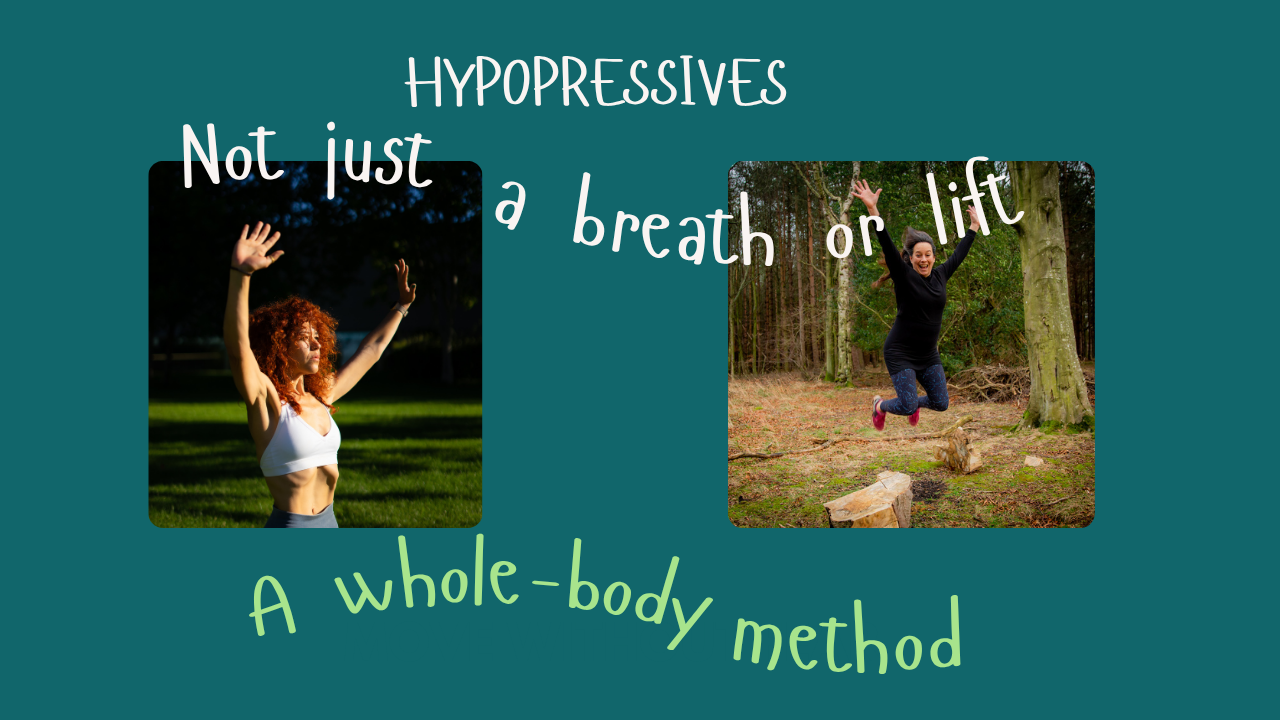
Old reductionist view of Hypopressive breathing and progressive version of hypopressives helping to create functional movement.
And I understand why that explanation has stuck around. I used to use it too, when I first started out over 12 years ago.
It is simple. It is visual. It gives people something to imagine. It gives teachers something easy to say and clients something easy to understand.
But I also think it is a bit reductionist.
Actually, I think it sells the method short.
Because Hypopressives are not just about sucking the belly in, I mean they are not even that, but that is what people think when they see the method on social media. They are not just about holding the breath. They are not just about creating a dramatic vacuum that pulls everything upwards and makes the pelvic floor magically behave.
They are so much more amazing than that. And the more I add to my own training, the more nuance and depth and potential I see in Hypopressives.
Hypopressives are a whole-body training method. They ask the body to reorganise. They invite the breath, ribs, diaphragm, abdominal wall, pelvic floor, spine, feet, jaw, fascia and nervous system into the same conversation.
And when those systems begin to communicate more clearly, something fantastic can happen.
The body may feel lighter. The spine may feel taller. The ribs may feel more open. The pelvic floor and pelvis may feel less heavy. The breath may feel less trapped. The pelvic floor may feel less like something you have to constantly control.
Sometimes clients do feel a lift.
But I do not think the most useful explanation is simply, “the apnoea pulls the organs up.”
I think the more honest, more useful and more hopeful explanation is this:
Hypopressives help the body reorganise pressure.
And when pressure is better organised, the tissues, organs, fascia and muscles can relate to each other differently.
That may create a feeling of lift. It may create more space. It may reduce heaviness. It may help symptoms settle. It may support the pelvic organs in a more responsive way.
But it is not just an upward pull.
It is a whole-system rebalancing.
A brief history of Hypopressives
The Hypopressive Method is usually traced back to Dr Marcel Caufriez, who began developing abdominal hypopressive techniques in the early 1980s. His work was particularly connected to postnatal recovery, uro-gynaecological rehabilitation and pelvic floor dysfunction. The original explanations often focused on reducing abdominal pressure, creating diaphragmatic suction, and encouraging a reflexive response through the pelvic floor and deep abdominal muscles. (ScienceDirect)
At the time, this was really important. Women were often being given exercises that increased pressure downwards into the pelvis, especially after birth. Caufriez began exploring a different approach. Instead of asking the body to brace, bear down or squeeze harder, the method looked at reducing pressure, improving abdominal tone and creating a more reflexive relationship between the pelvic floor, diaphragm and abdominal wall.
Later, the work evolved through different schools and teaching systems. Low Pressure Fitness, often associated with Piti Pinsach and Dr Tamara Rial, who were where my training began in Barcelona, helped bring Hypopressives into a wider fitness, postural and movement context. This helped the method move beyond a purely clinical or therapeutic setting and into a broader way of training the body.
And I think this evolution really matters.
Because the way we explain Hypopressives also needs to evolve.
At one point, the language was very focused on pressure reduction, abdominal suction and visceral lift. That made sense. It helped people understand that Hypopressives were different from traditional abdominal exercises and different from simply squeezing the pelvic floor.
But bodies are not just pulleys.
Organs are not simply dragged upwards.
And the pelvic floor is not healed by one single direction of movement. I mean it would make pelvic floor rehab much simpler if it were, but our body is actually way more complex and intelligent than that.
The body is living, responsive, intelligent and adaptable. It is constantly sensing, shifting, protecting, releasing and reorganising.
So when we reduce Hypopressives to “a vacuum that lifts your organs,” we lose the beauty of what is actually happening.
The old idea: apnoea creates visceral traction
One of the traditional explanations of Hypopressives is that when we exhale, hold the breath out, open the ribs and create the apnoea, the diaphragm lifts and creates a suction effect. This is often described as visceral traction, where the abdominal and pelvic organs are drawn upwards.
There may be some truth in this image.
During the apnoea, the rib cage changes shape. The diaphragm changes its relationship with the abdominal cavity. The abdominal wall responds. The pelvic floor may respond reflexively. The organs may shift within the abdominal and pelvic spaces.
So I am not saying that nothing happens internally.
Something absolutely does happen.
But the problem comes when we make that the whole story.
Because then people start chasing the lift.
They worry if they cannot feel anything dramatic. They think they are doing it wrong if their belly does not hollow beautifully. They compare their body to someone else’s body. They grip the abdomen, flare the ribs, clench the jaw or pull the belly in aggressively because they are trying to create the shape they think they are supposed to see.
And that is where the method can be misunderstood.
The point is not to force the body into a vacuum.
The point is to create the conditions where the body can reorganise itself.
That difference is huge.
It is not about forcing all the air out
This is another thing I think we need to talk about honestly.
Because what we often see online, and what people are sometimes taught, is that Hypopressives are basically this:
Exhale all your air. Hold your breath. Open your ribs. Create the vacuum.
Again, I understand why that explanation exists. It is simple. It sounds clear. It gives people steps to follow.
But it is not the whole method.
And if it is done aggressively, it can take people further away from what we are actually trying to create.
Hypopressives are not about blowing every last bit of air out of your body and then yanking your ribs open as hard as possible. That can very quickly become another form of bracing. It can create tension through the throat, jaw, abdomen and pelvic floor. It can make the nervous system feel under pressure. It can turn a beautiful, intelligent method into a performance.
And that is not what we want.
The exhale should feel natural. It should feel like the breath is leaving, not being forced out. There is a difference between completing an exhale and emptying yourself like you are trying to wring out a towel.
Then, after the exhale, the rib widening should be slow, steady and controlled.
Not dramatic. Not panicked. Not forced. And absolutely not rushed.
This is where the real intelligence of the method lives.
When we move slowly and steadily into the apnoea, we are not just creating a shape. We are giving the deep system time to respond. We are asking the ribs, diaphragm, abdominal wall and pelvic floor to organise gradually, rather than being dragged into a sudden, forceful action.
That matters because the pelvic floor and the deep abdominal system are not only about big, fast, obvious contractions.
They are also about endurance, tone, timing, support and subtle responsiveness.
The pelvic floor contains a high proportion of slow-twitch muscle fibres, which are designed for postural support, endurance and ongoing low-level activity. These fibres are not there simply to squeeze as hard as possible for a few seconds. They help create the background support that allows the pelvic organs, bladder, bowel, breath and movement system to work together throughout the day. Some papers describe the pelvic floor as having a predominance of slow-twitch fibres, with figures often cited around two-thirds or more depending on the muscle area studied. (PMC)
The transverse abdominis is also deeply involved in this postural, pressure-managing system. It is not meant to be gripped like a corset. It is meant to participate intelligently, adjusting with breath, posture, load and movement. Research has also explored the relationship between the pelvic floor, diaphragm and abdominal muscles in the maintenance of intra-abdominal pressure, which supports the idea that these structures work as a coordinated system rather than as isolated parts. (Nature)
So when we rush the exhale, force the rib opening or chase a dramatic vacuum, we can miss the very tissues we are trying to invite into better function.
Slow matters.
Steady matters.
Subtle matters.
And this is why I teach the apnoea as something we grow into, not something we attack.
The body needs time to feel what is happening. The nervous system needs to know it is safe. The ribs need to widen without flaring. The abdomen needs to respond without gripping. The pelvic floor needs the chance to organise without being bullied.
This is especially important for women who already live in a lot of tension.
If someone is anxious, braced, protective, prolapse-aware, pain-aware, trauma-aware or frightened of their symptoms, asking them to forcefully empty their breath and hold can sometimes make the body guard more.
We want the opposite.
We want the body to soften enough to respond.
We want the breath to become a doorway, not another stress.
We want the apnoea to feel like an invitation into space, not a fight for control.
That is why, for me, a good Hypopressive apnoea is not about how impressive it looks from the outside.
It is about what reorganises on the inside.
The ribs widen gradually. The spine lengthens quietly. The abdominal wall receives the change. The pelvic floor responds reflexively. The whole system begins to find a different kind of tone.
Not tension.
Tone.
And that difference is everything.
Hypopressives are often at their most powerful when they are not dramatic at all. They are powerful when they are slow enough for the body to listen, steady enough for the nervous system to trust, and gentle enough that we are not simply creating another bracing pattern.
So no, Hypopressives are not “exhale everything, hold and suck in.”
That is the internet version.
The real method is much more refined, much more intelligent and, honestly, much more amazing than that.
It is not just lift. It is pressure reorganisation.
When I teach Hypopressives, I am much more interested in pressure organisation than suction.
Your body is managing pressure all day long.
Every breath changes pressure. Every step changes pressure. Every cough, laugh, sneeze, lift, twist, reach and jump changes pressure. Even the way you sit, stand, hold your jaw, grip your toes or brace your stomach changes the way pressure moves through you.
Your diaphragm, pelvic floor, abdominal wall, ribs, spine, glutes, adductors, psoas, back extensors and feet are all involved in this conversation.
Pelvic floor symptoms often appear when the system is struggling to manage pressure well.
That may show up as leaking. It may show up as heaviness. It may feel like dragging, urgency, pain, constipation, a lack of sensation or the horrible feeling that your body is no longer as trustworthy as it used to be.
And I want to say this really clearly.
That does not mean your body is failing you.
It means your body is asking for better organisation, better support, better timing, better movement and often more safety.
This is where Hypopressives can be so underrated.
They do not just teach you how to hold your breath. They help you notice where your body is pushing pressure down, where it is gripping, where it is collapsing, where it is trying too hard, and where it has lost options.
They create more space through the ribs. They invite the diaphragm to move differently. They ask the abdominal wall to participate without bracing. They help the pelvic floor respond without being squeezed into obedience.
They give the whole system a chance to stop fighting itself.
And when pressure is better distributed, the pelvic organs may feel better supported. Not because we have simply hoovered them up, but because the whole container is working differently.
Hypopressives are not just “Hypopressive breathing”
This is one of my biggest bugbears.
People often call it “Hypopressive breathing.”
And yes, I know what they mean.
Breath is central. Breath is powerful. Breath is one of the most amazing and underrated tools we have for changing the nervous system, the pressure system and the way the body feels from the inside.
But Hypopressives are not just breathing.
Calling them “Hypopressive breathing” is a bit like calling Pilates “lying down” or strength training “picking things up.”
It is part of it, but it is not the whole method.
In a good Hypopressive practice, the whole body is involved.
We are looking at the ribs, the sternum and the diaphragm. We are looking at the transverse abdominis, obliques and rectus abdominis. We are looking at the pelvic floor, back extensors, psoas, adductors and glutes. We are looking at the thoracolumbar fascia and how force travels through the back body. We are looking at how the feet organise load and how the jaw may be holding tension that the pelvis is also trying to manage.
We are looking at posture, but not in a rigid, old-fashioned, “stand up straight” kind of way.
We are looking at living posture.
Posture that breathes. Posture that adapts. Posture that can absorb force. Posture that can organise pressure. Posture that gives the pelvic floor a chance to respond rather than constantly protect.
That is not just breathing.
That is training.
It may be quiet training. It may be subtle training. It may look less dramatic than lifting heavy weights or smashing yourself in a workout. There is a place for that too!
But subtle does not mean weak.
Sometimes subtle is where the real change begins.
The jaw, the feet and the pelvic floor
The pelvic floor does not live on its own little island. It is deeply connected to the rest of the body. This is why I always look beyond the pelvis.
The jaw matters. If someone is clenching their teeth, holding their tongue, gripping their throat or carrying tension through the face, that can tell us something about the whole system. Often, the body that grips at the jaw is also gripping somewhere else. The pelvic floor may be part of that same protective pattern. Emerging research has started to explore relationships between orofacial muscles, temporomandibular function and pelvic floor function, although this area is still developing and should not be overstated. (PMC)
The feet matter too.
Your feet are your first relationship with the ground. They sense, adapt, load, spring, stabilise and absorb force. They help your brain understand where you are in space. They help your pelvis know how to respond.
If the feet are rigid, collapsed, over-gripping or under-sensing, the effect does not stop at the ankle. It travels up through the knees, hips, pelvis and spine. The pelvic floor may then have to work harder, brace more, or respond to forces it was never meant to manage alone.
This is why I care about how someone stands.
I care whether they are gripping their toes. I care whether their weight is dumped into their heels. I care whether their feet can feel the floor. I care whether they can absorb force or whether everything feels locked, held and braced.
Because the pelvic floor has to respond to real life.
It has to respond when you walk, lift, carry shopping, climb stairs, run for the bus, pick up a child, laugh with your friends, cough, sneeze, dance, jump, garden and move through your day.
So if we only ever train the pelvic floor as an isolated squeeze, or only ever think about it during a breath hold, we miss the bigger picture.
Hypopressives give us a way to bring the pelvic floor back into the whole body.
And that is where the method becomes joyful.
Not because we are chasing perfection, but because we are giving the body more choices.
The pelvis needs movement, not just strength
A healthy pelvic floor does not need to be tight, it needs to be responsive.
It needs to know how to soften, lengthen, recoil, support, absorb, release and coordinate.
That requires movement.
The pelvis is not a fixed bowl. It is not a concrete structure. It is a living, responsive part of the body made of bones, joints, fascia, ligaments, muscles, nerves, blood vessels and sensory receptors.
When the pelvis becomes rigid, tucked, gripped, compressed or disconnected, the pelvic floor loses options.
Fascia needs glide and slide. Nerves need space. Receptors need movement. Muscles need timing. Organs need support without being squashed or pushed down. The whole system needs enough mobility to absorb force and enough stability to move you through the world.
This is why I do not just teach people to “do the apnoea.”
We mobilise the pelvis. We explore rocking, spiralling, shifting and sensing. We work with the spine. We work with the ribs. We bring attention to the feet, hips, shoulders and jaw. We look at how someone actually inhabits their body.
Because pelvic floor symptoms are rarely just about one weak muscle.
They are often about the whole system losing its ability to adapt.
And that is hopeful.
Because if the system has lost options, we can start giving options back.
The spine helps us bounce through life
Your spine is not just a stack of bones holding you upright.
It helps you absorb force. It helps you breathe. It protects and communicates with your nervous system. It helps organise pressure. It allows you to rotate, reach, bend, recoil and move through the world with rhythm.
A spine that can move well gives the body bounce.
A spine that has enough tone gives the body support.
But a spine that is too rigid may create bracing. A spine that is too collapsed may increase downward pressure. A spine that cannot rotate may ask the pelvis, hips or pelvic floor to compensate.
In Hypopressives, posture is not about becoming stiff or “perfect.”
Actually, I think chasing perfect posture is madness, what is that anyway?
What we are looking for is organisation and awareness.
We are asking whether the ribs can find a better relationship with the pelvis. We are asking whether the spine can lengthen without effort. We are asking whether the breath can move into the back and sides of the ribs. We are asking whether the pelvis can respond underneath us and whether the body can find lift without gripping.
That is a very different thing from forcing yourself upright.
It is less about holding yourself together and more about allowing the body to stack, spring and breathe.
Intermittent hypoxia: the cellular conversation
Intermittent hypoxia: the cellular conversation
One of the fascinating parts of Hypopressives is the use of apnoea, or breath suspension.
When we pause the breath after the exhale, we create a short, controlled change in oxygen availability. In wider physiology research, hypoxia and intermittent hypoxic exposure have been studied in relation to oxygen handling, cellular adaptation, HIF-1 signalling, mitochondrial function and metabolic response. However, the exact effects depend heavily on dose, health status, duration, method and individual tolerance.
So let’s make that a little bit less nerdy...
When oxygen levels change, even briefly, the body notices.
It does not mean the body is being harmed. It means the body is receiving a small signal that says, “Something has changed. How do we respond?”
In the right context, and with the right person, short and well-managed breath pauses may act as a kind of training stimulus. Not a punishment. Not a test of willpower. More like a gentle nudge to the body’s oxygen-handling systems.
This is where the science becomes really interesting. Hypoxia-related pathways, including HIF-1 signalling, are involved in how cells respond when oxygen availability changes. They can influence how the body manages energy, mitochondria, blood vessel responses and adaptation.
But, and this is important, that does not mean we can say, “Hypopressives heal your cells.”
That may be too much.
What we can say is that the apnoea reminds us that Hypopressives are not only mechanical. They are not just about ribs, posture, abdominal tone and pelvic floor response. They also create a physiological conversation inside the body.
The body is chemical.
It is electrical.
It is neurological.
It is emotional.
It is metabolic.
It is responsive.
So when we use breath, apnoea, posture and awareness carefully, we are not just asking muscles to work. We are asking the body to regulate, adapt and listen.
And this is why dose matters so much.
More is not automatically better. Longer breath holds are not automatically more advanced. A dramatic apnoea is not the goal.
The goal is a breath pause that the body can meet without panic, gripping or strain.
For one person, that may be a few seconds. For another, it may be longer. For another, it may not be appropriate at all, at least not yet.
That is why apnoea should always be adapted around the person in front of us. Pregnancy, cardiovascular conditions, unmanaged blood pressure issues, dizziness, active illness, anxiety around breath holding, trauma history, neurological conditions, cancer treatment or any medical concern may change how we approach it.
The magic is not in pushing.
The magic is in listening
The nervous system: the body will not release if it does not feel safe
This is where Hypopressives become really powerful.
Because pelvic floor symptoms are not always caused by physical injury alone.
Sometimes symptoms begin after birth, surgery, menopause, constipation, coughing, impact, sport, lifting or scar tissue.
But often, there is more in the story.
There may be grief. There may be loss, fear, pain, or shame. There may be years of holding everything together. There may be a lack of support. There may be a body that has been quietly bracing for a very long time.
The pelvic floor is deeply connected to survival.
It guards. It protects. It reacts. It responds to pressure from above and emotion from within.
So when we work with pelvic floor symptoms, we cannot only ask, “Is it weak?”
That is too reductionist.
We also need to ask whether it is overworking. Whether it is guarding. Whether it is bracing. Whether it is disconnected. Whether it is exhausted. Whether it is being asked to do the job of the breath, the glutes, the feet, the spine, the jaw and the nervous system.
Research and clinical guidance around pelvic pain and overactive pelvic floor conditions increasingly recognises the relationship between pelvic symptoms, pain systems, stress, anxiety, sympathetic nervous system activity and muscle guarding. This does not mean symptoms are “all in your head.” It means the nervous system and pelvic floor are in constant conversation. (PMC)
This is why I care so much about working from a space of balance.
Not fight. Not flight. Not freeze. Not collapse.
Balance.
When the nervous system has more safety, the body has more options.
The breath changes. The tone changes. The pelvic floor changes. The jaw changes. The spine changes. The whole person changes.
And no, this does not mean we can breathe away every problem. I wish
But it does mean we need to stop treating the pelvic floor as if it is separate from the woman living inside the body.
Fear changes the body
This is something I see all the time.
A woman leaks, and fear appears.
Fear creates tension.
Tension changes the breath.
The breath changes pressure.
Pressure increases symptoms.
Symptoms create more fear.
And suddenly, she is living inside a loop.
This is why I think hope is so important.
Not false hope. Not fluffy hope. Not “do this one thing and everything will be fixed” hope.
Real hope.
The kind of hope that says, “Your body is not f+++ed. It is responding. And if it can respond this way, it can learn to respond differently.”
Hypopressives can help interrupt the fear loop.
They can give the body a different experience.
A feeling of space. A feeling of height. A feeling of connection. A feeling of breath moving again. A feeling that the pelvic floor does not have to grip for dear life. A feeling that movement might actually be safe and the very best option.
And for many women, that is the beginning of trust.
Symptom reduction is not always about more strength
Of course strength matters.
I love strength.
Sometimes women absolutely need strength training. Sometimes they need pelvic floor muscle training. Sometimes they need a pelvic health physiotherapist. Sometimes they need scar tissue work. Sometimes they need TRE, somatic work, counselling, coaching or deeper nervous system support. Sometimes they need a better understanding of biomechanics so they can walk, lift, run and train without fear.
Hypopressives are not always the complete package.
But they are a fantastic foundation. they help the body become more available for the next step. Because if someone is gripping, bracing, fearful, breath-holding, clenching and pushing pressure down all day, simply adding more strength may not solve the problem.
Sometimes we need to restore space first.
Sometimes we need to restore movement first.
Sometimes we need to restore trust first.
Then strength lands differently.
Then movement feels different.
Then the pelvic floor has a chance to become part of the team again, rather than the poor exhausted muscle group trying to hold everything together by itself.
So, do Hypopressives create lift?
Maybe.
Some people feel lift. Some people see lift. Some people feel taller. Some people feel less heaviness. Some people feel more connected to their pelvic floor. Some people feel as if their whole body has been quietly reorganised from the inside.
And that is amazing.
But lift is not the whole story.
And for some people, chasing the lift becomes part of the problem.
Because the goal is not to create the biggest abdominal hollow.
The goal is not to perform the most dramatic apnoea.
The goal is not to look impressive from the outside.
The goal is to help the inside reorganise.
We are reducing unnecessary tension, improving pressure distribution, restoring mobility, improving force absorption. We are reconnecting breath and posture, giving the pelvic floor a better idea of timing. We are helping the body stop gripping and start responding.
So yes, Hypopressives may create a sense of lift.
But I would say they create something even better than lift.
They create possibility.
Hypopressives are a training method
This is why I describe Hypopressives as a training method, not just a breathing technique.
Yes, we use breath.
Yes, we use apnoea.
Yes, we use postures.
But we also use awareness, alignment, movement, loading, rhythm, nervous system regulation and progressive challenge.
We rock, reach, push, pull, lunge, rotate, transition and balance. We ground through the feet and lengthen through the spine.
We always begin quietly, but we do not stay there forever.
For some people, Hypopressives are the complete step they need. For others, they are the first step. They lay the foundations so the body can leap forward into strength, impact, confidence and movement again.
That is why I get frustrated when the method is reduced to “Hypopressive breathing.”
It is so much more than that.
It is an intelligent, layered, whole-body approach to pressure, posture, movement, sensation and safety.
The real gift of Hypopressives
For me, the real gift of Hypopressives is not that they lift everything up. It is that they help women stop feeling like everything is falling down.
They offer a way back into the body.
A way to notice without panic, to breathe without bracing, to move without fear, to feel the pelvic floor without obsessing over it. A way to build strength from softness and to understand that healing is not about forcing the body into obedience.
It is about helping the body feel supported enough to change.
That is the shift.
From lift to organisation. From suction to pressure management. From isolated pelvic floor work to whole-body integration. From fear to curiosity. From gripping to trust.
Hypopressives are not magic in the way unicorns are.
But when taught well, they are a fantastic, underrated, deeply intelligent way of helping the body remember that it has options.
And for many women, that is where healing begins.
Research and further reading
Hypopressives and pelvic floor function
Katz et al. 2024 reviewed the effects of hypopressive exercises on abdominal and pelvic floor muscles and found that hypopressives may improve strength, tone and symptoms, although results varied and in some studies the effects were less than or similar to pelvic floor muscle training. (PubMed)
Soriano et al. 2020 studied an abdominal hypopressive technique programme and reported positive effects on pelvic floor muscle tone, urinary incontinence symptoms, wellbeing and satisfaction. (ScienceDirect)
Hernández-Lucas et al. 2025 reviewed hypopressive techniques and the core complex, suggesting possible benefits for the pelvic floor, transverse abdominis, lumbar region and diaphragm, while also noting limitations in the available evidence. (MDPI)
Mitchell et al. 2025 compared pelvic floor muscle training and hypopressive breathing techniques for pelvic organ prolapse. Their review found pelvic floor muscle training showed greater effects on strength, while hypopressive breathing showed greater effect on some quality-of-life measures, though the authors noted the results were not statistically significant. (PubMed)
Pelvic floor, diaphragm and abdominal synergy
Zachovajeviene et al. 2019 discussed the synergy between the diaphragm, abdominal muscles and pelvic floor in maintaining intra-abdominal pressure, which supports the idea that the pelvic floor works within a coordinated pressure system. (Nature)
Molnár et al. 2021 explored combined pelvic floor and transverse abdominal muscle training in women with urinary incontinence, reflecting the clinical interest in the relationship between these muscle groups. (PMC)
Slow-twitch fibres and postural support
Marques et al. 2010 discusses pelvic floor muscle training and notes that muscles such as pubococcygeus have a high proportion of slow-twitch fibres, supporting the idea that pelvic floor function is not only about quick, strong squeezes but also endurance and sustained support. (PMC)
Quartly et al. 2010 describes the pelvic floor as containing both slow-twitch and fast-twitch fibres, with slow-twitch fibres forming the larger proportion in the cited description. (ScienceDirect)
Koelbl et al. 1989 reported that slow-twitch fibres are associated with support of the pelvic viscera, especially when intra-abdominal pressure rises, while fast-twitch fibres contribute to urethral closure during stress. (PubMed)
Häggmark et al. 1979 examined fibre types in human abdominal muscles and reported a substantial proportion of type I fibres across abdominal muscles, supporting their postural and endurance role. (PubMed)
Jaw, stress and pelvic floor
Sulowska-Daszyk et al. 2024 explored whether soft tissue therapy in the temporomandibular joint area could influence pelvic floor relaxation and function, adding to emerging interest in the jaw-pelvic floor relationship. (PMC)
Mínguez-Esteban et al. 2024 studied physical manifestations of stress in women and looked at associations between orofacial and pelvic floor muscles. (PMC)
Gernand et al. 2025 reviewed the role of psychologists in pelvic pain care and noted that people with pelvic floor disorders may also present with anxiety, depression or other mental health symptoms, supporting a broader biopsychosocial view of pelvic symptoms. (PMC)
Imperial College Healthcare NHS guidance on overactive pelvic floor discusses down-training, pain systems, the sympathetic fight-or-flight response and pelvic floor relaxation. (Imperial College Healthcare NHS Trust)
Intermittent hypoxia and cellular adaptation
Huang et al. 2022 reviewed HIF-1 and mitochondria, describing how hypoxia-related pathways can influence mitochondrial structure, metabolism and adaptation. (PMC)
Mialet-Perez et al. 2024 reviewed the relationship between HIF-1, reactive oxygen species and mitochondrial metabolism, highlighting the complexity of hypoxia-related cellular signalling. (ScienceDirect)