Trauma Release Exercises (TRE®️) for Pelvic Floor Tension: A Beginner’s Guide
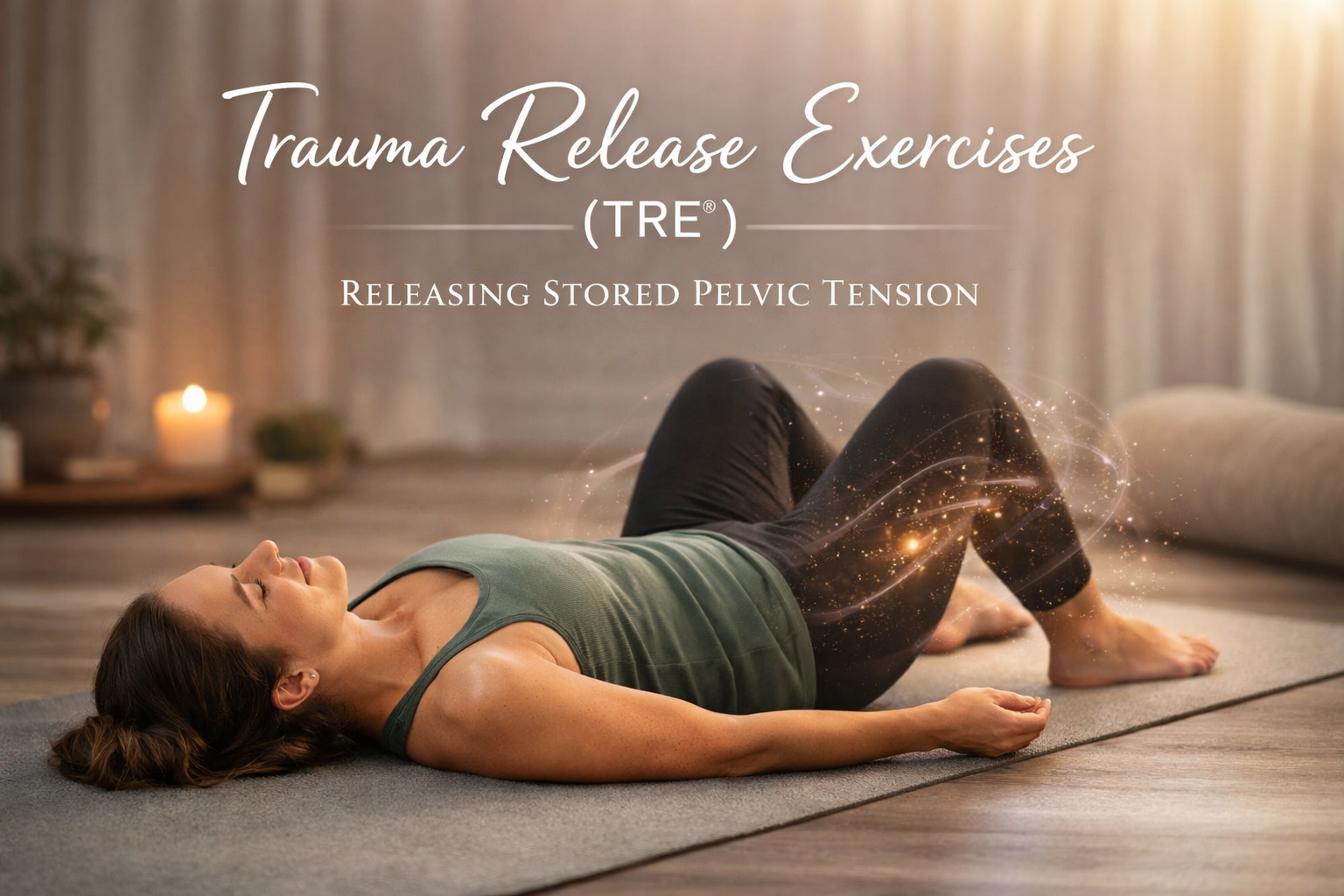
Woman practising Trauma Release Exercises to support pelvic floor tension release and nervous system regulation.
Sometimes the pelvic floor does not need more effort. Sometimes it needs a way to soften.
If your body feels tight, guarded, over-held, or unable to truly let go, you are not imagining it. For many women, pelvic floor tension is not simply about strength. It is about stress, protection, and a nervous system that has been holding on for a very long time.
We often think about tension as something obvious. A tight neck. A clenched jaw. Stiff shoulders. But the pelvis can hold too, and it often does so quietly. Because it is deep and unseen, many women spend months or years being told to strengthen what may already be struggling to relax. That is one of the reasons I feel so strongly about this work. Sometimes the body does not need more cueing to contract. Sometimes it needs to feel safe enough to release.
How Trauma Release Exercises Can Help You
That is where Trauma Release Exercises can offer something powerful. Not because they force the body to do something dramatic, and not because they push emotion out, but because they create the conditions for the body to do something deeply natural: discharge tension.
Stress is not just something we think our way through. It is something we carry. It can live in the breath, in the ribs, in the hips, in the belly, and in the pelvic floor. It can become part of how we sit, how we stand, how we brace, and how we cope. What may have started as a protective response can, over time, become a baseline pattern. That is often what I see in women with chronic gripping through the pelvis. Not a body that is failing. Not a woman who is doing it wrong. Just a body that has become very good at holding.
This is why the pelvis so often needs more than strengthening alone. If the system has learned to stay on guard, then true recovery may need to begin with release.
TRE® is one of the ways I help women find that. It is a body-led process that invites the natural shaking response many mammals use after stress or threat. In humans, we often override that response. We hold it together. We stay composed. We disconnect from sensation and keep moving. But the body still carries what it did not get to complete. TRE® offers a gentle way back into that unfinished release.
Although the tremors may begin in the legs, hips, or pelvis for many people, they are not just about the pelvis. The body responds as a whole. The shaking may stay subtle and localised, or it may move more widely through the trunk, shoulders, jaw, or arms. The point is not where it starts. The point is that the body is being given permission to respond in its own way.
That is one of the reasons it can feel so amazing. Clients often describe it as mind-blowing in the best way. They say they feel deeply chilled afterwards. Some suddenly feel emotional, not in a scary way, but in a deeply relieving one. Some cry. Some laugh. Some simply lie there afterwards in quiet surprise, saying they had no idea it would feel like that. Again and again, what people describe is the sense that their body is finally being listened to.
I think that matters so much, because many women have spent years overriding their body, tightening against it, pushing through it, or distrusting it. TRE® offers a different experience. The body gets to lead. Sensation is allowed. There is no performance, no perfect outcome, and no pressure to explain everything with words.
This can be especially meaningful for women who have lived in constant stress mode, for women after difficult births, and for women who feel tight, guarded, or stuck despite doing all the “right” things. One of the reasons this work can be so relevant to pelvic health is the deep relationship between the pelvis, the hips, the breath, and the psoas. The psoas is a powerful postural and movement muscle, and when the body has been living in protection for a long time, the deep front of the body often carries that load. This can influence breathing, pelvic organisation, lower back tension, abdominal pressure, and the tone of the pelvic floor itself.
That is why stretching alone does not always solve it. A body that still feels protective will often return to the same holding pattern. What needs to shift is not just length in the tissue, but safety in the system.
This is also where I see such a beautiful relationship between TRE® and the Hypopressives Method. TRE® helps the body let go, while Hypopressives help the body reorganise. TRE® can soften the deep, background gripping that has become normal, and Hypopressives can then help rebuild support through breath, posture, pressure management, and reflexive coordination. One helps create space. The other helps the body learn what to do with that space.
That sequence is important. Letting go is not the same as collapsing, and rebuilding tone is not the same as gripping. For many women, this is the missing piece. They have spent years being told to engage more, squeeze more, brace more, strengthen more. But what they actually needed first was a chance to come out of the brace. Only then can true support begin to return.
A first TRE® session is usually much gentler than people expect. We begin with simple movements to wake up the legs and hips, then allow the body the opportunity to begin trembling naturally. There is no forcing, no pushing, and no pressure to make something happen. You stay in control throughout, and that sense of choice matters. It helps the body trust the process.
What many women notice afterwards is not intensity, but relief. A deeper breath. A quieter mind. Softer hips. Less gripping in the jaw. A surprising sense of calm. Sometimes the shifts go beyond the pelvis altogether. Women notice better sleep, easier digestion, less background tension, more emotional spaciousness, and a greater sense of being in their body rather than battling against it. Not because the body is being pushed into release, but because it is finally being given the chance to complete something natural.
That is why I love this work so much. It is simple, honest, and deeply respectful of the body. It reminds people that the body is not the enemy.
For some women, TRE® can feel especially supportive because it does not rely on going over the story again and again. Sometimes talking is helpful. Sometimes it is essential. But sometimes what is needed is a body-up approach - a way of listening from the inside out, and allowing the body to release in its own language and in its own time. That can feel incredibly freeing.
And when that sits alongside breathwork, Hypopressives, and gentle pelvic retraining, it can become a deeply supportive part of healing. Because your pelvic floor does not just need to contract more. It needs to feel safe enough to release.
When that begins to happen, something changes. The body softens. The breath moves. The holding begins to ease. And from there, real strength becomes possible - not through force or more gripping, but through safety, responsiveness, and a body that no longer has to hold itself so tightly.
If this speaks to you, I’d love to support you. You can book a TRE® taster session with me, Abby Lord, or join one of my somatic pelvic health workshops to begin reconnecting with your body in a gentler, deeper way.
FAQs
Is TRE® a talking therapy?
No. It is a body-led somatic process. It can sit beautifully alongside counselling, but it works through sensation, movement, and the body’s natural shaking response rather than talking everything through.
What does the shaking feel like?
Most women describe it as a gentle tremor, vibration, or wave moving through the body. It may begin in the legs, hips, or pelvis, but it does not have to stay there. Many people feel calm, lighter, or deeply relaxed afterwards.
What if I feel emotional?
That can be a very natural part of the process. Some people laugh, some cry, and some simply feel a big sense of relief. The body often releases in the way it needs to.
How often should I practise TRE®?
It is lovely to begin with guidance and then build a rhythm that suits your body. Short, regular sessions are often more supportive than doing too much at once.
Can I start TRE® during pregnancy?
This is something I would approach individually and gently. In many cases, I prefer to explore it postnatally, when the body is ready for that kind of release work.
Interested?
Your body may not need more effort. It may need more release. If pelvic tension, guarding, or chronic holding have become your normal, TRE® can offer a gentle, body-led way to soften what has been stored and reconnect with a deeper sense of ease. Book a TRE® taster session with Abby Lord or join a somatic pelvic health workshop