What Trees Can Teach Us About Breath, Blood Flow, Fascia and the Pelvic Floor
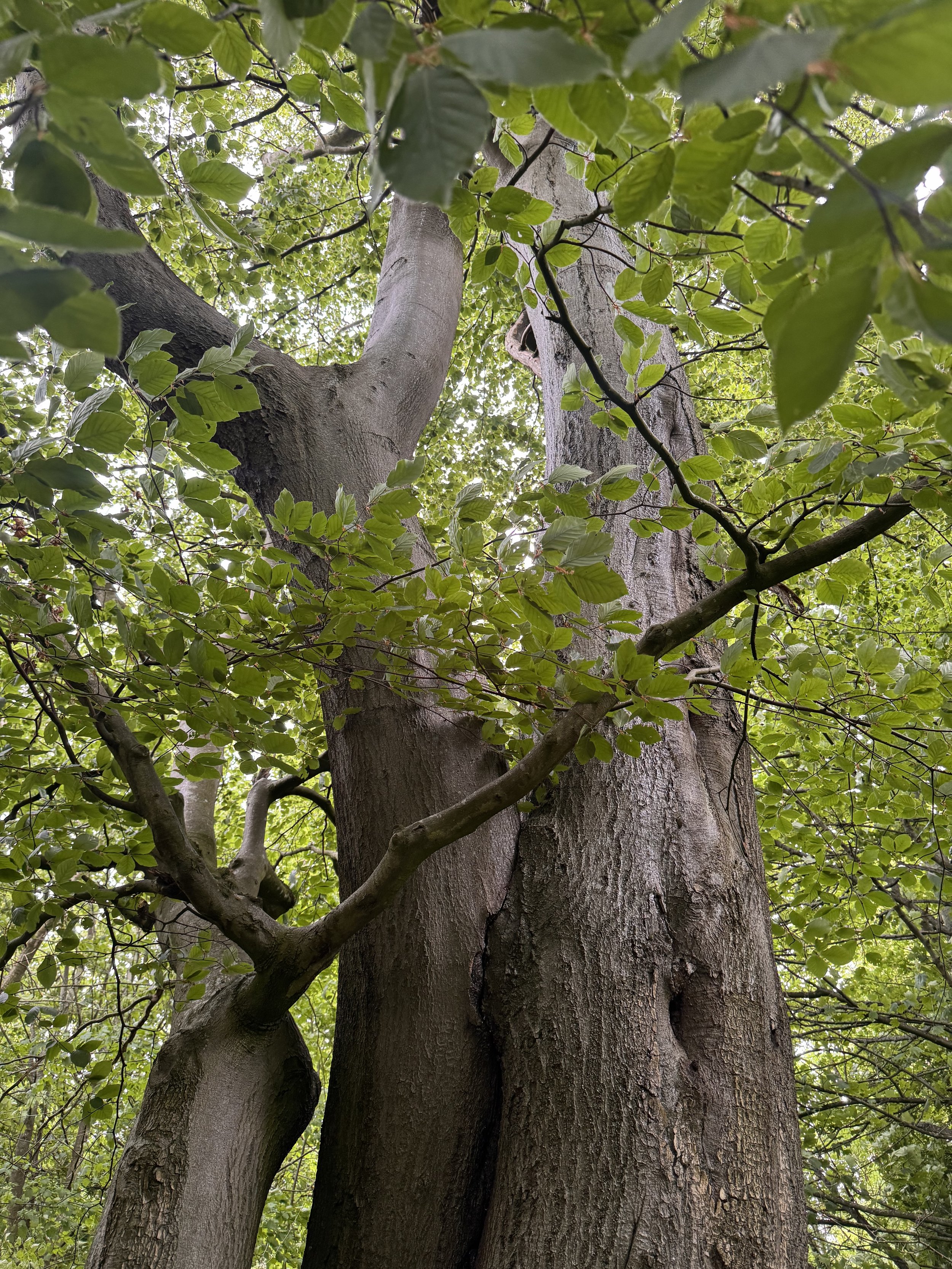
This blog has been inspired by the reporting of the death of Major Oak in Sherwood forest - an oak tree I sat under once many moons ago.
Have you ever looked at a tree during a drought?
It does occasionally happen in Scotland, although you are more likely to see it when you are on holiday somewhere like the south of Spain. The leaves start to curl. The branches lose some of their bounce. The whole tree seems to become quieter, tighter, more protective.
This isn’t because the tree has suddenly become weak. It is because its natural flow has been disrupted.
And I think our bodies can be very similar. Stay with me on this one, I promise it will all become clear.
When breath becomes shallow, posture usually starts to collapse. The head often drifts forwards, the jaw tightens, the ribs begin to stiffen and the pelvic floor starts gripping. The body is not necessarily weak. It is actually protecting.
But protection, over time, can become restriction.
And this is where trees give us such a beautiful way to understand the body.
A tree does not pump water like we pump blood
A tree does not have a heart, although it does have heartwood. Heartwood is the old centre of the tree. It no longer carries water, but it gives the tree strength, memory and structure. In many ways, it is the tree’s quiet backbone.
A tree does not push water upwards from the roots with a mechanical pump. Instead, water is drawn upwards through the xylem, the tree’s water transport system. As water evaporates from the leaves, it creates a pull from above. And this is super cool and kind of blew my mind when I leant about it years ago. This happens because water molecules cling together, that pull travels down through the tree and draws water up from the roots.
This is a cue I often use in classes: heels like the roots, and head and arms moving away like the leaves or branches of a tree. That sense of direction, pull and continuity is so important.
The tree depends on constant continuity. The water column has to stay connected. When there is drought, the system becomes strained. Air bubbles can form inside the xylem and interrupt that flow. The tree may begin to close its stomata to conserve water. This is a clever survival response, but it also limits exchange.
And when exchange is limited, flow is reduced. Growth is reduced. Vitality is reduced.
Tree Wisdom: When a Tree Holds Its Breath
Stomata are tiny microscopic pores found mostly on the underside of leaves. You could think of them as the tree’s little lungs and gatekeepers.
They open to let carbon dioxide in, which the tree needs for photosynthesis. They also allow oxygen and water vapour to leave the leaf. This process of water leaving through the leaf is called transpiration, and it helps create the pull that draws water upwards from the roots.
Each stoma is controlled by two small guard cells. When these guard cells fill with water, they swell and open the pore. When they lose water, they shrink and close it.
This is one of the tree’s clever survival systems.
But it also comes with a trade-off.
For the tree to make sugars, grow and exchange with the world around it, the stomata need to open. But when they open, the tree also loses water.
So during drought, when the roots sense dry soil, they can send chemical messages to the leaves telling the stomata to close.
This protects the tree from drying out.
But if the stomata stay closed for too long, the tree can no longer take in enough carbon dioxide. Photosynthesis slows. Growth slows. The tree is, in a way, holding its breath.
And this is where the body comparison becomes so powerful.
Our bodies do this too.
When we are under stress, pain, fear, pressure or overwhelm, we often hold our breath. Sometimes literally. Sometimes through the way we brace, grip, tighten and pull ourselves in.
The jaw clamps.
The belly grips.
The ribs stop moving.
The pelvic floor holds.
The body closes down.
It is protective.
It is clever.
It may even be necessary for a while.
But if we stay there too long, the cost is flow. The cost is movement. The cost is softness, recoil, breath and trust.
Like the tree, the body may be trying to conserve energy and protect itself.
But healing often begins when the system feels safe enough to open again.
To breathe again.
To exchange again.
To let life move through.
The tree closes to survive, but prolonged closure limits growth; the body holds breath to survive, but prolonged holding limits flow and pelvic-floor ease.
Fascia is not the body’s xylem, but like xylem, it depends on continuity. When that continuity is interrupted, flow, glide and recoil can change.
The xylem of a tree is not fascia, but it gives us a beautiful image. Xylem is a transport and tension system. Fascia, in the body, is also a living web of tension, glide and communication. It helps tissues move in relationship to one another. When fascia is hydrated, mobile and responsive, movement can travel through the body like a ripple.
But after surgery, injury, inflammation or long-held guarding, the body may lay down scar tissue and extra collagen. This repair is clever and necessary, but sometimes it creates adhesions, where layers that should slide begin to stick. When this happens, we can lose glide, elastic recoil and ease. Nerves may become more sensitive too, not because they are broken, but because they no longer have the same freedom to move through the tissues around them.
This really matters for the pelvic floor because the pelvis is full of nerve pathways, fascial connections, scars, ligaments, organs and pressure relationships. A C-section scar, hysterectomy scar, episiotomy scar, pelvic surgery, chronic inflammation or years of bracing can all change the way force travels through the body.
The symptom might show up as leaking, heaviness, pain, urgency or tightness, but the story may involve much more than the pelvic floor itself.
And while our bodies work differently from trees, I think the metaphor is really powerful. Because we are also living pressure systems. We depend on blood flow, breath flow, lymph flow, nerve communication, fascial glide, emotional flow and movement flow.
When those flows are supported, the whole system feels more alive. When they are restricted, the body starts to compensate.
Our body has its own fail-safes too
Unlike a tree, we do have a pump. The heart moves blood around the body. Our blood vessels regulate pressure. Our veins have valves to help stop blood travelling backwards.
Trees do not have valves like our veins. They have tiny safety doors between their water-carrying channels. These pit membranes help water move from one channel to another, but they also help contain air bubbles when the tree is under drought stress. So the tree’s fail-safe is not about stopping water from simply falling down. It is about protecting the continuity of the water column.
In the body, our veins do have valves to help prevent backflow. But fascia has a different kind of fail-safe. It relies on continuity, glide, hydration and movement. When one area becomes restricted by scar tissue, tension or loss of movement, the whole system has to reroute load, pressure and sensation.
Trees rely on cohesion to keep water rising. We rely on valves, breath, fascia, movement and muscle activity to keep flow and pressure moving well.
Our muscles help squeeze blood and lymph back towards the heart. Our breathing helps support pressure changes through the trunk. The diaphragm moves and carries our heart gently with it. The ribs move. The spine responds. The pelvic floor responds, and the bladder nods.
This is why I never see the pelvic floor as a separate little hammock at the bottom of the body. It is part of a much bigger pressure conversation.
Every breath changes pressure. Every posture choice you make changes pressure. Every step, balanced or not, changes pressure. Every clenched jaw, tucked pelvis, braced belly or collapsed chest changes pressure.
And the pelvic floor is listening to all of it.
It is listening to the breath, the feet, the ribs, the jaw and the nervous system. It is listening to whether the body feels safe or under threat.
So when a woman leaks, feels heaviness, has pain, urgency, dragging or pelvic tension, I am rarely thinking, “Oh, her pelvic floor is just weak.”
I am thinking: where has flow been lost? Where has movement been lost? Where is pressure being mismanaged? Where is the body gripping instead of sharing load? This is the basis of my Pelvic Floor MOT’S.
Fascia is the body’s living tension system
This is where the tree comparison becomes even more beautiful.
A tree rises through tension. Water is pulled upwards because of cohesion, evaporation and tension inside the xylem.
Our bodies rise through a different kind of tension. Fascia, muscle, breath, bones, pressure and gravity all work together to hold us upright and responsive.
Not with rigid tension. Not with bracing. Not with chronic gripping. But with gorgeous responsive tension.
The kind of tension that lets you spring, recoil, rotate, bend, yield, lift, land, reach and breathe.
Fascia is the connective tissue web that wraps, links and communicates throughout the body. It does not work well when we treat the body like a collection of separate parts. It responds to relationships.
A foot pressing into the ground. A hand reaching away. A spine spiralling. Ribs widening. A pelvis yielding. A head floating back over the body.
This is how the fascial system wakes up.
This is how the body remembers that it is not just a stack of bones and muscles. It is a whole, connected, living system.
A tree needs the pull of water cohesion. We need the pull of movement. We need gravity. We need the ground. We need reaching, rotating, walking, loading, yielding and rebounding.
Not because we need to force the body into more tension, but because healthy fascia needs direction. It needs glide. It needs hydration. It needs variation. It needs load.
It needs life.
The pelvic floor needs pull, not just strength
This is one of the biggest misunderstandings in pelvic health.
We often talk about the pelvic floor as if it simply needs to be stronger. Squeeze more. Lift more. Hold more. Control more.
But the pelvic floor is not supposed to hold the body together by itself. It is part of a whole-body fascial and pressure system.
If the feet are stiff, the pelvis may lose options. If the hips are gripping, the pelvic floor may grip too. If the ribs are rigid, the diaphragm cannot move well. If the diaphragm cannot move well, pressure cannot be shared well. If the head sits forward, the neck, jaw, ribs and breath often change. If the body is under stress, the pelvic floor may become protective.
So the answer is not always to strengthen the pelvic floor harder.
Sometimes the answer is to help the whole body remember how to share load again. To restore pull, glide, recoil, breath and trust.
Because a pelvic floor that is constantly gripping is not necessarily strong. It may be overworking. It may be guarding. It may be doing the job that the rest of the system has forgotten how to share.
What happens when the head moves forwards?
Forward head posture is another place where this whole-body conversation becomes clear.
When the head drifts forward, the neck has to work harder. The jaw may tighten. The upper ribs may stiffen. The shoulders may roll forward. The breath may move higher into the chest. The diaphragm may lose some of its freedom.
Now, I am not saying forward head posture simply cuts off blood flow to the brain it does have a bit of an effect., but the body is much cleverer than that, and blood flow is regulated in many ways.
But head and neck position can change the mechanical and neurological environment of the neck.
And that really does matter.
The brain receives information from the neck, eyes, jaw, breath and vestibular system all the time. If the body is constantly living in a position of strain, effort or protection, that becomes information.
The nervous system listens.
The amygdala, the part of the brain involved in threat detection and emotional salience, is interested in safety. It is always asking: am I safe? Do I need to protect? Is there a threat here?
And the pelvic floor is part of that protective system.
Many women know this without needing a textbook.or a study to tell them. Stress can make urgency worse. Anxiety can make pelvic pain worse. Fear can make prolapse symptoms feel louder. Embarrassment can make the body clamp. A difficult season of life can show up in the bladder, bowel, pelvis, hips or jaw.
This is not “all in your head.”
It is in your nervous system.
And your nervous system is in your body.
Breath as irrigation
Breath is not just air exchange.
Breath is movement.
It moves the ribs, the diaphragm, the spine and the pelvic floor. It influences pressure. It affects venous return and lymphatic flow. It speaks directly to the nervous system.
But I am not talking about forcing the belly out. I am not talking about big performative breathing.
I am talking about a true 360° breath.
A breath that widens the ribs. A breath that moves into the back body. A breath that gives the diaphragm space to descend. A breath that allows the pelvic floor to yield.
A breath that says to the body: you do not have to grip so hard.
When the breath becomes more spacious, the body often starts to soften. When the ribs move, the diaphragm has more options. When the diaphragm has more options, the pelvic floor has more options. When the pelvic floor has more options, symptoms can begin to change.
Not because we have forced the pelvic floor to behave itself like some naughty child.
But because we have changed the conversation around it.
A body in drought
I often think many pelvic floor symptoms are signs of a body in drought.
Not necessarily dehydrated in the simple sense, although hydration matters too. I mean a body that has lost its fluid flow.
A body that has been holding on to its breath. A body that has been clenching its jaw, which can clamp the pelvic floor and pelvis into closed. A body that has been gripping its belly. A body that has been sitting for long hours, rushing through life, pushing through stress and trying to hold everything together.
A body that has lost rotation, recoil, bounce, softness and trust.
And then the pelvic floor starts shouting at us.
Leaks. Heaviness. Dragging. Urgency. Pain. Tightness. A feeling that something is not quite right.
The pelvic floor may be the place you feel the symptom, but it may not be the place where the whole story began.
Restoring the flow
So where do we begin?
We begin by giving the body back its options.
Not by forcing it to comply. Not by squeezing it harder and harder, although there is a place in pelvic health for PFMT, pelvic floor muscle training. Not by telling the body it is broken, because this mindset, this repetition that you are somehow less, really does not help.
We begin with breath. We begin with the ribs. We begin with the feet. We begin with the jaw. We begin with the spine. We begin with tiny movements that remind the body it can yield and rebound.
We begin with the nervous system.
We begin with safety.
This is why, in my work, I use Hypopressives, breathwork, release work, somatic movement, TRE®️ and strength work together. Because the body needs more than one conversation.
It needs to know how to soften. It needs to know how to organise pressure. It needs to know how to move against gravity. It needs to know how to load. It needs to know how to rest. It needs to know how to trust itself again.
Like trees, we need tension to thrive
A tree does not thrive by being floppy.
And it does not thrive by being rigid.
It thrives through relationship. Roots and soil. Water and leaves. Tension and flow. Light and gravity. Flexibility and strength.
And so do we.
Our bodies need tone, but not gripping. Strength, but not bracing. Breath, but not force. Posture, but not stiffness. Movement, but not punishment. Support, but not control.
The pelvic floor is not meant to carry the whole body alone. It is meant to be part of a living system of pressure, pull, flow and recoil.
So if your pelvic floor is leaking, dragging, gripping or feeling disconnected, perhaps the question is not, “How do I make it tighter?”
Perhaps the better questions are:
Where has my body lost flow?
Where has my body lost movement?
Where has my body stopped sharing load?
Where does my nervous system need safety?
A tree in drought does not need to be shouted at for wilting. It needs water, space, restored flow and time.
Your body is no different.
And that is where we begin.
Get in touch if you are ready to start understanding where your flow is restricted. Contact me.