The Power of Happiness and Love for Pelvic and Heart Health
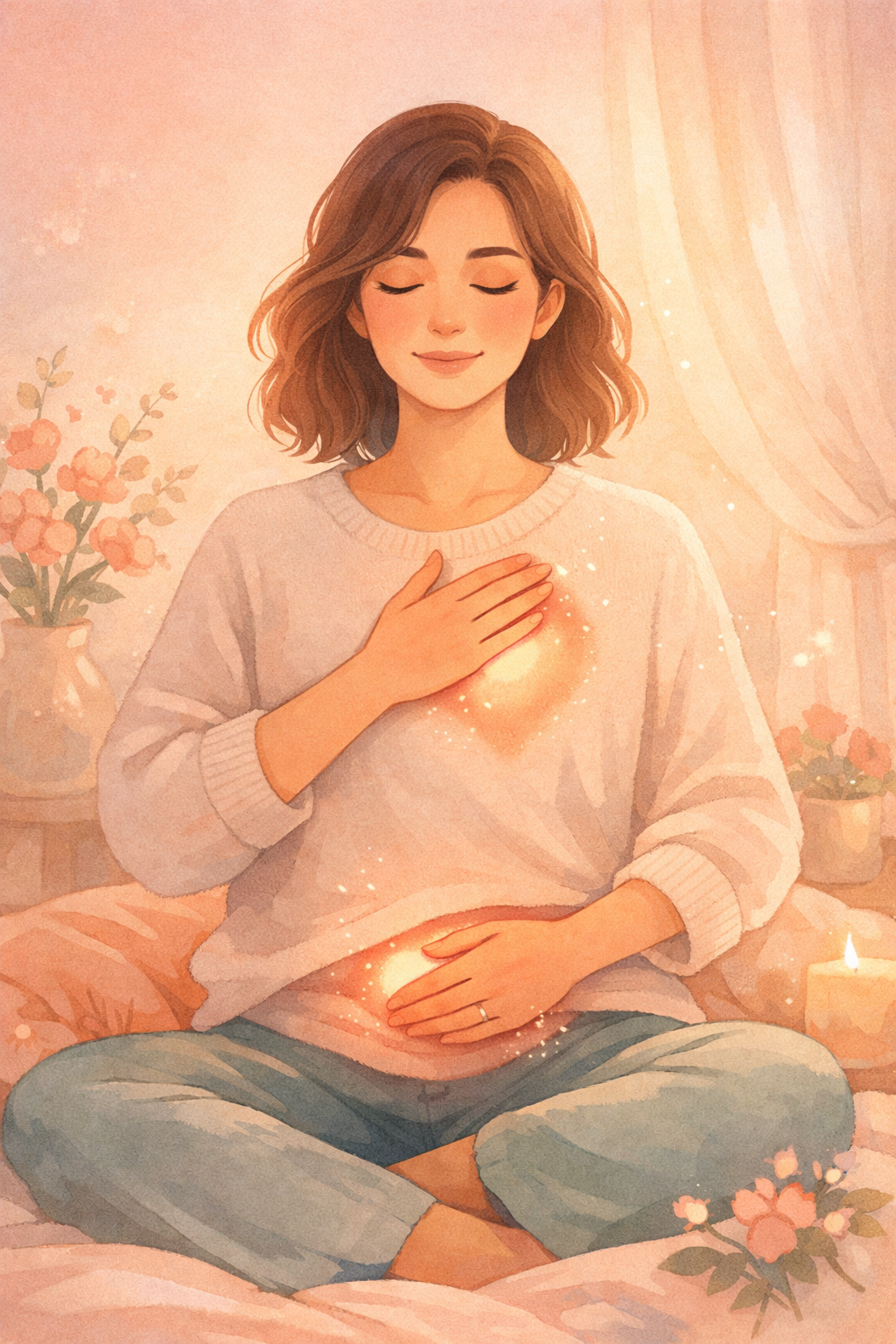
Woman resting one hand on her heart and one on her lower abdomen, symbolising the connection between emotional wellbeing, heart health and pelvic health on Mother’s Day.
How feeling safe, connected and cared for may support both heart and pelvic health
Mother’s Day can stir up many things.
Love. Gratitude. Grief. Relief. Longing. Joy. Exhaustion.
For some women, it is breakfast in bed and sticky little hands. For others, it is memory, loss, complexity, or simply another Sunday where they are still carrying everyone else.
But whatever this day brings, there is something worth saying gently and clearly:
Your emotional world is not separate from your physical body.
The way you feel does not just live in your thoughts. It moves through your nervous system, your muscles, your breath, your heart rate, your sleep, and your sense of tension or ease. That does not mean happiness is a magic cure, it does mean that love, connection, laughter, safety and emotional support are not “soft extras.” They are part of biology.
The body responds to more than exercise and nutrition
We are used to thinking about health in terms of food, steps, strength training and supplements. Those things matter. But human health is also shaped by relationships, emotional states and the feeling of being held in some way by life.
A growing body of research suggests that positive psychological well-being all the things like positive emotion, life satisfaction, optimism and purpose are associated with better cardiovascular outcomes. Importantly though, this is mostly associational research, not proof that happiness directly prevents disease. Still, the pattern is strong enough that the American Heart Association has described well-being as an important frontier for cardiovascular health.
One 2019 systematic review and meta-analysis of 15 studies involving 229,391 people found that optimism was associated with a lower risk of cardiovascular events and lower all-cause mortality. Again, that does not prove causation, but it does suggest that the inner world and the heart are not strangers to one another.
The flip side matters too. A 2024 systematic review and meta-analysis found that poor social relationships were associated with a 16% increase in incident cardiovascular disease risk. In other words, disconnection is not just emotionally hard. It may also carry physical cost.
What is happening biologically?
This is where people often start throwing around phrases like “happy hormones.” The truth is a bit more nuanced than that.
Human emotion is not controlled by one neat chemical switch. But several neurochemicals and signalling systems do seem to be involved in bonding, reward, pain modulation, stress buffering and well-being. Among the most discussed are oxytocin and the endogenous opioid system (which includes endorphins). Dopamine and serotonin are also involved in mood and motivation, but the science of well-being is complex and not reducible to a single formula. Much the same way as pelvic health can’t be healed with just squeezes.
Oxytocin: connection, touch and stress buffering
Oxytocin is often nicknamed the “love hormone,” but that label can oversimplify it. What the research does support is that oxytocin is involved in social bonding, stress regulation, fear reduction and pain modulation. A 2024 review described oxytocin as part of an anti-stress system, with effects on the HPA axis and sympathetic nervous system.
There is also human evidence linking affectionate touch with higher endogenous oxytocin. In an ecological momentary assessment study published in eLife, affectionate touch was associated with higher natural oxytocin levels and appeared to buffer stress on both a subjective and hormonal level.
That does not mean a hug “treats” a health condition. But it does support the idea that warm, safe human contact is biologically meaningful.
Endorphins: the body’s own pain-relief and bonding chemistry
Endorphins are part of the body’s endogenous opioid system. They are involved in pain relief, pleasure and social bonding. Reviews of the opioid system suggest it plays an important role in positive emotional states and affiliative behaviour.
There is even direct evidence that social laughter can trigger endogenous opioid release in humans. A PET study found that laughing together may activate this system, offering one possible neurochemical pathway for social bonding. Related work also suggests laughter can increase bonding and up regulate the endorphin system.
So when you laugh with people you feel safe with, that is not frivolous, it is actually physiology.
What does this have to do with the pelvic floor?
This is the place to be careful and not to over hype possibilities.
There is not strong evidence that feeling happy directly “heals” the pelvic floor in a simple one-step way. I would definitely not tell you that because it wouldn’t be true.
What the evidence does show is that pelvic floor symptoms and emotional health are often closely linked. Women with pelvic floor dysfunction can experience significant anxiety, depression and emotional distress, and those psychological factors may affect symptom burden, attendance and outcomes in treatment.
A 2024 systematic review and meta-analysis found measurable information similar to what I see all the time with the women I work with. And that was notable rates of anxiety and depression across people with pelvic floor disorders, reinforcing that emotional well-being is not peripheral to pelvic care.
For women with chronic pelvic pain, the picture is even clearer: pelvic symptoms often exist within a broader biopsychosocial and nervous-system context. Studies have reported autonomic dysfunction in women with chronic pelvic pain, and systematic review evidence suggests that combining pelvic floor physical therapy with mindfulness may improve pain-related outcomes such as catastrophising, though more high-quality research is still needed.
So no, love is not a substitute for pelvic health assessment, strength work, release work, or medical care.
But yes, a body that feels safer, calmer, more supported and less alone may be a body with a better chance of softening protective tension, breathing more freely, and engaging in healing behaviours.
That really matters.
The heart and pelvis are not separate stories
I talk a lot about pressure, breath, posture and fascial relationships. But underneath all of that is a living human being with a nervous system.
A woman who is chronically braced, rushing, over giving and swallowing her own needs is not just “stressed.” She may be living in a physiology that is less restorative.
And a woman who has moments of warmth, laughter, belonging, touch, support and real exhale is not just “feeling nice.” She may be experiencing shifts in stress physiology, social bonding pathways, pain modulation and cardiovascular regulation.
That does not mean we chase happiness as another performance target.
It means we respect joy as medicine-like, even when it is not medicine.
A more truthful Mother’s Day message
On Mother’s Day, I do not want to tell women to “just be grateful” or “choose happiness.”
That is far too shallow for real life.
What I do really want to say is this:
Feeling loved and supported matters to the body.
Safe touch, laughter and connection may influence oxytocin, endorphin and stress pathways.
Positive well-being is associated with better heart health over time, even if the exact mechanisms are still being worked out.
Pelvic health is not only mechanical. It is also shaped by stress, emotional load, nervous-system state and whether the body feels safe enough to let go.
That is not trivial.
That is whole-person health.
So what can a mother do with this?
Not “fix herself.”
Just begin with small, biological acts of nourishment.
A proper exhale.
A laugh with someone who gets you.
A hand on your heart.
A hug that feels welcome.
A walk in the daylight.
A pause before the next demand.
A class, a practice, a space where your body is allowed to stop gripping for a moment.
These things may seem small, but small does not mean insignificant. The nervous system listens to repetition. The heart does too. And sometimes healing begins not with more effort, but with more safety.
Mother’s Day closing
If you are a mother reading this, or grieving one, missing one, becoming one, or mothering everyone else while forgetting yourself, this is your reminder:
Your body is not only moved by force.
It is also moved by kindness.
By breath.
By connection.
By joy.
By the moments that tell your system, even briefly, you are safe here.
And that message may matter more for your heart and your pelvis than we have given it credit for.
If this resonated with you, and you know your body has been holding more than it needs to, my work is here to help you reconnect with breath, softness, support and strength from the inside out.
Whether you are navigating pelvic floor symptoms, stress, tension or simply a body that feels like it has been bracing for too long, you are welcome here.
[Explore classes / Book a session / Join my beginner programme]
References
Boehm JK, Kubzansky LD. Positive psychological well-being and cardiovascular disease: exploring mechanistic and developmental pathways. Emotion Review. 2021.
Rozanski A, Bavishi C, Kubzansky LD, Cohen R. Association of optimism with cardiovascular events and all-cause mortality: a systematic review and meta-analysis. JAMA Network Open. 2019.
Albasheer O, et al. The impact of social isolation and loneliness on cardiovascular disease risk factors: a systematic review and meta-analysis. Scientific Reports. 2024.
Uvnäs-Moberg K, et al. The Yin and Yang of the oxytocin and stress systems. Frontiers in Endocrinology. 2024.
Schneider E, et al. Affectionate touch and diurnal oxytocin levels: an ecological momentary assessment study. eLife. 2023.
Peinado Molina RA, et al. Prevalence of depression and anxiety in women with pelvic floor dysfunctions: a systematic review and meta-analysis. International Journal of Gynecology & Obstetrics. 2024.
Mestre A, et al. Pelvic floor physical therapy and mindfulness: approaches for chronic pelvic pain in women — a systematic review and meta-analysis. 2022.
NICE. Psychological therapy for women with pelvic floor dysfunction. Evidence review for guideline NG210. 2021.
de Vries LP, et al. The human physiology of well-being: a systematic review on the association between neurotransmitters, hormones, inflammatory markers, the microbiome and well-being. Neuroscience & Biobehavioral Reviews. 2022.
Manninen S, et al. Social laughter triggers endogenous opioid release in humans. Journal of Neuroscience. 2017.
Dunbar RIM, et al. Laughter influences social bonding but not prosocial generosity to friends and strangers. PLOS ONE. 2021.
Nummenmaa L, Tuominen L. Opioid system and human emotions. British Journal of Pharmacology. 2018.