Upper Rib Gripping & Hourglass Syndrome: Why Your Pelvic Floor Needs Your Breath — Not More Bracing
Many people are drawn to Hypopressives because of the impressive ribcage movement they see in videos.
But here’s the hidden trap…
Some begin to overuse the upper abs and lift the ribs aggressively or draw them down excessively, especially if they already have a history of trauma, guarding, or stress-driven breath holding.
This pattern is called Hourglass Syndrome, and it’s one of the most misunderstood pelvic-core issues.
This post is a gentle, science-based guide to how your body learned this pattern… and how we can softly guide it somewhere new.
Why Your Upper Abs Might Be Working Overtime
Hourglass Syndrome is a breathing and tension pattern where the upper abdominals grip tightly inward while the lower belly pushes out or doesn’t engage at all.
This can lead to:
Ribcage locked down
Diaphragm unable to move fully
Breath stuck high in the chest
Pelvic floor gripping or burning
Pressure forced downward
A nervous system always ready for danger

It’s not a posture problem. It’s a protection strategy.
Hourglass Syndrome & Trauma: The Body Keeps Score about everything…
When the nervous system has been under threat, whether from:
ongoing stress
medical trauma
emotional trauma
childhood or sexual abuse
sudden life shock
chronic overwhelm
…the front of the body reflexively becomes a shield.
The upper belly tightens and pulls in to guard the most vulnerable areas:
✔ heart
✔ gut
✔ reproductive organs
✔ deep core
✔ emotions stored below the surface
The message from the body is crystal clear:
“We do not feel safe to soften here.”
This is survival intelligence.
Not failure. Not weakness. Not “bad posture.”
How Hourglass Syndrome Affects the Pelvic Floor
Upper-ab gripping pushes pressure downward , and of course it then becomes the pelvic floors job to hold it.
This can contribute to:
pelvic pain or burning
prolapse symptoms
leaking despite “strengthening”
constipation
difficulty relaxing the pelvic floor
lower back tightness
reduced rib and diaphragm movement
You can be both tight and uncoordinated, and still be told by some doctors to “squeeze more.” This isn’t because they are mean it’s because they are looking just at your pelvic floor and missing the cues from above and following a standard protocol for the symptoms they see.
But squeezing here in this scenario will only deepen the tension.
What Most People Get Wrong About Hypopressives
Hypopressives are not:
✘ forcing ribs up
✘ bracing the upper abs
✘ sucking in to look slimmer
✘ holding a perfect upright posture
Instead, they teach the body how to:
✔ redistribute pressure throughout the core
✔ let the lower belly indeed the whole abdominal wall to respond to breath
✔ create spaciousness without force
✔ allow reflexive pelvic floor lift
✔ move and breathe with the whole torso
Hypopressives are about less gripping and way more space everywhere!
On the inhale:
the upper and lower abdomen expands — including the back and sides - like a corset.
On the exhale:
a soft release, not hard tightening.
Some find it helpful to imagine:
“Inhale all the way to your feet, your hands, and your head.”
“Exhale gently from them too.”
Breath should feel freeing and definately not like some hardcore performance.
🌿 A Gentle Guide to What Your Body Is Doing… and Where We’re Inviting It to Go
What Your Body Has Been Doing to Protect You
Front-Body Shield
Ribs draw inward
Upper belly holds tight
Chest guarded and watchful
→ “Don’t expose what hurts.”
On-Alert Spine
Head slightly forward
Waist pulls back
→ “Stay ready.”
Pelvis Takes Over
Lower belly pushes forward
Pelvic floor grips
→ “If nothing else holds me, I will.”
Small, high breath
Less movement = less vulnerability
→ Safety in staying small
💛 These strategies kept you here. They are wise. They are protective.
🌱 Where We Are Inviting Your Body to Go
Back-Body Support
Ribs widen behind you
Spine supported from the inside out
→ “I can stand, without armouring.”
Front-Body Softness
Belly rests
Pelvic floor releases
→ Safety without defence
Shared Stability
Pelvis supported — not gripping
Breath carries the load
→ Less downward pressure
Full-Body Breath
Inhale = space and flow
Exhale = soft letting go
→ Ease instead of effort
How this change will feel
Not drastic.
Not forced.
Just…
a little more space
a little less vigilance
a body that can be upright and still feel safe
Why This Is Hopeful
Hourglass Syndrome is not structural and this means it is behavioural and protective.
What the body learned for survival, it can absolutely unlearn with safety.
When the nervous system feels safe, the breath drops, the ribs expand, the pelvic floor stops gripping, and the body finally rests.
Try These Gentle Re-Patterning Practices
🌬️ 1️⃣ Back-Body Expansion Breath
Place hands on lower ribs — inhale to widen the sides and back more than the front.
🫶 2️⃣ Soft Exhale
Let breath fall out like a sigh — no upper-ab tightening - look in a mirror when you do this and make sure you are not gripping.
🦶 3️⃣ Grounded Standing
Feet under hips, soften knees, feel the ground rising to meet you, when you breathe inhale all the way to your feet, widening your ribs, abdomials all the way around and all the way to the soles of your feet.
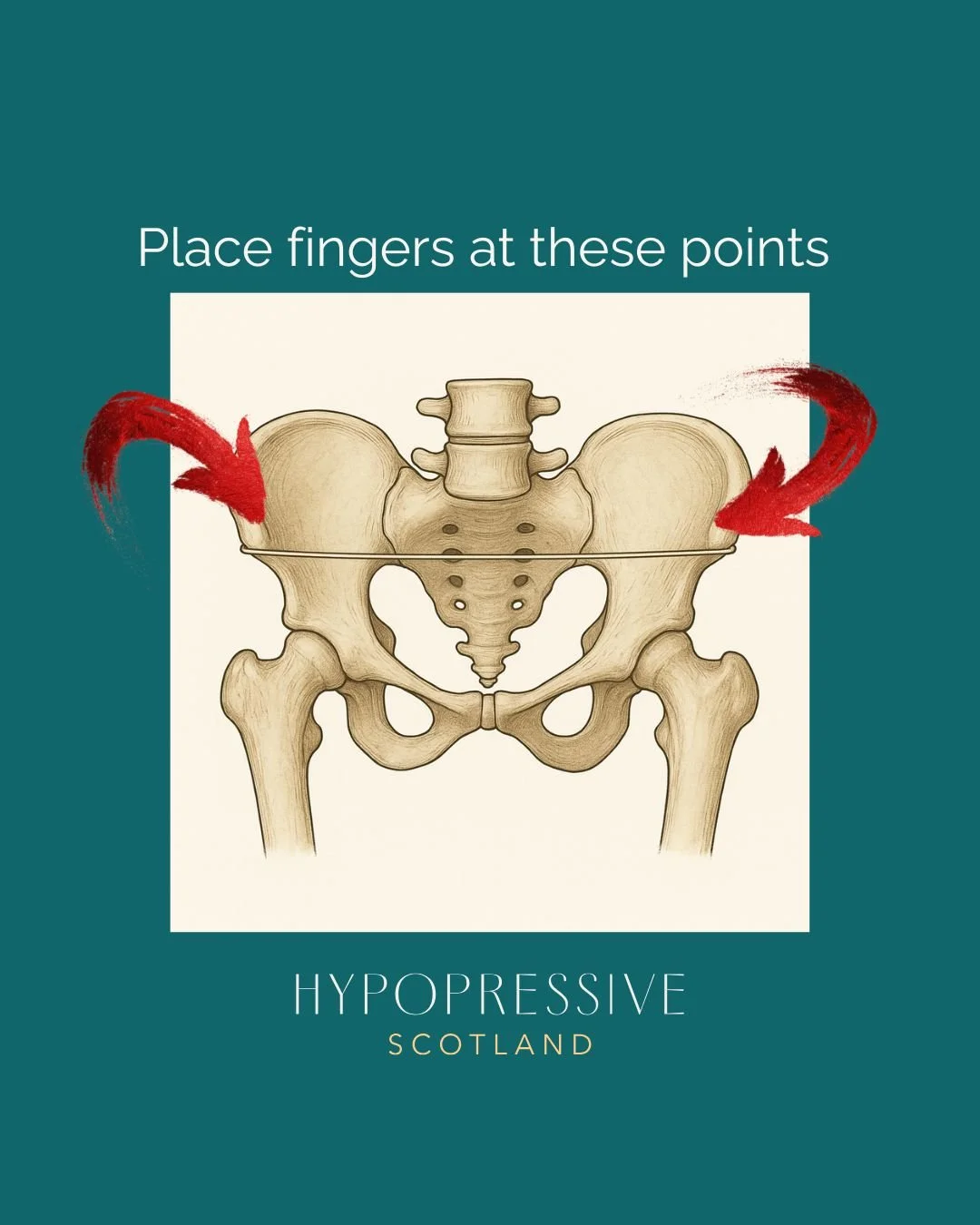
🧘♀️ 4️⃣ Supine Position
Lie semi-supine, Place your hands on your pelvis one on each side holding finger tips just on the inside of each bone (see picture) visualise a string between each side.
As you widen the ribs visualise the string loosening feel the lower abdominals between the two bones at the top of your pelvis grow, soften.
Then as you exhale and the ribs drift down visualise the string getting tauter and feel the muscle drawing in.
Check that you are not gripping with your upper abs and if you are - try inhaling into your pelvis followed by your ribs and exhale from the pelvis first, let the ribs drift down after - this changing the pattern can help us to re-pattern the breathing and we can come back and co-ordinate them as a team together again once we stop gripping.
🍃 5️⃣ Safety Cue Mantra
“I can stand and face the world without preparing for danger.”
Small, consistent nudges help shift deeply held patterns.
Working With Abby: Support for Hourglass Breathing Patterns
If you recognise yourself in this, you’re not alone, and your body is not stuck.
Abby offers:
Pelvic Floor MOT assessments
Breath-based pelvic floor retraining
Hypopressives that avoid over-gripping
Trauma-informed support
Online and in-person sessions
Safe pacing + nervous-system awareness
✨ Your Pelvic Floor MOT is a powerful first step in understanding your patterns and what your body needs instead of gripping.