Women Are Not Small Men. But We Have Also Not become Suddenly Fragile Either.
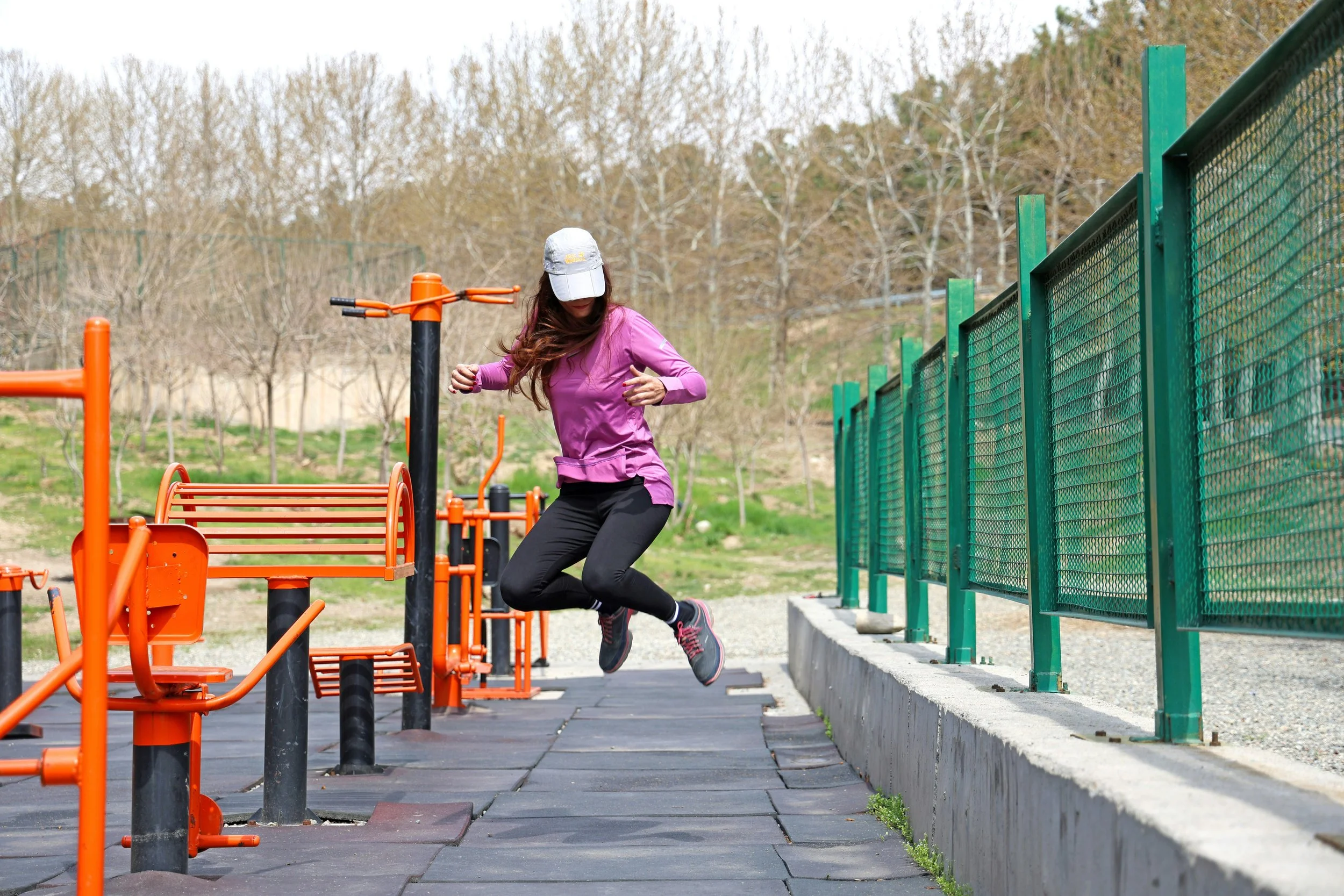
Woman having fun exercising - jumping in park
How exercise for many needs to change after 40, and why your pelvic floor, hormones, nervous system and life story all matter
For decades, much of what women have been told about exercise, and everything else, has come from research based largely on male bodies.
Because it would be much more expensive and time-consuming to do large studies on women, and until the 1990s even drug companies creating painkillers often tested them on young healthy men.
This scenario has changed, but tests have, in some cases, shown that young healthy men can react better to pain medication like ibuprofen than women with period pain.
Why didn’t they test products for women on women? Because women’s bodies were seen as more variable than men’s, and it was easier to achieve reliable results from bodies that don’t menstruate, have the potential to carry babies, move through perimenopause, or experience the same hormonal shifts, pelvic changes, scar tissue, birth injuries, prolapse symptoms, leaking, fatigue, or cyclical fluctuations.
So when people say, “Women are not small men,” I get why that lands and feels comfortable. Because we most definitley aren’t
Because for many women, especially after 40, the advice they were given in their 20s suddenly stops working. The endless cardio. The calorie burning. The “push through” mentality. The HIIT every day. The idea that if your body is changing, you simply need more discipline.
But here is where I want to be really clear.
Women are not small men. Our bodies are different. But post-40 women are also not life-weary, the game of life and fitness is not done and over.
We are adaptable, intelligent, cyclical, emotional, strong, scarred, resilient, hormonal, wise, tired, capable, and often carrying far more than we realise. And our training should reflect that, and not be a “watch out ladies, everything falls apart after 40” message.
But with a smarter conversation. With listening. With taking the time to hear and acknowledge every part of the whole messy journey, because it all matters massively.
And that conversation has to include hormones, breath, pelvic floor function, pressure management, fascia, strength, recovery, sleep, stress, nervous system load, posture and the story your body has lived through so far.
Because we cannot change what we are not aware of. And learning to listen to your body is a skill.
This is not about giving every woman over 40 the same programme
One of the biggest problems I see in midlife fitness is that we still love a formula. Here is the programme for women in their 20s. Here is the programme for women in their 40s. Here is the menopause workout. Here is the pelvic floor fix. Here is the strength plan. Here is the cardio rule.
And to be brutally honest, for decades much of what we have been told about exercise has come from research built largely around male bodies, or highly controlled groups that do not fully reflect the reality of women’s lives. And while that is beginning to change, exercise science for women is still catching up.
Some reviews suggest only around 6 to 9% of sports science studies focus exclusively on female athletes, which means we have to be careful when anyone says, “The science says women should train like this.” Which women? A 22-year-old with painful periods? A 42-year-old in perimenopause? A 52-year-old postmenopausal woman rebuilding strength? An 86-year-old who wants to stay steady, independent and confident?
Women are not one neat category. We are not averages. We are living, changing bodies.
And yes, there are now encouraging studies looking at women over 40, 50, 60 and beyond. Research does show that strength training can support muscle mass, bone density, insulin sensitivity, balance, confidence and long-term independence. Some studies suggest women may lose muscle from their 30s onwards, and women can spend around one-third to 40% of their lives postmenopausal. That matters. But many exercise studies are still small, sometimes 30, 40, 60 or 100 women, and often exclude the very real-life complexity I see every week: births, hysterectomies, pelvic surgery, scar tissue, leaking, prolapse symptoms, hyper-mobility, trauma, ADHD, chronic stress, poor sleep, grief, caring responsibilities and years of pushing through. So while I respect the science, and I absolutely use it, I also know this: your age is not the starting point. Your story is.
Because a woman is not just her age.
She is her hormones, yes. But she is also her births, her surgeries, her scars, her sleep, her stress, her grief, her job, her joints, her nervous system, her relationship with exercise, her pelvic floor history, her confidence, her fear, her breath, her posture and her previous injuries.
As a movement educator, I do not draw blood. I do not test hormones. I am not diagnosing what is happening medically inside someone’s endocrine system. So I had to find another way.
A way of listening to the body through movement. And that is what I do when we first meet and in my Pelvic Floor MOTs. It is what I help you start doing for yourself too, so you can advocate for and listen to the body you are in.
My questions are:
How does she breathe?
Does her rib cage move?
Does her belly brace?
Does her jaw grip?
Does her pelvis tuck under?
Does she hold her breath when she stands up?
Does she leak when she runs?
Does she collapse into one hip?
Does she feel heavy, disconnected, anxious, exhausted, or afraid to move?
What trauma has she been through?
That information really matters.
Because your body is always communicating, sometimes quietly and sometimes like a very cross impatiant toddler.
The question is whether we have been taught how to listen.
What actually changes after 40?
After 40, many women begin to notice that their body does not respond in quite the same way.
Recovery post-exercise can feel slower. Sleep can become less easy. Muscle can feel harder to build and maintain. Energy levels can start to fluctuate, which makes it harder to motivate yourself to get going. Stress tolerance can drop quite dramatically. Joints may feel stiffer when you wake up, or get up from long periods of sitting, or even just when you go for a walk.
Tendons may feel less forgiving, pelvic floor symptoms can appear or start to shout louder, and old injuries you thought were long gone can start rearing their heads again.
And then, of course, there are the hormonal shifts.
Progesterone can fluctuate and decline during perimenopause. For some women, this may show up as more intense PMS, anxiety, bloating, sleep disruption, changes in bleeding patterns, fatigue, hot flushes, night sweats, lower libido, vaginal dryness, or breast tenderness.
Oestrogen changes too, but it does not simply disappear. I hate reading all the really scary stories across the internet about this, the dramatic “after menopause you have no oestrogen and so you need…” messaging that women are subjected to.
Before menopause, the ovaries are the body’s main producers of estradiol, and it is true this is the most potent form of oestrogen. After menopause, ovarian production drops significantly, but the body continues to make oestrogen in other places, including fat tissue, muscle, bone, skin, the brain and adrenal pathways.
Men do this too, despite never having ovaries. The difference is that after menopause, oestrogen production becomes quieter, more local, and more dependent on the health of the tissues making it. Which means movement, muscle mass, metabolic health, stress regulation and recovery become even more important, not just for how we look, but for how we feel, think, move and age.
So no, you are not imagining it. Your body may genuinely need different support, but different does not mean you suddenly become fragile.
It means we need to train with more intelligence.
By 40, many women are not weak. They are overloaded.
This is the part that often gets missed.
A woman in her 40s or 50s, and into her later life, the time of the crone and then wise woman, might be juggling work, children, ageing parents, teenagers, money worries, poor sleep, changing cycles, relationship stress, grief, caring roles, and decades of being told to just get on with it, by others or just that critical voice in her own head.
Then she wonders why her body does not love being thrown into burpees, sprints and heavy lifts with no preparation.
That is not weakness suddenly showing up. That is load. And load is not just what you lift in the gym.
Load is also stress, breath-holding, poor sleep, emotional holding, scar tissue, pelvic floor tension, under-recovery, pain, fear, overtraining, under-eating, perfectionism, negative self-talk and a nervous system that has forgotten what safety feels like.
This is why I am not interested in the simple message of “women over 40 just need to lift heavy.”
I love strength training. It is one of my favourite things to do and always has been. I want women lifting, carrying, pushing, pulling, walking, climbing, jumping, dancing and trusting their bodies to be able to do life with them and not work against them.
But strength has to be built in a body that is ready for it.
If your body is becoming a master at bracing, leaking, gripping, clenching, collapsing or constantly living in fight-or-flight, then we need to look at the strategy underneath the strength.
The pelvic floor does not know your age. It knows your strategy.
This is where I often see the missing piece.
A woman starts leaking in her 40s or 50s and assumes it is “just menopause.” Or she feels heaviness and assumes it is “just age.” Or sex becomes uncomfortable and she assumes it is “just hormones.”
Hormones may absolutely be part of this picture. Vaginal tissues, collagen, bladder sensitivity, recovery and muscle mass are all influenced by hormonal change.
But the pelvic floor also responds to habitual pressure, posture, breath, tension and nervous system state.
Your pelvic floor knows if you hold your breath every time you lift something. It knows if your rib cage is flared forward and your diaphragm cannot move well. It knows if your jaw is clenched. It knows if your glutes are gripping. It knows if your pelvis is tucked under all day. It knows if your feet have collapsed and your hips have lost their spring. It knows if you are bracing your belly, squeezing your pelvic floor, and calling it strength. It knows if you have been living in protection mode for years. It is fully aware of a body out of balance.
So yes, perimenopause and menopause may turn the volume up. But more often than not the pattern began long before.
That is why I always want to ask the right questions and look at your body in a way where we find out what your body’s strategy is. How is it organising itself? Where is the pressure going when you lift a child, a box, a weight? What happens in your breath, spine, ribs and feet before you leak?
Cardio is not the villain. Chaos is.
There has been a lot of conversation recently about whether women need to ease up on cardio after 40 and prioritise strength training.
I understand the point.
Many women grew up in the 80s and 90s being taught that exercise was about burning calories, shrinking the body, sweating more, eating less, and staying thin. My mum spent so much time doing Jane Fonda videos in our front room, which she did religiously regardless of how tired and exhausted she was as a single parent of 3 young children. She heard the message “you need to try harder, you are not doing enough.”
That message that my mum, and so many women followed, did damage.
And yes, after 40, strength training becomes incredibly important. We need muscle, bone loading, power, metabolic health and we need the confidence to be able to pick up heavy things and know that our body can respond intuitively.
But I also do not think cardio is the enemy.
Walking is not the enemy. Running is not the enemy. Cycling is not the enemy. Dancing is not the enemy. Swimming is not the enemy.
The problem is when cardio is used as punishment. Or when a woman is exhausted, leaking, sleeping badly, under-fuelled, anxious, and pushing through high-intensity training because she thinks that is the only way to stay in shape.
Cardio is not the villain, but chaos is.
If a woman leaks when she runs, holds her breath uphill and downhill, clenches her jaw, collapses through one hip, braces her belly, ignores pain and lives in fight-or-flight, then the issue is not simply the run.
It is the strategy.
And that strategy can absolutely be changed.
What the experts have helped us understand
There are many brilliant voices in this space.
Stacy Sims has done important work challenging the idea that women should be trained exactly like men and bringing attention to female physiology, hormones and performance.
Diane Lee has shaped so much of my thinking around the body as an integrated system. No muscle works in isolation. The pelvis, ribs, spine, breath, abdominal wall and pelvic floor are constantly communicating.
Sarah Duvall has done wonderful work helping women understand that pelvic floor symptoms are often about pressure, coordination, loading and strategy, not simply weakness.
Lauren Ohayon has helped many women see pelvic health as movement literacy, not just exercise prescription. I love that idea. Because sometimes the issue is not that a woman is not trying hard enough. It is that she has never been taught how to feel what her body is doing.
And then there are glorious women like Teresa Burkett, known as Homebody Trainer on Instagram, who bring this gorgeous, playful, unapologetic attitude to ageing and strength.
I love her energy because she makes ageing feel powerful and liberating rather than something to be worried about. Every year I am not looking for her ageing, but at the possibilities she brings. I think she is on “this is 66” just now, and her 66 is remarkable.
Silver hair. Pull-ups. Deadlifts. Rings. Joy. Humour. Strength without the obsession with perfection.
That attitude matters. You do not need to do what she does, but you do need to do what you enjoy in an unapologetic “my body needs this” style. That is what I love in the way she communicates to the world. Because women need to see what is possible.
Not in a “you must do this or you are failing” way. But in a “look what can happen when we stop treating age as decline” way.
That makes me smile.
And this is where my work sits
My work is not just strength training, it is also not just pelvic floor work and it is not just breathwork.
It is the intersection.
Pelvic floor rehab. Breath mechanics. Fascia and biotensegrity. Hypopressives. TRE. Franklin Method imagery. Resistance training. Somatic movement. Postural restoration. Nervous system regulation. Trauma-informed coaching. Women’s strength. Perimenopause. Longevity. Trust.
When I write it like that it seems huge, but it is all part of the same picture.
Because tissues need load, they also need safety. Muscles need challenge and they also need coordination. The nervous system needs capacity but it also needs recovery time. The pelvic floor needs strength but not more tension.
This is the nuance that gets lost when we reduce midlife fitness to “lift heavy” or “do less cardio.”
Most women do not need a smaller life after 40. They actually need better preparation for a fuller one.
What post-40 women actually need
In my work, I tend to think in three layers.
The first is regulate.
Before we ask the body to do more, we often need to help it feel safe enough to stop gripping. This might include breathwork, rib mobility, jaw release, foot work, eye movements, TRE, gentle rocking, shaking, pelvic awareness and learning how to come out of constant bracing. This is the foundation work. A nervous system that feels safer can move better. A body that is not constantly protecting itself has access to many more ways to create functional strength.
The second is reorganise.
Then we look at how the body is arranging itself. How does the rib cage sit over the pelvis? Can the spine move like a spring? Can the pelvis tilt, glide, rotate and respond? Can the breath move into the back and sides of the ribs? Can the abdominal wall widen and recoil? Can the pelvic floor respond without being squeezed? Can the feet communicate with the hips and pelvic floor? This is where Hypopressives, postural work, Franklin imagery and movement re-education become so powerful. We are not forcing the body into a shape. We are giving it back its options again.
The third is reload.
Then we build, and that can look like whatever you want it to, whatever you are looking to have as a goal. Walking, strength training, kettlebells, suspension training, carries, lunges, squats, hinges, skipping, jumping, running, dancing, life.
Because the goal is not to stay on the floor forever breathing beautifully, because our bodies need function too.
The goal is to take that breath, awareness and pressure organisation into real movement. The shopping bags. The hills. The grandchildren. The dancing. The garden. The gym. The sea swims. The run. The life you actually truly want to live.
The biggest myth about midlife women
The biggest myth is that women over 40 need to be careful.
I think women over 40 need to be prepared.
Prepared does not mean they have to be fearful, they do not suddenly become fragile. But keeping fit and continuing to be fit and mobile does mean there will be some challenges, and they do need to be prepared for that.
Prepared means your body has the breath, strength, mobility, tissue capacity, nervous system support and pressure strategy to meet the challenge.
I firmly believe we do not necessarily need to do more as we age (although my body has asked for more time to be spent on it), but we do have to have a plan and consistency in the methods that we use.
If your body feels different, it is not suddenly starting to fall apart.
If you are leaking, feeling heavy, feeling tense, avoiding running, scared to lift, waking at night, feeling disconnected from your body, or noticing that your old exercise routine no longer works, it does not mean you have failed and it is game over for your fitness and fun or that you just have to accept you can’t do the things you love.
It means your body is asking for a different conversation.
One where we stop treating symptoms as separate little problems.
Needing to pee a little more often, your pelvic floor feeling a little off, your hips feeling a little stiff, feeling a little bloated, feeling a little more stressed than usual.
Often these are signals that your body is trying to get you to listen, to see it as a whole system. When we start to see it as a whole system, things can start to make sense. Once we are aware we can choose what we did to do to make a difference to how we move, feel and live.
Who I help
I work with all women, many in their 40s, 50s and beyond, who leak, feel heavy, have prolapse symptoms, feel tense, disconnected, anxious, stiff, sore, or unsure how to trust their bodies again.
Some have had babies. Some have had hysterectomies or pelvic surgery. Some are perimenopausal. Some are postmenopausal. Some have done years of Kegels and still do not feel better. Some are strong in the gym but leak when they run. Some are exhausted from being told to just strengthen their core.
Through breath, movement, Hypopressives, nervous system work, release work, resistance training and honest conversations, we rebuild from the inside out.
Not by making the body tighter. But by helping it become more responsive, more organised, more resilient and more alive.
Because you are not broken or a small man or fragile. And really truly honestly, I hate hearing these sentences coming from women who still have the best of their life left to live. Let me shout this in the nicest way, loud and clear.
You are not past it.
You are not too old.
Your body is still listening.
And with the right support, you can learn to listen back.
Science matters. But so does the woman standing in front of me.
Research gives us patterns.
Your body gives us the story.
And your story always matters.
References and further reading
Female underrepresentation in sports and exercise science: Cowley et al., Women in sport and exercise science research.
https://pmc.ncbi.nlm.nih.gov/articles/PMC10186450/
Current discussion around women, cardio and exercise after 40: The Guardian, “Do women need to exercise differently from men, and ease up on cardio after 40?”
https://www.theguardian.com/lifeandstyle/2026/may/07/do-women-need-to-exercise-differently-from-men-and-ease-up-on-cardio-after-40
Stacy Sims and female physiology: Dr Stacy Sims, “Women Are Not Small Men.”
https://www.drstacysims.com/wansm
Diane Lee and the Integrated Systems Model.
https://learnwithdianelee.com/the-integrated-systems-model/
Sarah Duvall and pressure strategies.
https://www.coreexercisesolutions.com/regulating-core-pressure/
Lauren Ohayon and movement-based pelvic health.
https://restoreyourcore.com/
Exercise, oestrogen and postmenopausal bone health: Razzak et al., 12-week aerobic and anaerobic exercise study in postmenopausal osteoporotic women.
https://pmc.ncbi.nlm.nih.gov/articles/PMC6619462/
Resistance training and bone density: Shojaa et al., systematic review and meta-analysis.
https://pubmed.ncbi.nlm.nih.gov/32399891/
HIIT, visceral fat and menopause: Dupuit et al., meta-analysis.
https://pubmed.ncbi.nlm.nih.gov/32613697/
Exercise and menopausal symptoms: Sternfeld et al., Menopause.
https://pubmed.ncbi.nlm.nih.gov/23899828/
Protein intake, muscle mass and ageing: Nunes et al., systematic review and meta-analysis.
https://pmc.ncbi.nlm.nih.gov/articles/PMC8978023/
Physical activity guidance: CDC and NHS.
https://www.cdc.gov/physical-activity-basics/guidelines/adults.html
https://www.nhs.uk/live-well/exercise/