Posture, Pressure and the Pelvic Floor: What No One Explains Properly
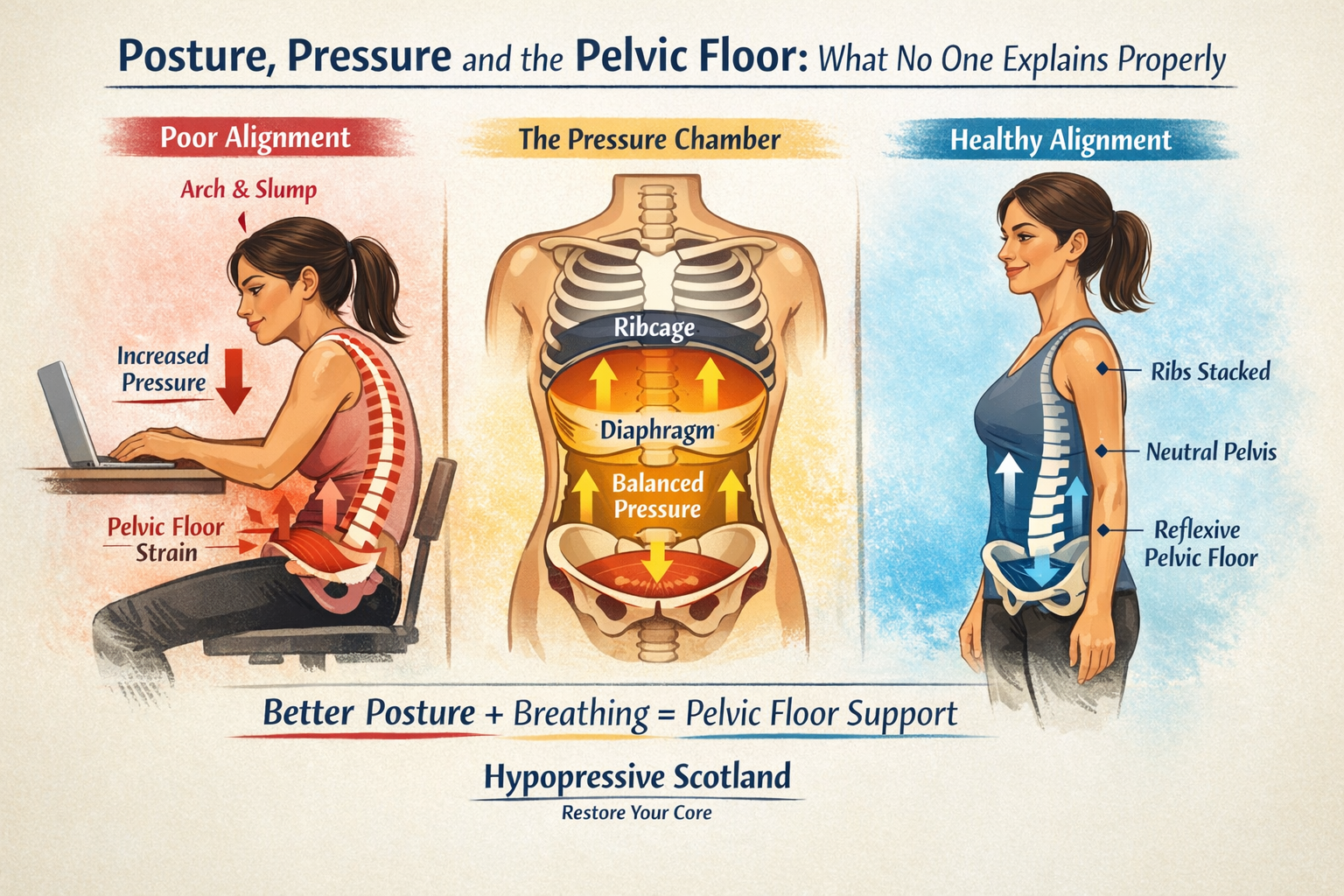
Image of the effect posture and pressure can have on the pelvic floor
Let’s clear something up straight away.
Posture isn’t all about looking taller, slimmer or more confident in your favourite wee black dress.
Posture is actually more about pressure. And when we talk about posture and pelvic floor health, what we are really talking about is how force moves through your body every single minute of the day.
You can be strong. You can run 10k. You can deadlift. You can hold a plank for two minutes. And still feel heaviness, leaking or that dragging sensation by 4pm. So, it’s got very little to do with how strong or competent you are. It is not a strength problem. It is usually much more likely to be a pressure problem.
Your torso is not just a stack of bones and muscles. It’s a clever multifaceted system that behaves in some part like a pressure chamber.
The diaphragm sits at the top. The pelvic floor forms the base. Your abdominal wall and deep back muscles form the sides. When those structures are aligned, pressure distributes evenly. When they are not, pressure has to go somewhere.
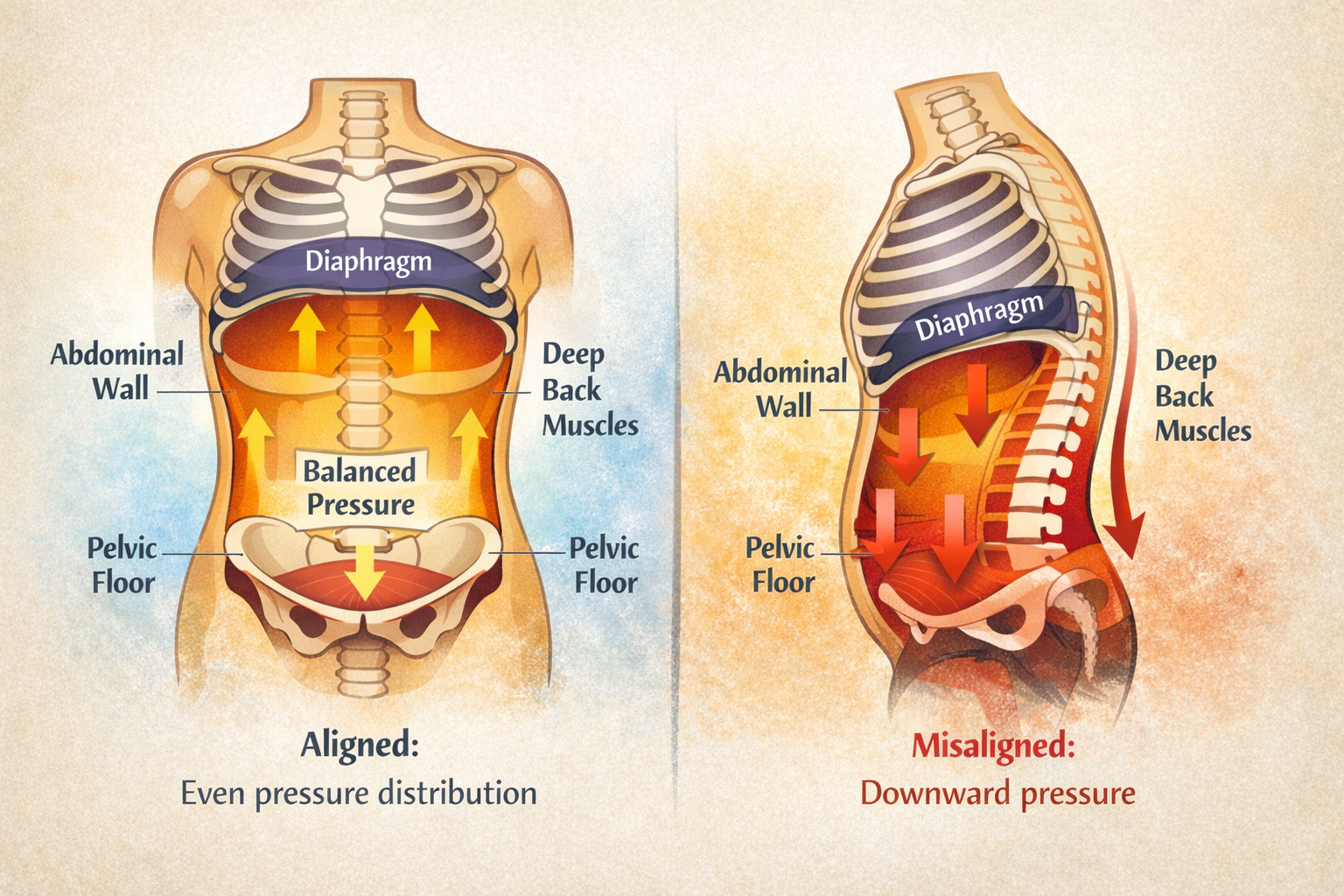
Internal pressure system for pelvic health
Gravity does the rest. And guess which structure sits at the bottom of the chamber…
Exactly.
The Physics of the Torso: Why Alignment Matters
Think of your core as a canister.
The ribcage is the lid.
The pelvis is the base.
The spine and abdominal wall are the central support.
When the ribcage stacks neatly over the pelvis, intra-abdominal pressure moves in all directions. It disperses evenly, It is shared and It is managed.
When you slump, arch, grip or brace constantly, the system changes shape. The ribcage shifts forward or collapses down. The pelvis tips. The spine compensates. Now pressure is no longer evenly distributed. It becomes directional.
Most commonly, it becomes downward. That downward piston effect is what many women feel as pelvic pressure or heaviness.
This is why posture and pelvic floor function are inseparable. The pelvic floor is not designed to absorb unmanaged pressure all day. It is designed to respond reflexively within a balanced system.
When alignment is off, the pelvic floor becomes the overworked shock absorber, and when our posture is out often times our shock absorber becomes dry and hard and it is this that can make your symtoms feel like they are getting worse, and a simple shift could make all the difference. Let’s look at two of the mots common.
Anterior Pelvic Tilt: The Loud Arching Pattern
Let’s start with the one everyone talks about. The classic arch-back posture.
This a classic with those who spend a lot of time at their desk working. Some gym lovers. Women who are told to stand tall and never tuck.
Then the pelvis tips forward. The lower back deepens. The ribs drift upward and forward. The abdomen lengthens. And the pelvic floor sits on stretch.
On the surface it can look confident. Open. Strong. But inside the pressure chamber, the container has changed shape.
Here is the part that gets missed.
A lengthened muscle is not automatically a strong muscle.
When the pelvic floor is held in a constantly stretched position because of anterior pelvic tilt, it loses optimal tension. And tension is what allows muscles to generate force effectively. Too short and they grip. Too long and they struggle to support.
In this position, intra-abdominal pressure tends to drive forward and downward. Add heavy lifting, impact or breath holding and that piston effect increases.
So what do most women do?
They squeeze harder.
But squeezing without skeletal alignment does not correct pressure direction. It simply adds more tension inside a misaligned system.
Posture and pelvic floor health are not about clenching. They are about stacking.
But here is where it gets interesting.
Not everyone lives in an arch. Some women live at the opposite extreme.
Posterior Pelvic Tilt: The Quiet Gripping Pattern
Instead of an exaggerated arch, the pelvis tucks under.
The tailbone curls forward. The lower back flattens. The ribs drift down and back. The abdominals grip. The glutes hold.
From the outside it can look controlled. Neat. Even “strong.”
But again, the shape of the pressure chamber has changed.
When the pelvis stays tucked, the pelvic floor is shortened and held. A shortened muscle is not automatically supportive. Just like a clenched fist cannot respond quickly, a constantly tucked pelvic floor loses its ability to lengthen and recoil.
And support depends on recoil.
In this pattern, intra-abdominal pressure often pushes backwards into the spine or downward into an already braced base. Add habitual abdominal gripping or shallow breathing and the system becomes rigid.
Rigid systems do not absorb load well.
This is why some women with strong cores still experience pelvic pain, constipation, difficulty emptying, or a sense of internal tension rather than heaviness. The issue is not weakness. It is over-compression.
In a posterior tilt pattern, squeezing more only serves to reinforce the problem.
The goal is not arching. It is not tucking.
It is stacking.
When the ribcage sits over the pelvis without bracing, and breathing becomes three dimensional again, the pelvic floor regains elasticity. It can lengthen. It can recoil. It can support without gripping.
And that is where real resilience lives.
Breathing: The Missing Link in Pelvic Support
Now we need to talk about breathing, because this is where intra-abdominal pressure becomes very real.
Your diaphragm and pelvic floor are a pressure pair. When you inhale, the diaphragm descends and pressure increases slightly within the abdomen. The pelvic floor responds and lengthens. When you exhale, both structures recoil.
That is healthy, dynamic pressure management.
But if you breathe high into your chest all day, barely allowing the ribcage to move, pressure does not dissipate well. The abdomen often stays braced. The system remains under constant subtle load.
Add poor posture into that mix and you get continuous downward force.
No dramatic event. Just steady compression.
When posture is aligned and breathing becomes three dimensional again, pressure redistributes. The pelvic floor does not need to brace defensively. It can respond reflexively instead.
This is why posture and pelvic floor conversations must always include breath.
Why Gym Workouts Can Make It Worse
This is the bit that surprises active women.
Strength is brilliant. I love strength. But strength without alignment can amplify dysfunction.
Crunches, heavy lifts, high impact classes. All of these increase intra-abdominal pressure. That is not bad in itself. Pressure is part of human movement.
The problem comes when that pressure is already misdirected.
If you are bearing down under load, gripping your abdomen, arching your back and holding your breath, you are repeatedly driving force downward.
You might feel strong.
But your pelvic floor may actually be feeling exhausted.
This is why some runners leak despite excellent cardiovascular fitness. This is why some lifters feel heaviness after leg day. It is not weakness. It is unmanaged pressure inside a poorly stacked system.
Re-Stacking the Body from the Inside Out
This is where Hypopressives change the game.
Hypopressives are not about squeezing harder. They are about reorganising the container.
Through specific postures, breath mechanics and a decompressive apnoea phase, the ribcage and pelvis begin to stack more naturally. The abdominal wall responds reflexively. Resting tone recalibrates.
Many women describe a vacuum sensation. That is the decompressive effect. Instead of driving pressure downward, we are redistributing it.
Over time, posture changes without conscious bracing. The body learns a new resting alignment. Intra-abdominal pressure becomes something the system manages automatically rather than something the pelvic floor absorbs alone.
This is why posture and pelvic floor function improve together.
It is systemic.
The Hypopressive Scotland Approach
At Hypopressive Scotland, we do not chase symptoms.
We look at mechanics.
We assess how you stand, how you sit, how you breathe, how you lift your toddler, how you scroll at your desk. We identify postural triggers that drive pelvic symptoms.
We train you for real life loading, not perfect Instagram posture.
Posture and pelvic floor health are not about aesthetic correction. They are about creating a pressure system that works when you cough, laugh, run, lift and live.
And that requires more than being told to just do Kegels.
The Real Takeaway
A strong pelvic floor does not exist in isolation.
It depends on posture. It depends on breathing. It depends on how intra-abdominal pressure moves through your body.
When alignment is restored, support gradually follows.
If you are tired of managing symptoms instead of understanding the cause, this is your sign.
Book a postural assessment with Hypopressive Scotland. Or join one of our foundational workshops and learn how to correct pressure at its source.
Because you deserve a body that supports you back.
FAQ
Can bad posture cause bladder leaks?
Yes. Misalignment increases downward pressure on the pelvic floor, especially during impact or load.
Will improving my posture fix my pelvic floor?
Posture is a critical part of restoring function. It works alongside breathing and pressure control to create sustainable change.
Why do I feel more pelvic pressure when sitting at my desk?
Sitting often collapses the ribcage over the pelvis, directing intra-abdominal pressure downward.
Is sucking in my stomach bad for posture?
Yes. Constant bracing increases internal pressure rather than managing it effectively.
How do Hypopressives change my standing posture?
They reset resting tone and improve stacking of the ribcage over the pelvis, allowing posture to improve without conscious effort.