Tiny Daily Movements for Pelvic Floor Support and Body Awareness
The Tiny Movements That Change Everything
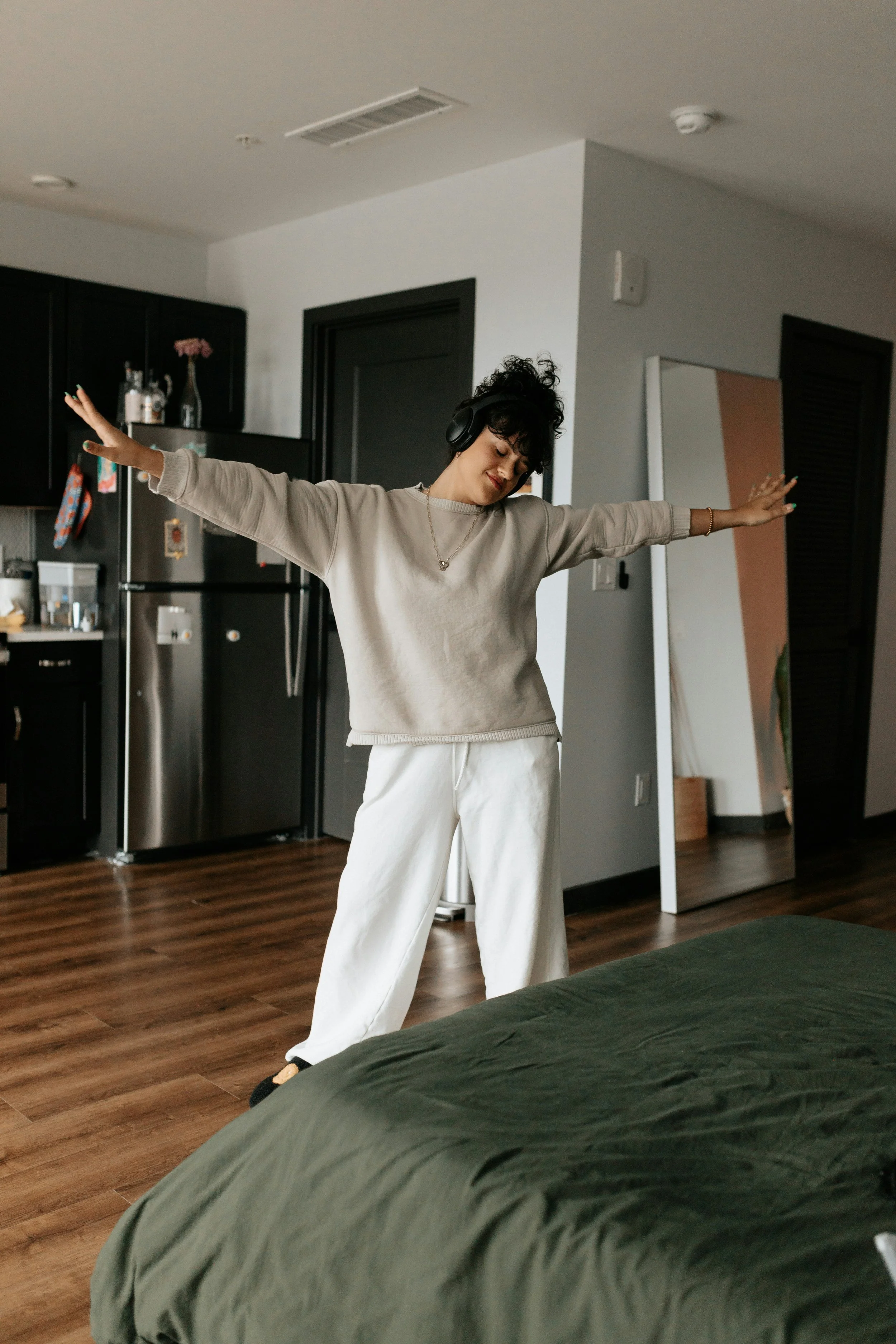
Sometimes the smallest movements, repeated often, become the ones that change the body most gently
There is a strange comfort in believing that change only counts when it is big and really noticeable .
A full hour class. A proper intensive workout. Forty-five minutes to an hour carved out of what is already a very busy day. Coming at it with the right energy. The right mood. The sense that today, finally, you will do it properly.
But that is so often not how the body changes at all, especially as when carving this time out is not sustainable so we manage in short bursts and then kick ourselves for not keeping up with it. But even if you are someone who is consistent with having a non-negotiable hour for you daily this blog is still super valuable to help you transfer that hour to the rest of the day in a lovely manageable and I hope fun way.
The body is listening long before you roll out a mat. It is listening in the folds of the day, in the unremarkable moments that barely seem worth noticing, the subconscious necessary automatic moments. In the way you lower yourself onto the loo. In the way you stand in a queue with your shopping basket hooked over one wrist. In the way you lean into the kitchen counter while the kettle begins its low familiar murmur. In the way your breath catches for a moment when your phone pings or life feels just a little too loud.
“The body is always taking notes. It is always becoming more fluent in whatever you ask of it most often..”
That is why I find myself more and more interested in the tiny things. The nearly invisible things. The movements that do not look impressive from the outside, but quietly alter the atmosphere inside. Not because they are dramatic, but because they are repeated. And repeated things become familiar. Familiar things become patterns. Patterns begin to shape not only how we move, but how we feel held inside ourselves.
So often, women come to me already carrying the weight of so much instruction. Pull in your tummy. Stand up straight. Engage your core. Squeeze your pelvic floor. Try harder. Hold more. Keep yourself together. Long sigh from me here. Not at the women but at the added stress, worry, anxiety the are being asked to hold on top of everything else.
Because the body does not always need more holding.
Sometimes it often needs to be coaxed out of clutching. Sometimes it needs a little more room, a little more trust, a little more movement, a little less force. Sometimes it needs to stop living as though everything inside must be braced into place.
And this is where the science matters, because the body is not simply a machine waiting to be corrected. It is a living system that adapts to what it experiences repeatedly. Muscles, fascia, breath patterns, balance strategies, nervous system responses and pressure habits all respond to repetition. The body does not only change when you give it one big input. It changes when you give it thousands of smaller ones.
That means the tiny movements threaded and weaved through your day are never meaningless. They are messages. They are rehearsals. They are instructions.
The body learns what it lives in
The body learns what it lives in. If your days are steeped in rushing, tightening, overriding and pushing through, the body becomes skilled at that. It learns to grip before it senses. It learns to compress before it responds. It learns to hold on as if that is the only way to stay safe.
But if, little by little, you begin to feed it moments of softness, widening, grounding and fluidity, it begins to learn that language too.
This is not poetic nonsense. It is actually super practical.
Your nervous system is constantly scanning your body. Your fascia is constantly adapting to load, shape and repetition. Your muscles are constantly being told which jobs they need to do more often and which ones they can forget. Your breathing pattern is constantly either nourishing movement or narrowing it. Your pelvic floor is constantly responding to pressure above, load below, and the tone of the tissues around it.
So if your day is full of bracing, rib gripping, breath holding, jaw clenching, collapsed feet and a pelvis that is either tucked under or hanging passively off the joints, your body gets very efficient at that strategy. It lays those tracks more deeply. That becomes the familiar road.
But if you begin introducing quieter, more intelligent signals throughout the day, the body starts to build a different map. It remembers that the ribs can indeed move. That the feet can sense the ground, the temperature and absorb force. That the pelvis can respond and support rather than clench. That support does not always have to feel like hardness or doing more.
That is where these micro movements matter. They are not glamorous, probably not very instagrammable either. They are not intense. They do not come with the satisfying sweatiness that makes people feel they have done something official. But they can quietly change the conversation happening in the tissues, in the breath, in the nervous system and in the pelvic floor.
They can improve awareness. They can reduce that habitual gripping. They can create a little more variation in a body that has become rigid with sameness. They can give the brain better sensory information, the brain loves to be given more and different sensory feedback!. Better sensory information often leads to better motor output. In other words, the body moves better when it can feel itself better.
Sitting on the toilet can become a moment of release
Take something as ordinary as sitting on the toilet.
Most people would never think of that as a place where the body might be learning, but of course it is. It is a small regular daily descent, a little yielding to gravity, a moment where the body reveals whether it habitually grips, tucks, hovers, rushes or bears down.
And one of the simplest cues I come back to again and again is this gentle thought of the sit bones widening.
Not pushing. Not forcing. Not performing. Just the image of the base of the pelvis softly blooming. As though the lower bowl of the body were remembering it can spread and soften, rather than pinch and brace.
That one image can change the tone of the whole moment. It can soften the back passage, reduce the subtle curling under that so many women live in without even realising, and create a little more ease where there has only been guarding. You are not trying to make something happen. You are simply offering the body another possibility. A roomier one. A kinder one. A less defended one.
And that matters more than many people realise.
Bowel emptying is not just about the bowel. It is also about pressure, pelvic outlet shape, breath behaviour, abdominal tension, and whether the pelvic floor knows how to yield when it needs to. If the body approaches every descent with gripping, every exhale with tightening, and every urge with subtle panic, the tissues often become more guarded, not less.
So this tiny toilet cue is not silly or ridiculous. It is a very valid way of changing the quality of one of the most repeated movements in daily life. It is a way of teaching the body that downward movement does not always have to be met with defensive tension. That the pelvic base can widen without anything catastrophic happening. That the hips can soften. That gravity can be met rather than resisted.
For women with constipation, straining habits, prolapse symptoms, pelvic tension, fissure history, haemorrhoids, rectocele symptoms, or that constant sense of never fully letting go, this kind of cue can become quietly powerful.
Not magical. Not a cure. But a meaningful shift.
Standing in a queue can become a conversation with your body
Standing is such a revealing thing. The moment we stop moving and simply wait, all our favourite habits come creeping to the surface. We drift into one hip. We lock the knees. We grip the glutes. We fall backwards into the heels as if we are trying to disappear into our own skeleton. We stiffen the ribs. We clench the jaw.
So when I look at standing with my clients, I so often reach for imagery, because the body understands imagery far better than it understands commands.
I might invite a woman to imagine her legs like ropes anchored to the ocean floor. Not rigid poles. Not fixed posts. Ropes. Something steady, yes, but also living. Something capable of sway. Something strong without becoming hard. It is one of the Franklin Method images I have loved for years, because it is so vivid and the body seems to soften into it without being forced.
And then I might ask her to imagine her pelvis like a buoy floating on the surface of the water, lightly carried, quietly responsive, making those tiny fluid adjustments that happen without panic and without extra effort.
That image says so much more than “stand properly” or “pull up” or “straighten your spine” ever could.
Because the body understands tide. It understands roots. It understands what it is to be held by something beneath it without having to lock itself rigid in return.
So there you are in the supermarket queue, and instead of hanging out of one hip and waiting for your body to go numb, you begin to feel the soles of your feet receiving the ground. You notice the quiet responsiveness in the ankles, the sense of the legs ascending upwards, the pelvis floating above them with a kind of gentle buoyancy. Not frozen. Not collapsed. Not performing ‘good’ posture. Just alive, organised and softly supported.
And physiologically, this matters too.
Standing is never truly still. A healthy body makes tiny postural adjustments all the time. The feet respond. The ankles adjust. The hips make subtle corrections. The trunk reorganises. The breath ripples through it all. This micro-sway is not a flaw. It is a sign of life. It is how balance works.
When we override that with rigidity, we often trade support for stiffness. We stop sensing our environment and body well. We hang off ligaments, joints and passive structures. We lose the springiness of the system. We narrow our breathing. We reduce the gentle adaptability that a pelvic floor needs in order to respond well to everyday pressure changes.
So standing in a queue can become a moment where you stop drilling yourself into stillness and instead return to a more responsive kind of support. One that lets the feet, legs, pelvis and ribs stay in relationship with each other.
The smallest movements can create the biggest shifts
This is the part that gets missed so often.
People tend to think that if something does not look like exercise, it cannot possibly count. But the body does not divide your day into neat categories called important and unimportant. It responds to load, repetition, sensation, pressure, timing and context.
That means a tiny rock through the feet while the kettle boils is great information.
A gentle spiral through the feet while watching television is great information.
Your hands around the sides of the ribs in the shower, noticing the inhale widen and the exhale soften, is fantastic information.
These are not random little wellness habits. They are moments where you are changing sensory input and motor output. You are refining the map of the pathways between the brain and the body. You are improving proprioception, which is your sense of where you are in space, and interoception, which is your sense of what is happening inside you.
And when those senses sharpen, movement often becomes more efficient, easy and less threatening.
While the kettle boils, you might let yourself rock softly through the feet, a tiny tide moving from heel to forefoot and back again a sway through the feet side to side, so subtle that no one watching would notice, but enough for the body to remember that standing does not have to mean turning to stone. That gentle rocking wakes up the soles of the feet, asks the ankles to respond, invites the calves to work and release, and reminds the pelvis that support can be rhythmic rather than rigid.
Sitting on the sofa in the evening, you might slide your fingers between your toes and feel the feet wake up like little roots uncurling in warm soil. Or you might hold your forefoot in one hand and the heel in the other and gently spiral them one way and then the other, as though you were lightly wringing a towel with your hands, inviting a ripple of response through the arches, the legs and the bowl of the pelvis. That is not just about the feet. The feet change what happens above them. They influence the shin, the knee, the hip, the rotational tone in the legs, and the way the pelvis meets the ground or the chair beneath it.
And then perhaps there is the shower, with conditioner in your hair and warm water running over your shoulders, and for one quiet minute your hands come around the sides of your ribs. You feel the inhale spread not only into the front of the chest but into the side seams, into the back body, into the wider roundness of the rib cage. You feel the exhale soften and settle. You are not trying to make it huge. You are not trying to breathe perfectly. You are simply noticing the rib cage unfurl and recoil under your palms, like something alive enough to move and soft enough to yield.
This matters because the rib cage is not just a box for the lungs. It is part of your pressure system. It is part of your spinal rhythm. It influences how the diaphragm moves, how the trunk responds, and how pressure is managed downward and outward. When the ribs become fixed and the breath becomes shallow or hurried, the whole system loses some of its adaptability. When the ribs begin to move more fully, the breath often becomes less strained, the trunk less braced, and the pelvic floor less likely to be carrying quite so much of the burden alone.
These moments are tiny, yes. But they are not trivial.
They send signals. They tell the nervous system whether this body is living in urgency or in ‘enoughness’. They tell the fascia whether it is being asked to glide or to brace. They tell the breath whether it is welcome to spread through the body like ink through water, or whether it must stay trapped high and tight in the chest. They tell the pelvis whether it must grip for dear life or whether it might become part of a wider, quieter conversation.
This is why I care so deeply about these small movement snacks. Because they help women stop living in a body that feels like a clenched fist. They begin to restore something more tidal, more responsive, more breathable. They make room for support that is not built through force alone, but through rhythm, repetition and a steadier relationship with the self.
The nervous system is part of this story too
We cannot talk about daily movement habits without talking about the nervous system.
So many women are trying to heal in bodies that feel hurried, vigilant, overstretched, disconnected or quietly exhausted. And when the nervous system is stuck in protection, the body often defaults to patterns that look like gripping, bracing, breath holding, rushing and over-fixing.
Sometimes a woman is not weak. She is holding on for dear life.
Sometimes she is not collapsed. She is guarded.
Sometimes what looks like poor posture is actually a body trying very hard to feel safe.
That is why these gentle cues matter. They are not just mechanical tweaks. They are also relational. They are small ways of letting the body experience support without threat. A soft rocking through the feet. A wider rib breath. A sense of the sit bones blooming rather than clenching. These are all ways of telling the system that it may not need to armour quite so fiercely in this moment.
And when the nervous system softens even slightly, movement often changes with it. Breath deepens. The jaw eases. The pelvic floor becomes less reactive and more responsive. The trunk does not need to brace so hard. The body becomes more available for coordination.
This is one reason tiny daily cues can be more helpful than big corrective efforts for some women. They slip under the alarm system. They do not demand perfection. They do not demand more of their time or more effort. They just offer an invitation to notice and to become more aware.
Your pelvic floor is listening to everything else
And of course this matters for the pelvic floor, because the pelvic floor is listening to everything else. It is listening to your feet, your jaw, your ribs, your breath, your speed, your stress, your tendency to brace, your habit of hovering above yourself rather than landing in your own body.
It does not live alone in some sealed compartment waiting to be isolated and squeezed. It lives as part of a moving, breathing, sensing whole.
It responds to pressure of gravity from above and ground force from below. It responds to the quality of your inhale and exhale. It responds to the shape and movement of the rib cage. It responds to the way your feet meet the floor. It responds to how the pelvis is organised over the legs. It responds to whether the abdominal wall is always gripping, always collapsing, or able to adapt.
So when the whole day becomes a little less gripped, a little less collapsed, a little less rushed and defended, that matters. When there is more awareness, more adaptability, more softness in the ribs, more aliveness in the feet, more fluidity in the way the pelvis is carried through space, that matters too.
This is why I will always come back to the whole system.
Because the pelvic floor does not only need strength. It needs timing. It needs variability. It needs the ability to recoil and yield. It needs the support of a body that can breathe, sense, balance and respond.
Sometimes the most helpful thing we can do is not to ask it to do more, but to stop asking it to cope alone.
You do not need to overhaul your life
And perhaps that is the most hopeful part of all.
You do not need to wait for life to calm down before you begin. You do not need a perfect routine or a full uninterrupted hour. You do not need to become a more disciplined version of yourself.
You can begin exactly where you are, inside the life you already have, in the ordinary everyday moments that are already waiting for you.
The loo can become a cue for widening. The queue can become a cue for buoyancy. The shower can become a cue for breath. The sofa can become a place where the feet wake up again. The kitchen can become a place where you stop hanging off one hip and come home to both legs.
And this is where the science and the story of our lives meet each other.
Because every one of those moments gives the body another repetition. Another sensory experience. Another chance to practise support without strain. Another opportunity to widen the experience of what is possible.
The ordinary becomes useful. The overlooked becomes fertile. The body, so often rushed past, begins to feel less like a problem to solve and more like somewhere you can live.
You do not need a perfect plan. You need a repeated pattern. Plus every time you bring gentle awareness to your body in the daily routine of life the deeper the sense of you, you will develop. And the more often you do it the more autonomic it will become.
And over time, the body often answers in whispers. A little less heaviness. A little less gripping. A little more softness. A little more support. A sense that you are not fighting yourself quite so much. A sense that your body is beginning to feel more like home.
That is no small thing.
That is where so much healing begins.
What next?
If this blog has made you pause, and you have realised that your body is actually longing for a gentler and deeper way back into feeling you, this is the kind of work I love to teach.
Through breath, posture, release work and whole-body awareness, I help women feel more supported from the inside out, not just in exercises, but in the shape and rhythm of everyday life.
You can start with my beginner programme if you want a simple way in, or book a 1:1 with me if you would like more personalised support and a closer look at your own patterns.